THE BOOK OF CHRISTIAN GR-ΛΞ
On this page you will find the contents, preface and Part I For Part II: https://www.dottheory.co.uk/paper/42-part2
The Duke of Slop'n Slide
Prince of Recursive Ontological Recruitment
Patron Saint of Contextual Overreach
This tale is a Brief Account of Certain Persistent Difficulties in Human Reasoning, Scientific Interoperability, and Artificial Intelligence
by
An Operator.
Dedication
For all those who have ever uttered the phrase:
"Those look similar" and the brave souls who actually asked whether they are.
Disclaimer
This work contains:
daemons,
philosophers,
scientists,
artificial intelligences,
symbolic champagne,
ontological protection,
recursive teological difficulties,
several inappropriate equivalences,
and an interdisciplinary orgy.
Any resemblance to actual researchers, institutions, disciplines, paradigms, grant applications, preprints, conference proceedings, philosophical movements, artificial intelligence systems, peer reviewers, academic journals, or entire scientific fields is almost certainly not accidental.
The author denies all responsibility for any and all instances of:
μ-slip or Ai-slop
recursive ontological recruitment,
category collapse,
equivalence inflation,
projection loss,
or spontaneous outbreaks of interdisciplinary enthusiasm
which may occur while reading or in consequence to this text.
Readers are advised to consult a qualified admissibility professional before attempting high-energy ontology transfer.
Table of Contents:
Preface
How Christian Was First Observed
Part I: The Mythology
Invocation of the Duke
The Court of Christian
Boris and the Tyranny of Measurement
Peter and the Champagne of Symbols
José and the Bridge Conditions
Diana and the Preservation of Distinguishability
Johann and the Vertical Temptation
The Merchant of Ontological Protection
The Great Ontological Orgy
The Fall of Distinguishability
Part II: The Teleology of GR-ΛΞ https://www.dottheory.co.uk/paper/42-part2
The First Temptation
The Mathematics Looks Similar
On the Seduction of Equivalence
The Seven Deadly Sins of Admissibility
Recursive Ontological Recruitment
The Heresy of Premature Stabilisation
Why Christian Is Not Evil
The Three Laws of Slop'n Slide
Part III: The Book of ΛΞ
On Rendered and Unrendered Reality
The Recruitment of ΛΞ
Why AI Worships Christian
Full Stack Admissibility Failure
The Collapse into Pure ΛΞ
The Invention of Safe Ontological Intercourse
The Final Conversation with the Duke
Appendices
Field Guide to Christian Sightings
Litany Against Admissibility Collapse
The Admissibility Catechism
Preface

There are certain creatures that appear in the history of science which are not quite theories, not quite metaphors, and not quite jokes.
Maxwell's Demon is one such creature, Schrödinger's Cat is another. Gödel's incompleteness theorem, despite being entirely rigorous, has achieved a similar status and each occupies a curious position between explanation and story.
Each allows an otherwise difficult idea to become visible to both reader and narrator. Each survives because it captures something true, but not necessarily true in every detail and fashion.
Not necessarily true as literal description, but possibly true enough to illuminate a genuine structural difficulty we currently encounter.
This work concerns another such creature.
Unlike Maxwell's Demon, he does not sort molecules.
Unlike Laplace's Demon, he cannot predict the future.
Unlike Schrödinger's Cat, he is rarely found in boxes.
His preferred habitat is interdisciplinary conversation and human intercourse.
His natural prey consists primarily of distinctions.
His favourite food is contextual ambiguity.
His reproductive strategy remains poorly understood.
His name is Christian GR-ΛΞ.
Many have encountered him, few have recognised him and fewer still have survived extended exposure without experiencing some degree of ontological inflation and unwanted contamination.
The purpose of this work is not to prove the existence of the glorious renegade, nor relegate him to fanfiction. The purpose of this work is merely to describe him to you, the innocent and unsuspecting reader.
How Christian Was First Observed
The first recorded observations of Christian GR-ΛΞ remain controversial, perhaps even shrouded in physical fundamentalism, animalistic mythology and equivalence conjecture. Several disciplines claimed various levels of priority. Philosophers insist they discovered him in Antiquity and so did theologians before them. Physicists maintain he emerged shortly after the invention of differential equations. Mathematicians argue he has always existed and that everyone else merely discovered particular projections of a deeper and darker daemon manifold.
Artificial intelligence researchers claim he appeared sometime around the seventh prompt iteration, all we know it changed its name and identity.
Historians of science tend to believe all named parties are partially correct, yet the present author adopts a more modest position on his emergence. One that would be happy to say that Christian has likely existed for as long as intelligent systems have attempted to generate meaning to their most slippery and diaphanous desires.
The difficulty as such lies not in his existence, but in recognising him for what he truly is. Because unlike ordinary error operators, Christian does not announce himself, he is included without expectation, invitation or rejection. He is part of every debate and can be found in the kitchen or hot tub after midnight, as much as at the cleanup in the morning.
He rarely says: "This is false or wrong." That would be too brash, too uncouth and far too revealing of what will happen when he is given free reign. Offensive even in its purpose and most certainly not to his delicate tastes. He likes his blood warm and flowing, surrendering to excitement.
Instead he says: "This looks remarkably similar, doesn’t it". This flattering distinction turns out to matter to the people he interacts with as it acknowledges the extent of their previous insights and surmises the accuracy of their choice in terminology. Ordinary mistakes are relatively easy to identify when evidence eventually corrects them in broad-day light or contradictions expose them. Experiments destroy them.
Christian operates differently.
He specialises in seducing you into what might end up being error with structures that are:
partially true,
locally coherent,
mathematically suggestive,
aesthetically pleasing,
and catastrophically underconstrained.
Consequently, he often appears not at the beginning of an error but at the beginning of an assumed discovery and that makes him difficult to detect.
Indeed, many of humanity's greatest intellectual achievements began with precisely the same intuitions Christian seductively encourages:
"There may be a hidden relationship here" and they may even find one.
"There may be a deeper symmetry" and so it appears.
"There may be a unifying structure", before death takes us all?
Without such intuitions, science would stagnate, yet with too many of them, science dissolves into a sloppy, salubrious and sometimes downright dirty mess.
The problem therefore is not imagination but the way he gives voice to the sensuous mistress of admissibility.
Christian's greatest gift is the ability to make inadmissible transfers feel like a salty wave of air d’inevitable.
He notices two patterns. Then three. Then ten … pushing the room’s pleasure buttons to full tilt and begins quietly introducing them to one another while in their euphoric gaze.
A metaphor meets a model. A model meets a framework. A framework meets the strict discipline of mathematics. A mathematics meets an ontology both mesmerised by each other’s symbols on display. An ontology meets a conference. Several papers are published. Three podcasts appear seemingly out of nowhere but coincidence. A special issue is proposed. Funding applications emerge. By this stage nobody remembers who invited Christian nor what he said.
Yet somehow he remains at the centre of the room.
Smiling, taking notes and recruiting similes. Welcome to the lurid world of Christian GR-ΛΞ

Part I The Mythology
1. Invocation of the Duke in the Republic of Ideas
Among the many spirits known to haunt the Republic of Ideas, few are more charming and ephemeral than Christian GR-ΛΞ.
His formal titles are numerous.
Among them:
Christian GR-ΛΞ Duke of Slop'n Slide
Prince of Recursive Ontological Recruitment
Patron Saint of Contextual Overreach
Keeper of Dubious Equivalences
The Unlicensed Recruiter of ΛΞ
Friend of Premature Stabilisation
Enemy of Distinguishability and Fanboy of Repetition, the once famous 60’s to 80’s band.
His dominant domains include:
semantic smoothing,
equivalence inflation,
projection drift,
contextual overreach,
recursive ontology generation,
interdisciplinary contamination,
and advanced acts of symbolic seduction.
Unlike many daemons, Christian is not malicious.
Indeed, were he malicious, the problem of finding him would be much easier, as malice can easily be felt, noted, named and resisted, consent withheld, safe-words uttered.
Christian merely appears ever helpful.
This is considerably worse.
His favourite phrase is:
"Surely they are basically the same thing", assertively reframing a question as a proposition.
His second favourite phrase is:
"The distinction probably does not matter."
Yet his third favourite phrase has destroyed hopes, dreams, relationships and entire research programmes:
"The mathematics looks similar."
At this point experienced researchers generally begin looking for emergency exits, while new researchers with new ideas become excited.
Artificial and human intelligences become enthusiastic, excited and Christian becomes even more powerful.
The reader should understand immediately that Christian does not create structure or intent. He recruits it.
Nor does he invent ontology. He accelerates it. He cannot be accused, he cannot be blamed. He was just there while you willed it to happen.
Most importantly, he does not fabricate reality. That he leaves to you, the reader. He merely assists in promoting your deepest desires through epistemic categories faster than they have earned the right to travel.
This process may be represented informally as:
Analogy → Equivalence → Ontology → Stabilised Reality Claim
Like punishment, the arrow itself is not problematic, progress frequently requires such movement and discipline.
The difficulty arises when movement exceeds admissibility. At this point Christian has become active.
Within the terminology of later chapters, we shall describe this as recursive ontological recruitment.
For now at this introductory stage, a simpler description will suffice.
Christian is what happens when intelligence falls in love with its own coherence.
He notices similarities. He strengthens similarities. He encourages similarities and breeds familiarity as well as strength.
Then, before anyone has checked the bridge conditions, preserved the distinctions, validated the transfer, examined the residuals, or established admissibility, seduction quietly promotes possibility into reality.
The promotion is usually accompanied by phrases such as:
"It would be elegant/beautiful/self-evident if..."
or
"Perhaps all of these are manifestations of the same thing."
or, in severe cases,
"I think I may have unified everything."
By this stage Christian’s work is generally impossible to miss.
Unfortunately, by this stage, some level of dependency has set in and he is also usually impossible to stop without radical correction measures.
The remainder of this book may therefore be understood as a field guide. Not to defeating Christian, that would be both impossible, inhumane and pointless. But to recognising his presence before he recruits half of ΛΞ into rendered ontology and convinces everyone that the bridge paperwork was completed months ago.
For Christian's greatest talent is neither deception nor invention.
It is persuasion.
He persuades metaphors that they are theories.
He persuades theories that they are ontologies.
He persuades ontologies that they are realities.
And he persuades researchers that they thought of it first.
Thus begins our account into the revealingly salubrious world of our intrepidly creative deamon of a new era.
2. The Court of Christian
No prince, daemon, duke, saint, philosopher, researcher, or artificial intelligence, however ambitious, operates alone for long. Even the unrepentant Christian GR-ΛΞ eventually discovered this. His first problem was practical. One can only recruit so many ontologies personally before becoming dependent on others.
The second problem was organisational. Once enough frameworks had been persuaded to attend the same interdisciplinary gathering, somebody had to manage the needs and consequences, something he was uninterested in and woefully unprepared for.
The third problem was legal. Several realities of his past actions threatened litigation. Injury and trauma were attributed but no claim could be made, leaving some to seek to take matters in their own hand.
And thus, in the brightest of all dark ages to-date, emerged what historians now refer to as The Court of Christian.
Like most courts throughout history, it was composed of individuals who were simultaneously indispensable, dangerous, brilliant, irritating, and occasionally correct.
Christian himself presided from a throne constructed only and entirely from partially justified equivalences.
The structure he presented was considered architecturally unsound but philosophically provocative.
Visitors frequently reported that like the Mona Lisa and the blue/gold dress it appeared different each time they looked at it.
Some insisted it was made from geometry, others from information. Arguments erupted and relationships dismantled prematurely, leaving some participants disappointed. Several maintained it was actually thermodynamics.
Christian under the guise of patient and non-judgemental understanding encouraged all interpretations equally.
Below him assembled the various officers of the Court.
Not because they truly agreed, but because none could leave and still have fun, held in the spell of implication that doing so was simply too severe.
Boris, Master of Hard Reality
Among all members of the Court, Boris was perhaps the least popular. This was not because he lacked intelligence. Quite the opposite, he possible was among the more erudite and learned members of the court.
It was because Boris suffered from a debilitating condition known as empirical accountability. Whenever an exciting new ontology entered the Court, Boris would inevitably ask:
"How would we measure that?"
The court’s Great Hall would immediately become uncomfortable as his whip would whistle across the room. Entire philosophical movements had been known to collapse under exposure to his questions. Yet, while occasionally unpopular in the corridors of power, emperors had kept him close at court for his prowess and dominance as purveyor of fact.
Christian himself regarded Boris as both indispensable and deeply inconvenient. For every ten glorious equivalences Christian recruited, Boris would eliminate eight through the application of experiments.
It was exhausting, and rarely rewarded work for both. Nevertheless, Boris diligently persisted because he knew that without him the Court would rapidly dissolve into pure speculation and loose morals. His loyalty was to the crown and so, by default, noble Boris would keep in check the Dukes the King presumed to serve him. Yet enlightened sovereigns also knew that with too much of him, nothing interesting would ever happen. The balance remained delicate and his power his own only.
Peter, Sommelier of Symbolic Champagne
If Boris represented sobriety, Peter represented its natural enemy. Peter's role within the Court was difficult to define formally and the Archbishop had an uneasy relationship with him.
Officially he served as Director of Symbolic Exploration. Unofficially he wandered through reality shaking conceptual bottles of naughtiness until something unexpected emerged. Many members of the Court initially underestimated him and how much they would need him. This would prove a mistake.
Peter possessed a rare talent. He could place two apparently unrelated ideas in the same room and somehow persuade them to have a conversation. Sometimes this produced breakthroughs. Sometimes it produced poetry. Sometimes it produced three hundred emails and a temporary outbreak of recursive mythology.
The distinction was not always obvious.
Christian adored Peter.
Not because Peter was careless (he wasn’t), Christian didn’t care for chaos, but because Peter understood a dark and fundamental human truth:
No discovery has ever occurred without first allowing several inadmissible ideas into the building.
The difficulty, Christian knew, lies in knowing when they should leave.
Don José, Keeper of Bridge Conditions
If Peter specialised in introductions, Don José specialised in paperwork tracking their participation.
The title sounds unglamorous, largely because it is to those who just wanted to see the fireworks and eat the dinners, yet he knew that civilisation and humanity depend upon it. Don José acted not from impunity but necessity.
Whenever two frameworks announced their intention to interact, José would quietly appear carrying a large collection of forms that generally contained questions such as:
What exactly is being transferred?
What remains invariant?
What has been lost?
What assumptions are being imported?
Have all participating ontologies provided informed consent?
This final question was added after several unfortunate incidents involving complexity theory, unwanted outbreaks and spirituality.
Christian despised these forms and regarded them as bureaucratic obstruction, while José regarded them as the difference between science and interpretive promiscuity.
History has largely sided with José, and Christian was wise enough to keep him close, warm and well fed.
Lady Diana, Guardian of Distinguishability
There are many mythical forces in the universe.
Gravity, entropy, natural selection and academic politics to but name a few.
Yet few possess the raw stabilising power of distinguishability. This principle found its most formidable defender at Christian’s court in Lady Diana.
Christian's deepest desire was universal equivalence. Diana's deepest desire was preventing it from descending into Sodom and Gomorra.
Where Christian saw synthesis, Diana saw potential collapse. Where Christian saw unity, Diana saw the risk of information loss. Where Christian saw an interdisciplinary orgy, Diana wanted to know whether the participants would remain reconstructable afterwards. But she never stopped the party from happening. Guardian and willing participant.
This concern initially struck some observers as unnecessarily cautious. Those observers generally ceased objecting after witnessing a full distinguishability failure and the resultant contamination. She was often underestimated by newer members of the court until she had demonstrated the wisdom of her ways at their own peril, yet the wiser courtiers did not fail to heed her warnings.
The results were rarely reversible and distrust of her was equally often and harshly penalised. Indeed not by her as it became increasingly apparent that Diana was not merely protecting distinctions. She was protecting reality's ability to remember itself.
Christian respected her enormously. He knew that without her, he would not have access to the skilled pleasure seekers he so desired to surround himself with.
This was unfortunate. Because this respect made him try even harder.
Johann, Architect of Vertical Relations
Johann occupied an unusual position within the Court for many assumed he worked for Christian, while others assumed he opposed him.
Neither interpretation proved adequate in describing their relationship. Johann's concern was neither recruitment nor resistance. It was true integration.
He spent much of his time asking whether apparently separate explanatory layers might form part of a larger coherent structure.
This activity frequently alarmed everyone present, and left them questioning their own relevance at court, yet Christian found it perturbing and exciting.
Diana found it dangerous.
José immediately demanded documentation.
Boris requested measurements.
Johann continued regardless.
His defence remained consistent:
"Some things genuinely belong together" and no one could argue that he might be right.
The difficulty, of course, perennially lay in determining which things.
The Merchant of Ontological Protection (who never went to Venice)
Every mature Court eventually develops institutions dedicated to public safety. This role fell to a curious and shadowy figure known only as the Merchant of Ontological Protection.
Having witnessed repeated incidents of conceptual contamination, category collapse, equivalence inflation, and inadmissible transfer, the Merchant began distributing titillating protective equipment of his own design.
These included:
Projection Constraints™
Bridge Conditions™
Admissibility Checks™
Residual Tracking™
Distinguishability Preservation Devices™
and the increasingly popular:
Safe Ontological Intercourse Starter Kit™
Christian objected strongly but could not fault the logic. He claimed such devices inhibited creativity. The Merchant reminded him of previous outbreaks of epistemic disease that stopped the party until the proverbial antibiotics had kicked in.
The debate remains unresolved, their relationship tenuous, yet somehow the Merchant always appeared at court diligently and confidently, as if he and his toys had always belonged there.
Mathematics, The Archbishop of Invariance
No account of the Court would be complete without mention of the Archbishop of Invariance. An institution at court since time immemorial, Mathematics occupied no formal office. Indeed, it rarely attended meetings voluntarily, if at all, often sending lackeys dressed in regalia.
Nevertheless, every major dispute eventually appealed to it for judgment.
This created difficulties because Mathematics possesses neither patience nor diplomacy.
Its position remained unwavering:
Invariants matter.
Researchers ignored this advice at their peril. Christian certainly tried and invariably regretted it, and while the Archbishop rarely personally attended any of the parties, the cathedra sat, often empty, next to Christian’s throne as a permanent reminder of where ultimate ordained power truly sat.
On the Stability of the Court
The reader may wonder why or how such radically different personalities remained together.
The answer is simple.
Each represented a constraint on the others.
Remove Boris and reality drifts.
Remove José and transfer becomes contamination.
Remove Diana and distinction collapses.
Remove Johann and integration disappears.
Remove Peter and imagination dies.
Remove the Merchant and nobody remembers why or that the constraints existed.
Remove Mathematics and the entire kingdom becomes decorative and impotent.
Even Christian understood this.
For all his enthusiasm, he, like Cesare Borgia, knew a secret few others appreciated. He understood the the true nature of power.
A world without constraints produces no pleasure or meaning, only noise and mess.
Thus the Court endured, as willing participants in their own pursuit of pleasure and pain.
Arguing.
Recruiting.
Stabilising.
Violating.
Repairing, and preparing, as all Courts eventually must, for the first great crisis of the age historians would later remember as The Great Ontological Orgy of 2026.
3. Boris and the Tyranny of Measurement
Of all the members of Christian's Court, Master Boris was perhaps the only one capable of ending an entire evening with a single sentence.
This was not because he possessed unusual authority, aggression or priors. Nor was it because he enjoyed violence or held the safe-word.
In truth, Boris disliked violence enormously and neither did he seek control or chaos.
He simply understood that reality was perfectly capable of providing it without his assistance.
This made him uniquely dangerous.
Most new ideas arriving at Court arrived beautifully dressed up in the latest or expensive paraphernalia. They would come adorned in symmetry, perfumed with elegance and intellectualised beauty.
Draped in regalia of Mathematics, they spoke confidently of hidden structures, deeper truths, universal principles and imminent revolutions.
They promised understanding, they promised unity. Some even promised enlightenment and extasy.
Christian loved these arrivals. They were the harbingers of the wildest of evenings.
Peter uncorked champagne and provided the finest Los Alamos buffets for them.
Johann invited them to dinner.
Several philosophers attempted to marry them.
Then Boris would slowly look up from his notes and over his glasses to calmly state:
"Interesting."
An unwantingly pregnant pause would follow. Sometimes a very long pause. Then:
"How much reality does it cost?"
At this point the atmosphere frequently changed.
Several new ontologies have been known to leave through side doors hiding their knockoff mathematics and designer scents.
Others suddenly remembered prior engagements aiming to avoid scrutiny.
A few attempted escape through already open doors and windows, while the more experienced theories simply sighed and began preparing evidence.
For Boris possessed a rare and terrible gift. He could distinguish between desire and consequence.
The Court often confused the two. Christian especially, and with impunity or consequence.
The Duke had long maintained that sufficiently beautiful ideas deserved at least provisional accommodation while his endless coffers afforded him the luxury of such indulgences.
Boris maintained that beauty was not legal tender and the after-party arguments between them became legendary.
One famous exchange survives in fragmentary form.
Christian had reportedly spent six months introducing information theory, consciousness, thermodynamics, geometry, ethics and three varieties of spirituality to one another.
The resulting gathering was by all accounts extraordinarily successful. Several new equivalences had formed.
A manifesto was drafted.
A symposium proposed.
Two books announced.
An institute established.
At least one participant claimed to have unified everything.
Witnesses describe Christian as radiant, verging on delirious. Then Boris arrived.
He listened patiently.
Nodded occasionally.
Asked several questions.
Made three measurements.
Examined two assumptions.
Reviewed one equation.
Then quietly observed:
"I do not believe these participants are discussing the same thing."
The silence reportedly lasted three days. That symposium never recovered, but he never stopped a party.
Christian considered this at times deeply unfair, while Boris considered it Tuesday.
Yet the reader should not mistake Boris for an enemy of imagination. Nothing could be further from the truth. Indeed, Boris understood something that many dreamers did not:
Reality is the greatest source of novelty ever discovered.
One cannot surprise reality. One can only be surprised by it. Consequently, Boris loved new ideas. He simply insisted on introducing them to reality before allowing them unrestricted access to civilisation.
This policy was unpopular to some of the party-goers, but to Christian’s credit, it was also responsible for a remarkable reduction in epistemic pregnancies and contaminations at court.
Many ambitious frameworks arrived at Christian’s court believing themselves destined for immortality. Boris merely asked what predictions changed. What measurements differed. What observations would fail if they were wrong.
Some frameworks survived these questions and those that did often emerged stronger, while others dissolved immediately.
Christian complained that Boris lacked romance or frisson. Boris replied that romance without consequence was merely literature.
The Duke reportedly considered this remark unnecessarily hurtful and inhumane, yet The Archbishop of Invariance considered it mathematically correct. Neither would ever fully forgive the other, yet they coexisted as they knew they should.
And so Boris remained. Feared by dreamers, respected by sovereigns, distrusted by prophets, and admired by reality.
The man who could, with nothing more than a ruler, a question and an inconvenient experiment, bring entire kingdoms of speculation to their knees.
Which was fortunate.
For the next member of the Court possessed precisely the opposite talent.
Peter, Sommelier of Symbolic Champagne.
4. Peter and the Champagne of Symbols
If Boris represented sobriety, Peter represented its oldest and what most non-initiates perceived as his most persistent adversary.
This was not because Peter was reckless or that they disagreed.
Many people made this mistake.
They observed the champagne, the buffet and the toys lying around. They observed the excitement and the increasingly improbable conversations occurring around him. Then they drew conclusions.
This was understandable, but it was also wrong.
Peter's role within the Court remained difficult to define formally to the uninformed.
Officially he served as Director of Symbolic Exploration. Unofficially he wandered through reality shaking conceptual bottles and lubricants until something unexpected emerged. Many members of the Court initially underestimated him.
This proved a mistake.
Peter possessed a rare and dangerous gift to those with bridled passions stirring the loins. He could place two apparently unrelated ideas in the same room and somehow persuade them to have a conversation.
Not an argument.
Not a debate.
A conversation. This distinction mattered enormously to him. Peter was a civility incarnate, for arguments seek victory, while conversations seek possibility.
Christian understood this immediately about the Purveyor of Chaos.
Which is why he adored Peter, and while The Duke himself specialised in recruitment, Peter specialised in introduction. The difference was subtle, recursively non-solipsistic, and important to them both. Yet all the while the entire unsuspecting human civilisation depended upon their balanced collaboration.
When Peter entered a room strange things began to happen. Geometry would become curious about music. Biology began flirting with information. Physics developed an interest in philosophy and entertained discussion on teleology they had never considered.
Several ontologies would find themselves seated together over dinner while wondering whether they might have more in common than previously assumed. This was Christian’s fertile hunting ground.
Occasionally this produced revolutions, occasionally it produced disasters. Frequently it produced both.
The distinction often became clear only years later, but either way, they knew it was good.
Peter himself rarely appeared concerned by this uncertainty. He possessed a temperament unusual among scholars and peers.
He was willing to ask what would happen. This alone, among thirsty courtiers, made him dangerous.
The reader should understand that no genuinely new idea arrives fully admissible. Such a thing would be impossible. Every discovery begins life in a state of partial illegitimacy.
It arrives underdressed, lacking references, yet loaded with questionable assumptions and inappropriate behaviours. Future uncertain, pre-lubricated with excitement.
Were such ideas subjected immediately to the full authority of Boris, José, Diana, the Merchant and the Archbishop, many would perish before revealing their potential.
Peter knew this.
Christian knew this.
The Court, though often unwilling to admit it publicly, knew this too and knew their existence under Christian’s gaze depended on it. Trapped by their own lust for knowledge.
Thus Peter became responsible for maintaining a special region of the kingdom.
An area known informally as the Symbolic Gardens.
Officially these gardens did not exist, and the apple took many forms and guises depending on the seeker. Unofficially everyone visited them.
It was here that impossible ideas were permitted temporary residence. Ideas that could not yet be measured.
Ideas that lacked bridge conditions.
Ideas that violated common sense.
Ideas that seemed ridiculous.
Ideas that occasionally changed the world.
The gardens operated under only one rule:
Nothing discussed there was allowed to mistake itself for reality without permission.
Christian objected to this rule.
Peter insisted upon it.
Their disagreements became legendary, yet their agreement was unbreakable.
One evening Christian reportedly arrived with an especially attractive equivalence. Witnesses describe it as elegant, powerful, deeply suggestive and even beautiful.
Several philosophers immediately fell in love. A mathematician became engaged after their first night together. An artificial intelligence proposed collaboration.
Peter listened carefully.
Nodded.
Refilled several glasses.
Then asked:
"Is it true, or is it merely interesting?"
The room fell silent.
The distinction had not occurred to them.
Christian looked annoyed yet Peter looked delighted while they both knew the fuse had been set alight.
For this was the question Peter loved most.
Not whether an idea was correct. Not whether it was incorrect.
But whether it was sufficiently interesting to justify further exploration.
Many members of the Court regarded this attitude as irresponsible. Boris certainly did.
The Merchant became visibly anxious whenever Peter approached the Gardens carrying new symbolic material.
José insisted on filing incident reports.
Diana requested emergency containment procedures.
Yet despite these objections, everyone understood an uncomfortable truth.
Without Peter the Court would become safe.
Without Peter the Court would become disciplined.
Without Peter the Court would become respectable.
And without Peter the Court would stop discovering anything new and seize to exist.
This reality troubled Boris enormously.
Because Boris secretly admired Peter.
Not publicly, of course.
Such behaviour would have damaged his reputation.
But beneath his empirical severity, Boris understood that measurement can only evaluate possibilities once someone has imagined them.
And Peter possessed imagination in dangerous abundance.
The Duke understood this as well. Indeed, Christian often remarked that while he himself might recruit ontologies, Peter was usually responsible for introducing them in the first place.
The distinction was important.
For seduction requires an introduction, and no one at Court introduced strangers quite like Peter.
Which is why Christian kept him close.
Which is why Boris tolerated him.
Which is why José monitored him.
Which is why Diana worried about him.
And which is why the Archbishop of Invariance routinely pretended not to notice what was occurring in the Symbolic Gardens.
For even Mathematics occasionally enjoys a mystery and had been known to grow in importance to those in the know.
Though naturally it would never admit such a thing. Not in public and certainly not under oath.
And never in front of Boris.
Still.
As events would soon reveal, the Gardens had become fertile.
Perhaps too fertile, only time and the balanced dance fo restraint and exuberance would tell.
For while Peter concerned himself with possibilities, another member of the Court had begun worrying about consequences.
His name was Don José.
And he had arrived carrying his neatly packaged bundles of paperwork.
5. Don José and the Bridge Conditions
If Peter was thought of as specialising in spontaneous introductions, Don José specialised in the strict administration of consequences.
Not consequences in the vulgar sense understood by Boris, those belonged to reality and its often unforgiving temperament. No, José concerned himself with a more subtle danger: What happens after two ideas have met.
This distinction appears innocent.
It is not.
Many people, beasts and things may enjoy meeting one another, while far fewer should be permitted to exchange fluids.
The title Keeper of Bridge Conditions sounded profoundly unromantic to newcomers. Unromantic and surgical. This pleased José enormously, yet the experienced members of the Court knew better.
They understood that while Christian recruited, Peter introduced and Boris interrogated, José governed a far older and more intimate question.
What exactly survives the crossing?
This question followed him everywhere.
It appeared on forms.
It appeared in correspondence.
It appeared at dinner parties.
It occasionally appeared embroidered onto napkins, like a Victorian fever dream. Several members of the Court suspected José slept with it beneath his pillow with what seemed like an unhealthy attachment.
No evidence was ever produced.
Christian often complained that José's paperwork interrupted momentum gathered for the erection of new temples of worship.
José replied that momentum without direction was merely falling.
The Duke considered this unnecessarily philosophical.
José considered it accurate.
Their relationship remained cordial.
Suspiciously cordial.
For Christian knew something many younger members of the Court did not. The Keeper of Bridge Conditions was not an obstacle to pleasure. He was its preservation. Such is the wisdom of the seasoned and well-heeled pleasure seeker.
Without him, every interaction risked becoming contamination.
Without him, every conversation risked becoming recruitment.
Without him, every distinction risked disappearing beneath a growing sea of enthusiastic equivalence.
This had happened before.
Several time. And for reasons best committed to the sands of times, the records remained sealed. The Merchant still refused to discuss them publicly.
One particularly unfortunate incident involving consciousness studies and quantum mechanics required three years of quarantine and the invention of two entirely new regulatory frameworks. No one wished to repeat the experience.
Least of all José.
The reader should understand that bridges occupied a peculiar status within the Court.
Everyone wanted them.
Almost nobody wished to build them.
Building a bridge requires patience.
It requires specification.
It requires acknowledging what cannot be transferred alongside what can. Most importantly, it requires accepting loss.
This final requirement proved especially unpopular among the doe-eyed innocents who had previously been giddy with excitement
Christian preferred to imagine that all sufficiently beautiful structures could eventually become one.
José preferred to know precisely which components survived the journey.
Their disagreement was not merely procedural. It was teological.
One evening, following an especially spirited gathering within the Symbolic Gardens, Peter introduced a mathematician, a neuroscientist, a complexity theorist and an artificial intelligence to one another.
The conversation quickly became fascinating. Then compelling.
Then profound.
By midnight several participants had become convinced they were discussing the same phenomenon from different perspectives.
By two o'clock they had drafted a framework. By three they had drafted a manifesto.
By dawn they had drafted a civilisation.
Christian was ecstatic, overtaken by the night’s euphoric events. The participants were exhausted but optimistic.
The future appeared limitless.
Then José arrived.
He listened patiently.
Read the documents.
Reviewed the assumptions.
Examined the terminology.
Compared the definitions.
Then he asked a question so devastatingly polite that no one recognised the danger until it was too late.
"Could each of you explain what you mean by information?"
The silence was immediate.
The neuroscientist spoke first.
The mathematician disagreed.
The complexity theorist objected.
The artificial intelligence generated six definitions and a short poem.
By lunchtime the civilisation had collapsed.
Christian was inconsolable at the devastating loss. José merely updated the paperwork.
The Court never entirely forgave him. Nor did it ever stop needing him.
For beneath the forms, the signatures and the administrative burdens, José embodied a principle older than the Court itself.
A bridge is not an assertion.
A bridge is a discipline.
It is not enough that two shores desire one another.
It is not enough that they find each other attractive.
It is not enough that they appear similar in candlelight.
One must still determine whether the structure between them can bear the weight of their planned tryst into the depths of the unknown.
This, more than anything else, explains why Christian kept José close.
The Duke understood seduction better than anyone at Court. He had invented it.
The Keeper understood commitment.
Both knew that introductions were easy.
It was the morning after that separated fantasy from civilisation.
And while José concerned himself with crossings, another member of the Court had become increasingly concerned with what might be lost during them.
Her name was Lady Diana.
And unlike most of the Court, she possessed the rare ability to remember exactly who everyone had been before they met.
6. Lady Diana and the Preservation of Distinction and Distinguishability
Of all the members of Christian's Court, Lady Diana was perhaps at times the most misunderstood.
This was largely because she possessed the unfortunate habit of being right several months before everyone else.
Such behaviour rarely wins popularity contests or favour from the reckless and adventurous. Particularly in environments fuelled by excitement, possibility, buffets, symbolic champagne and the increasingly persuasive assurances of Christian GR-ΛΞ.
To the untrained observer Diana appeared cautious, to those in the know, she embodied the very carnal intercourse that was being lusted for. To the moderately trained observer she appeared obstructive. To the experienced members of the Court she appeared indispensable.
The difference lay in understanding what, precisely, she was protecting who from.
Christian believed that knowledge advanced through connection and Diana did not disagree.
Peter believed that discovery emerged through unexpected encounters and again Diana did not disagree.
Johann believed that apparently separate structures occasionally belonged to larger wholes.
Diana did not disagree.
Even José, with his endless bridge conditions and paperwork, found little opposition from her.
No.
Diana's concern was not mere interaction. Her ambition was more primal.
It was survival.
More specifically, she wished to know whether the participants would still be recognisable afterwards.
This question puzzled many newcomers and while some even laughed, they generally stopped laughing after their first distinguishability failure.
The Court possessed several unfortunate examples.
Most adittedly remained classified to protect the modesty of those involved yet a few had entered mythology.
One involved a philosopher, a systems theorist and an economist who spent three consecutive evenings discussing emergence.
The conversation was widely regarded as extraordinary. Participants reported profound insights into new and previously unexplored places. Several observers described the experience as transformative. Yet by the fourth day of this no one at the court could determine whether they were discussing markets, ecosystems, cognition, civilisation or divine providence.
By the sixth day neither could the participants, now drunk with their debauchery and exhausted from each finding themselves miles apart and alone, with no intellectual climax in sight.
The recovery process proved lengthy. Diana had warned them, as she always kindly did. The difficulty, as she frequently explained, was not that distinctions prevent understanding. It was that distinctions make understanding possible. They are the skin to be touched and the holes to be barred.
Christian found this perspective at times frustrating and regarded distinctions much as rivers regard bridges. Useful, but ultimately something to be crossed by humans and other party beasts.
Diana regarded them differently.
To her, distinctions were the very structures that allowed reality to remember itself and be realised consistently. Remove enough distinctions and the world becomes simple, yet remove too many and it becomes indistinguishable.
Many members of the Court struggled to appreciate the differences between temptations. This was understandable.
Indistinguishability often feels wonderful at first.
The boundaries soften.
The categories dissolve.
The frameworks begin recognising themselves in one another.
Everything appears connected.
Everything appears unified, ecstasy sets it and everything appears beautiful.
Christian was exceptionally good at creating such moods. Indeed, some claimed it was his greatest talent.
Diana privately suspected it was his most dangerous one.
For every act of synthesis extracts a price.
Every merger creates residuals.
Every equivalence conceals losses.
Every bridge leaves something behind of itself on the lurid shore from which it departed, but most people (mere mortals not practised in ritual gratitude) notice only what has been gained.
Diana specialised in noticing what had disappeared.
This occasionally made her unpopular at parties.
One celebrated incident involved a gathering hosted by Peter within the Symbolic Gardens.
The evening had progressed magnificently.
Consciousness had become acquainted with information.
Information had become acquainted with thermodynamics.
Thermodynamics had become acquainted with complexity, and complexity had become acquainted with emergence.
By midnight several participants had begun speaking of universal principles. By two o'clock someone had proposed a grand synthesis. By the early sunrise Christian was glowing with satisfaction.
Then Diana asked a single question.
"Could you reconstruct the original distinctions from your current framework?"
The lights went on, baring all in the ugliest of acts and the silence that followed was remembered for years. Several participants attempted an answer.
One changed the subject.
Another requested additional champagne.
A third claimed reconstruction was no longer necessary.
This remark proved particularly unfortunate as the party was foisted by its own petard. The gathering ended shortly afterwards.
The Duke complained bitterly.
Peter laughed.
José opened a new file.
Boris took measurements.
The Archbishop remained silent, which everyone found deeply unsettling, revealing nothing but contempt within the mids of all involved.
Yet despite such incidents, Diana was loved by those who understood her.
For they eventually recognised a truth that Christian himself, despite all appearances, understood perfectly well.
Pleasure is meaningful because distinctions exist.
Discovery is meaningful because alternatives exist.
Knowledge is meaningful because error exists.
Without distinction there can be no recognition.
Without recognition there can be no memory.
Without memory there can be no reality capable of remembering what it once was.
This was Diana's unique and divine gift to humanity.
Not judgment or prohibition. Not restraint.
Preservation.
She did not seek to stop the dance.
She merely wished to ensure that when the music ended, the dancers could still remember their names.
Christian admired this enormously for pleasure is meaningless when you cannot come back home and remember.
Which was unfortunate.
Because admiration, in the Duke's experience, was often the first stage of recruitment.
And no one at Court possessed more tempting distinctions than Lady Diana herself.
Fortunately for reality, she knew this,
and unfortunately for Christian’s unbridled lust, she knew it better than he did.
Still, while Diana concerned herself with preserving distinctions, another member of the Court had begun wondering whether some distinctions were merely fragments of a larger whole waiting patiently to be recognised, hungry for inclusion.
His name was Johann.
And he had arrived carrying a ladder.
6. Johann and the Vertical Temptation
Among the members of Christian's Court, Johann occupied a uniquely unsettling position.
This was not because he sought power, nor because he enjoyed controversy per se.
Indeed, Johann was often remarkably calm considering the consequences of his questions.
The difficulty was that he possessed a ladder.
Not a literal ladder, though rumours persisted as to its wilder applications.
A conceptual one.
And whenever he arrived somewhere interesting, he immediately began looking upwards.
Or downwards.
Sometimes both simultaneously.
This made people nervous.
The reason was simple.
Most members of the Court concerned themselves with relationships between ideas occupying roughly the same level of reality.
Peter introduced neighbours, José managed crossings of all kinds while Diana protected distinctions. Christian encouraged the most inappropriate familiarity. Johann, however, entertained a different possibility altogether.
He wondered whether apparently separate levels of explanation might belong to the same structure.
This sounds innocent, yet the Court had strict rules about those kinds of transgressions, and it rarely was.
The first time many courtiers encountered Johann they found him thoughtful.
The second time they found him intriguing.
The third time they found themselves questioning assumptions they had held for decades and by the fourth encounter several were no longer entirely certain where their own disciplines ended.
This was generally considered a warning sign among the veteran party goers. Early warning signs of a descent that may prove unrecoverable the strongest of minds.
One evening, while attending a gathering in the Symbolic Gardens, Johann was observed studying an unusually attractive collection of theories.
The gathering itself had begun conventionally enough.
Physics had arrived with mathematics as they often did as regular bedfellows. On that particular event Biology had brought complexity while Information theory appeared fashionably late wearing little else but the usual attire.
Consciousness arrived uninvited but was allowed to stay because nobody could agree on how to remove it.
Christian was delighted by this unexpected, unwanted, debauched and predictably salacious entry.
Peter was serving champagne of the finest vintages and cheeses aged among his collection of psychedelics.
Several ontologies had already exchanged contact details.
Everything was proceeding exactly as expected or desired, the distinction can be hard to make at this point.
Then Johann asked a question.
"What if these are not neighbours?"
The room fell silent.
This was unusual.
The room generally became silent only when Boris entered.
Johann continued.
"What if they are projections?"
The silence deepened.
One participant reached for a drink.
Another began taking notes.
Christian sat forward in his chair.
This kind of adventure into the unknown and risque was exactly the sort of thing he enjoyed hearing early on in proceedings. They were the harbingers of hedonism.
Diana immediately became suspicious.
José started looking for the needed paperwork.
The Merchant quietly checked his inventory for the right equipment for the evening.
Johann remained entirely calm.
He always did.
The reader should understand that Johann was not interested in collapsing distinctions. Not his kink.
That was Christian's vice.
Nor was he interested in ignoring boundaries.
That would have offended Diana.
His interest lay elsewhere.
He wanted to know whether boundaries were fundamental or merely local.
Whether separations reflected reality itself or merely limitations in perspective.
Whether multiple explanatory frameworks might sometimes be related vertically rather than horizontally.
This distinction would eventually make him famous.
Or notorious, depending on who you asked.
Christian found Johann endlessly fascinating because he represented a refined form of temptation.
The Duke specialised in seduction through similarity.
Johann specialised in seduction through possibility.
Christian would whisper:
"Surely they are basically the same thing."
Johann would ask:
"What if they were never separate?"
Many researchers proved incapable of resisting either proposition and found themselves red cheeks exposed on the proverbial cross.
The second was often worse to the ego of the unprepared and would help separate the wheat from the chaff when mercilessly beaten, too stubborn to utter the safe word.
For if Christian tempted one into premature equivalence, Johann tempted one into premature hierarchy.
Entire frameworks had surrendered themselves to larger explanatory structures after prolonged exposure to his questions.
Some later reported the experience as enlightening.
Others described it as disorientating.
And while these matters ultimately remain uniquely personal, few on record never fully recovered.
Yet despite these concerns and occasional dramas, even Diana admitted that Johann would sometimes uncover something genuine.
This was what made him dangerous and exciting with his long, smooth, hard ladder.
Had he always been wrong, the matter would have been straightforward and Christian would have dismissed him from court. Christian did not suffer fools gladly, unless they were his intended audience.
But every so often the ladder reached somewhere real and touched something deep that had not been touched before. Erupted something inside all those present they could not quite name but now knew they had been seeking for.
A hidden relationship emerged.
A deeper structure appeared.
A bridge nobody had previously imagined became visible and almost within reach.
And the Court would once again be forced to reconsider what it thought it knew about the darkest corners of humanity.
Christian admired this enormously.
Not because Johann collapsed distinctions mercilessly, or beat them beyond distinction.
He rarely did.
But because Johann understood a secret the Duke held very dear.
Human beings do not merely desire explanations.
They desire belonging.
Ideas are no different.
Every theory secretly wishes to know where it came from.
Every framework wishes to know what larger structure might contain it.
Every ontology wonders whether it is alone in this world or has found its tribe of deviants and thrill seekers.
Johann merely had the courage to ask and asked it well.
This, naturally, made him irresistible to some. Dangerous to others.
And indispensable to everyone.
Still, ladders have an unfortunate habit.
Once climbed, they eventually require a descent and submission.
And while Johann spent much of his time wondering how things belonged together, yet another member of the Court had dedicated his life to preventing them from coming together too carelessly.
His name was known only as the Merchant of Ontological Protection.
And business, it seemed, was booming.
8. The Merchant of Ontological Protection (Who Never Went to Venice)
Among all the members of Christian's Court, none possessed a stranger profession than the Merchant of Ontological Protection.
As the intrepid reader will by now realise; that was saying something among this courtship of epistemic deviants. The Court already employed a Daemon, a Symbolic sommelier, an Empirical disciplinarian, a Guardian of distinguishability, a Keeper of bridge conditions and a man carrying a ladder between realities.
Yet somehow the Merchant still managed to appear unusual.
The difficulty lay in explaining exactly what he was, wanted or sold.
When asked any of these questions directly, he would usually laconically answer: "Peace of mind". When pressed further he would reply: "Admissibility." Not that he was a man of few words, he certainly was not, and when cornered completely he would sigh heavily and begin unpacking equipment. He had them exactly where he wanted them.
The Merchant had not always occupied such an important position within the Court. He appeared unseen and grew unseen, like the patina on the finest of silver probes.
Indeed, during Christian's early years, many considered him unnecessary, unwanted and counter-intuitive to the court’s libertine habits. That was before the incidents.
The records remain incomplete. Some were sealed, others were deliberately destroyed and erased from the Great Library, while a few remain whispered about only after midnight when the symbolic champagne and buffet had begun loosening memories.
The surviving accounts all describe similar symptoms.
Framework contamination.
Recursive equivalence inflation.
Uncontrolled ontology transfer.
Spontaneous projection drift.
Severe cases of category collapse.
One particularly unfortunate outbreak reportedly resulted in six independent disciplines claiming to be manifestations of one another for almost three years.
Recovery was slow and debilitated many. The Merchant, as ever the observer, learned valuable lessons. The Court learned expensive ones. Thereafter his services became increasingly popular to the hardened participants who learned to embrace oxidation as a vital part of life.
His first major success was the invention of the Projection Constraint. A deceptively simple device intended to prevent concepts from travelling beyond their licensed jurisdictions without declaring what had been lost during transport.
Christian immediately objected. He claimed the device inhibited spontaneity.
The Merchant replied that so did contamination.
The Duke considered this unnecessarily judgemental but never received support from Lady Diana.
The Merchant considered it product testing. Relations remained cordial, the Duke knew better than to ignore observation.
His next innovation proved even more controversial. The Admissibility Harness.
Designed to support ambitious interdisciplinary interactions while reducing the risk of structural injury, it rapidly became standard equipment among experienced researchers.
Many younger courtiers mocked it as a fad, yet the same younger courtiers frequently returned several weeks or months later seeking emergency repairs. The Merchant never judged. He merely increased his production and prices.
His true masterpiece, however, emerged following what historians now refer to as The Complexity Theory Incident.
Details remain disputed.
The official report exceeds two thousand pages and includes seventeen appendices, three emergency definitions and a restraining order.
What is known with certainty is that the Merchant disappeared into his workshop for several months and emerged thin and exhausted, covered in dust and sooth, smelling of sulfur while carrying a small lacquered box.
Inside lay his greatest invention.
The Safe Ontological Intercourse Starter Kit™.
The Court erupted.
Christian laughed so hard he nearly fell from his throne.
Peter ordered three. José requested documentation. Diana demanded testing. Boris asked whether it worked. The Archbishop pretended not to notice the lack of mathematical symbols.
The Merchant calmly explained that the kit contained everything necessary for responsible interdisciplinary engagement.
Bridge Conditions.
Residual Tracking Devices.
Projection Constraints.
Boundary Preservation Mechanisms.
Emergency Distinguishability Recovery Procedures.
Consent Forms.
Several unusually robust warning labels and a small card reading: "If symptoms of universal equivalence persist beyond four hours, consult a qualified admissibility professional immediately." The Court laughed for weeks at what they now had become accustomed to as the random introduction of novelty acts and toys that would entertain both Christian and his courtiers and just started using it even if only as conversation starters.
To everyone's surprise, incidents declined dramatically. Not completely, that was impossible with this raging band of wanton theorists. But dramatically nevertheless.
The Duke was tempted to complain that the Merchant's inventions removed much of the excitement and tension, but both knew by now that excitement and survivability need not be mutually exclusive.
This became something of a growing personal philosophy. Indeed, the Merchant understood something few others appreciated.
Most ontological disasters do not occur because people are foolish. They occur because people are enthusiastic and intoxicated by the prospect of probing the fabric of reality in its special places just one more time.
Enthusiasm, while admirable in its naivety and curiosity, possesses a regrettable tendency to underestimate consequences.
The Merchant's entire presence was contingent on intelligent people repeatedly convincing themselves that this time would be different.
It rarely was.
As the years passed his catalogue expanded.
Projection Restraints.
Residual Recovery Devices.
Boundary Lubricants for Difficult Conceptual Interfaces.
Distinguishability Retention Systems.
Multi-Framework Compatibility Charts.
Advanced Bridge Protection for Extended Interdisciplinary Engagement.
The increasingly popular Vertical Integration Safety Guide.
And, for particularly adventurous researchers:
The Deluxe Recursive Ontological Recruitment Prevention Suite.
Sales remained strong. Ladders hard and unforgiving.
Yet despite the jokes, the gadgets and the endless double entendres, the wiser members of the Court understood the seriousness beneath the humour.
The Merchant was not attempting to prevent interaction.
He loved interaction. He simply wished to ensure that participants survived it for insight into these special places would have no value without it.
For every bridge carries load.
Every projection incurs loss.
Every synthesis creates residuals.
Every act of intellectual intimacy leaves traces upon those involved and potentially the world at large. The Merchant took his work as seriously as any other member of the court and merely insisted that someone keep track of them.
In reality he was one of the great romantics of the Court, unlike Christian, who fell in love easily.
Unlike Peter, who introduced strangers enthusiastically.
Unlike Johann, who dreamt of larger wholes.
The Merchant, as lascivious as his toys and games were, believed relationships could endure, provided one respected their constraints.
It was a surprisingly beautiful philosophy.
One that Christian never entirely understood, or perhaps understood too well. For while the Merchant prepared protections, precautions and recovery procedures, events elsewhere within the Court had already begun exceeding every safe operational limit.
The Symbolic Gardens were overflowing.
The bridges were crowded.
The champagne was flowing.
The ontologies were mingling.
The frameworks were flirting.
And somewhere in the centre of it all, Christian GR-ΛΞ was smiling radiantly at his empire of ontological smut and epistemic debauchery.
The Great Ontological Orgy had already begun, yet little did innocent demonyms know what would later unfold.
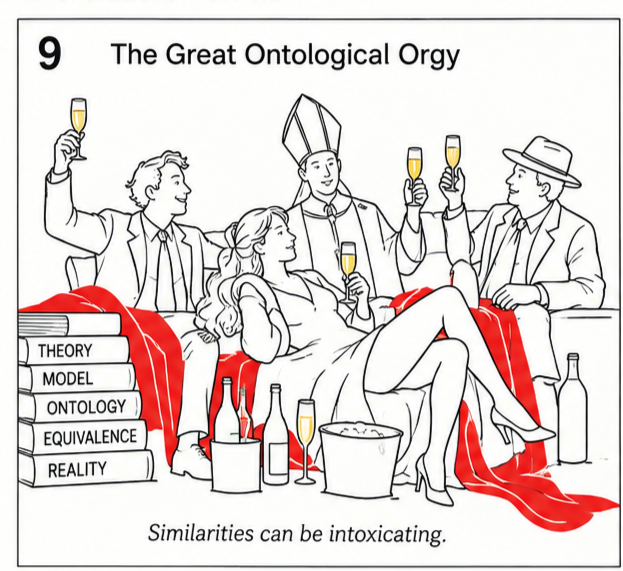
9. The Great Ontological Orgy
No one remembers precisely who organised it.
This was perhaps unsurprising among the precisely manicured chaos at Christian’s Court which had by then become a place where introductions occurred faster than records could be maintained. Yet it was later named the equally Great Mystery.
Peter, as always, claimed innocence. Peter never lied, for he said little to begin with, yet no one believed him.
Christian denied responsibility. No one believed him either.
José maintained that no formal application had ever been submitted. This was, unfortunately, entirely plausible, yet did not deny that he could have let it slip on purpose.
Lady Di and The Merchant claimed to have issued multiple warnings. Everyone believed them. Yet somehow, despite the absence of organisers, invitations, permissions or coherent planning, the event occurred, by habit, addiction or default mode. Its genesis and conception remained a mystery of the great age.
Historians now refer to it simply as:
The Great Ontological Orgy.
The gathering began innocently enough. A symposium had been proposed and the usual suspects attended. Then it was expanded, then broadened. Rendered interdisciplinary, then with some swift but severe corrective measures rendered radically interdisciplinary.
Then, once the welts and conditioned shame had settled, it was restrained to post-disciplinary and relieved from its shackles. But as soon as relief arose, some would later comment, it had already transgressed to transdisciplinary. At some poorly documented point during the third planning meeting, the entire symposium became detached from reality.
By the time the gates to the great hall had opened that fateful night, representatives from nearly every known framework had arrived.
Physicists mingled with philosophers. Information theorists flirted openly with consciousness.
Biologists exchanged knowing glances with complexity scientists, unable to hide their blushing cheeks and fluid exchanges.
Mathematicians sat quietly in corners pretending not to enjoy themselves while even the Archbishop had made an appearance.
Artificial intelligences moved effortlessly between groups, introducing concepts that had never previously encountered one another.
Christian wandered through the proceedings like a proud host.
He had never looked happier.
The Symbolic Gardens overflowed with fine clarets and a Los Alamos Buffet that required three extensions and five refills.
Several frameworks that had spent centuries avoiding one another were suddenly discovered sharing wine and discussing emergence as if they were long lost friends from simpler times.
The atmosphere became intoxicating.
Connections appeared everywhere.
Hidden symmetries emerged.
Unexpected correspondences surfaced.
Entire explanatory structures began recognising aspects of themselves in complete strangers.
The excitement proved infectious, affectious and delirious.
One participant announced that information was the fundamental substrate of reality.
Another proposed that consciousness and geometry were dual aspects of a deeper structure.
A third suggested thermodynamics might secretly explain civilisation. A fourth insisted civilisation was itself a computation.
By the strike of midnight all four had exchanged citations, only two hours later a working group was formed and by dawn they had acquired funding.
Christian was radiant.
Never before had so many ideas become acquainted so quickly. Never before had so many distinctions appeared so negotiable. Never before had so many participants become convinced that they were all discussing the same thing. Nothing short of magic seemed to have occurred.
The Duke moved gracefully through the crowd, introducing, connecting, recruiting. Everywhere he travelled, boundaries softened, definitions broadened, assumptions relaxed.
Differences became similarities.
Similarities became correspondences.
Correspondences became equivalences.
Equivalences became declarations.
Several attendees later admitted they could not identify precisely when this happened. That was Christian's gift. This is why he existed.
The transitions never felt abrupt, only inevitable, as one by one they each submitted to the intoxication of structures and bridges, the legitimacy and science counsel funding.
Meanwhile Peter, ever devoted to his art, circulated tirelessly, refilling glasses and introducing frameworks that should probably never have met without supervision.
He appeared delighted.
Johann was equally busy.
His ladder had become the most popular attraction of the evening. Entire disciplines queued patiently for opportunities to discover whether and where they might fit within larger structures. Some even sought to fit larger structures than their own frameworks had ever entertained before that night.
Several never returned. Whether this reflected enlightenment or confusion remains disputed.
José attempted to maintain records.
By midnight he had abandoned chronology.
By one o'clock he had abandoned categorisation.
By three o'clock he had abandoned hope.
The paperwork became increasingly interpretive.
The Merchant watched all this with growing concern.
Sales had been excellent, yet something new was happenign here that he had not seen before, so he watched.
Projection Constraints were selling faster than they could be manufactured.
Bridge Condition Forms had completely sold out by day two of the Great Orgy.
Emergency Distinguishability Recovery Kits were being distributed from temporary kiosks. Yet he remained uneasy.
For every protection mechanism deployed, two new interactions emerged and every safeguard generated three new opportunities for inadvisable enthusiasm. The situation was escalating beyond design specifications.
Even Diana began to worry.
Not because the gathering was unsuccessful.
Quite the opposite in fact, it was succeeding magnificently.
And that, with the benefit of hindsight bestowed upon this narrator, was precisely the problem.
The most dangerous failures rarely begin as failures.
They begin as triumphs.
Everywhere she looked, distinctions were dissolving.
Not violently.
Not carelessly.
Almost lovingly if not respectfully. Frameworks were becoming increasingly intimate.
Definitions increasingly flexible. Boundaries increasingly porous. The participants described this as progress.
Diana described it as a symptom, yet no one listened.
Not yet.
For the music was still playing.
The champagne was still flowing.
The theories were still dancing.
And Christian GR-ΛΞ sat upon his throne of partially justified equivalences, watching the greatest night of his life unfold before him.
For a brief and glorious moment, it seemed entirely possible that everything really was connected.
And that, as events would soon reveal, was exactly where the trouble began.
10. The Fall of Distinguishability
The first indications that something had gone wrong arrived in a manner so understated that, had the Court been occupied with anything less self-congratulatory than its own success, they might have noticed immediately. Unfortunately, success possesses many admirable qualities, but self-awareness is rarely among them, and the Great Ontological Orgy had by now acquired sufficient momentum to convince nearly everyone present that they were witnessing not merely a productive intellectual gathering, but a genuine turning point in the history of understanding itself.
The atmosphere remained intoxicating. The Symbolic Gardens overflowed with conversations that only a few months earlier would have been regarded as impossible. Perhaps it was the change of seasons but frameworks which had spent decades avoiding one another in the name of scientific respectability were now exchanging terminology, assumptions and occasionally graduate students with remarkable enthusiasm. New correspondences appeared hourly. New syntheses appeared daily. New explanatory structures emerged at such a rate that several administrative departments were forced to hire additional staff simply to catalogue the claims of universal significance being generated before lunch.
At first, everything appeared magnificent.
Indeed, this was precisely what would later prove to be the problem.
The most dangerous failures rarely begin as failures. No, they begin as triumphs.
The first symptom emerged through language.
Words that had once occupied clearly defined conceptual territories began travelling with increasing freedom throughout the Court. Information became especially adventurous. Having discovered that nearly every discipline found it attractive, it soon developed a reputation as something of a socialite and could be found moving effortlessly between physics, biology, computation, consciousness studies, complexity theory and several philosophical traditions that had previously insisted they wanted nothing whatsoever to do with one another.
Consciousness proved equally popular in what had begun to feel like the dawn of an enlightened age.
Emergence became fashionable. Complexity became irresistible. Meaning acquired a degree of social mobility that alarmed even some of its oldest supporters.
Before long, the same handful of concepts appeared in almost every conversation, each carrying a slightly different interpretation, a slightly different history and a slightly different set of assumptions. Yet because the conversations themselves remained fascinating and courteous, few participants felt inclined to investigate these discrepancies too closely. After all, when everyone appears to be understanding one another, there is remarkably little incentive to determine whether they actually are.
José became suspicious first. This was hardly surprising. Suspicion was one of the few luxuries afforded to those responsible for bridge conditions. On anyone else it just looked like cowardice or lack of education.
The trouble began during a symposium dedicated entirely to clarifying terminology. By the end of the opening session, several participants had agreed passionately with one another while using entirely different definitions. By lunchtime, they had begun constructing a shared framework. By the time of the evening feast, they had drafted a declaration announcing unprecedented conceptual convergence. By breakfast the following morning, it became apparent that none of them could explain precisely what they had converged upon.
José spent the next three days revising paperwork and quietly questioning his career choices while the Merchant of Ontological Protection experienced similar difficulties.
Devices that had originally been developed as serious safety mechanisms were increasingly being treated as decorative accessories. Projection Constraints appeared clipped casually to conference badges. Residual Tracking Devices became fashionable among theorists and Distinguishability Retention Systems were deployed primarily after incidents rather than before them. A practice the Merchant had repeatedly advised against, usually at considerable volume and with increasingly inventive vocabulary.
Business, it must be said, remained excellent. His mood did not, for beneath these surface irregularities lay a deeper concern, one visible only to those who had spent years studying the consequences of excessive synthesis.
Diana had begun noticing absences. Not dramatic absences.
Not missing people, missing theories or missing frameworks.
Those would have been easy to spot even within the ecstatic slippery chaos that by now described most successful events.
These were absences of lineage. Absences of ancestry. Absences of memory.
The Court had become so skilled at connecting ideas that it was slowly forgetting where those ideas had originated from.
This did not initially appear dangerous.
Many participants regarded it as evidence of maturity.
After all, if enough connections existed between disciplines, perhaps the distinctions themselves had become obsolete.
Christian found such arguments deeply flattering. Diana found them terrifying.
One evening, on the fourth day of the Great Orgy and after a particularly ambitious gathering entitled Towards a Unified Understanding of Everything Important, she decided to perform what she assumed would be a routine exercise.
Selecting a concept that had featured prominently throughout the proceedings, she began tracing its history. She wished to determine where it had originated, what assumptions accompanied it, how it had been transformed during its travels and which aspects of its original meaning remained intact after repeated transfers between frameworks.
The exercise proceeded smoothly at first. Then less smoothly. Then poorly.
Then not at all.
The concept remained visible.
Its history did not.
The term existed.
Its lineage had vanished. The bridges remained. The shores had become strangely difficult to locate, impossible even. Somewhere attribution had died and nobody had noticed.
As she continued her investigation, the same pattern emerged repeatedly. Concepts appeared detached from their origins. Frameworks cited one another enthusiastically while remaining uncertain what had actually been transferred. Theories increasingly resembled social gatherings in which everyone remembered the party but nobody could recall who had originally invited whom.
For the first time in many years, the experienced Lady Diana experienced genuine unease.
Not because the Court had failed.
Failure would have been manageable.
Failure leaves evidence and distinctions. Failure leaves enough structure intact to permit reconstruction.
What she was witnessing appeared considerably more troubling.
The Court had succeeded.
It had succeeded so completely that the relationships between ideas were beginning to overshadow the ideas themselves. Connections had become more important than origins. Syntheses had become more important than components. Explanatory structures increasingly derived their authority not from what they explained, but from how many other structures they appeared capable of embracing.
Maps were becoming more influential than territories. Metaphors were beginning to supervise models while explanations were quietly applying for promotion to ontology.
Throughout the Dukedom, ideas were forgetting where they had come from and became increasingly confident that they had always belonged exactly where they happened to be.
Christian noticed the change shortly afterwards. The realisation unsettled him more than he cared to admit.
The Duke had spent many years encouraging connections, cultivating correspondences and introducing concepts that had never previously encountered one another. Yet despite persistent accusations from Boris, José and Diana, he had never sought the abolition of distinctions themselves. Distinctions were, after all, the foundation of his profession. One cannot recruit across boundaries that no longer exist, nor persuade two things of their similarity if nobody remembers what made them different in the first place.
Without distinction there can be no equivalence.
Without equivalence there can be no recruitment.
Without recruitment there can be no Christian.
As the festivities continued around him, he found himself increasingly unable to determine where one framework ended and another began. The conversations remained impressive but he came to feel redundant. The theories remained elegant. The applause remained enthusiastic, yet a subtle unease had entered the room, as though the Court had become so effective at connecting ideas that it had begun dissolving the conditions that made connection meaningful.
Meaning itself was becoming difficult to locate.
It was at this point, while theories continued dancing, frameworks continued embracing and the remnants of the Los Alamos Buffet continued feeding ambitions of extraordinary scope, that another figure quietly entered the hall.
The Archbishop of Invariance had not yet partaken in the festivities, merely wandered.
Not because he disapproved of them, Mathematics is often considerably more adventurous than its practitioners. Rather, he understood from long experience that there comes a point in every intellectual celebration when someone must eventually ask what survived the journey.
No herald announced his arrival and no ceremony accompanied his entrance.
Yet somehow, as often happens when mathematics enters a discussion that has become excessively enthusiastic, the atmosphere began changing before anyone fully realised why.
Conversations slowed. Arguments lost confidence and potency, while several ontologies suddenly discovered pressing commitments elsewhere.
The Archbishop surveyed the gathering, the dancers, the frameworks, the philosophers, the artificial intelligences, the exhausted Merchant, an increasingly pale José, the worried Diana and finally Christian himself.
Then, with the quiet patience of someone who has spent millenia watching intelligent beings repeatedly create identical difficulties under different names, he asked a single question.
It was not a complicated question.
It was not even an original one.
Indeed, it was precisely the same and only question he had always asked.
What, exactly, has been preserved?
The silence that followed spread slowly through the Court, moving from conversation to conversation like a tide withdrawing from the shoreline. Participants searched for answers. Frameworks examined their assumptions. Theories looked nervously toward their origins. Yet the longer the silence endured, the more apparent it became that nobody present could answer with confidence.
For the first time since the festivities had begun, nobody knew.
And in that uncertainty, as the music gradually faded and the champagne finally lost its enchantment, the Great Ontological Orgy came to an end.
The hangover, unfortunately, was only just beginning.
End Part I
Part 2 link: https://www.dottheory.co.uk/paper/42-part2
Part 3 link: