RUDR — The Scientific Art of Disagreeing Without Losing Our Way
Part of the Only Kant’s literary series. Warning: Quantum Porn may impact your wider reading enjoyment.
Risk, Uncertainty, Disagreement and Repair: a proposed navigational instrument for scientific communication, accountability and the rather human business of learning to be wrong.
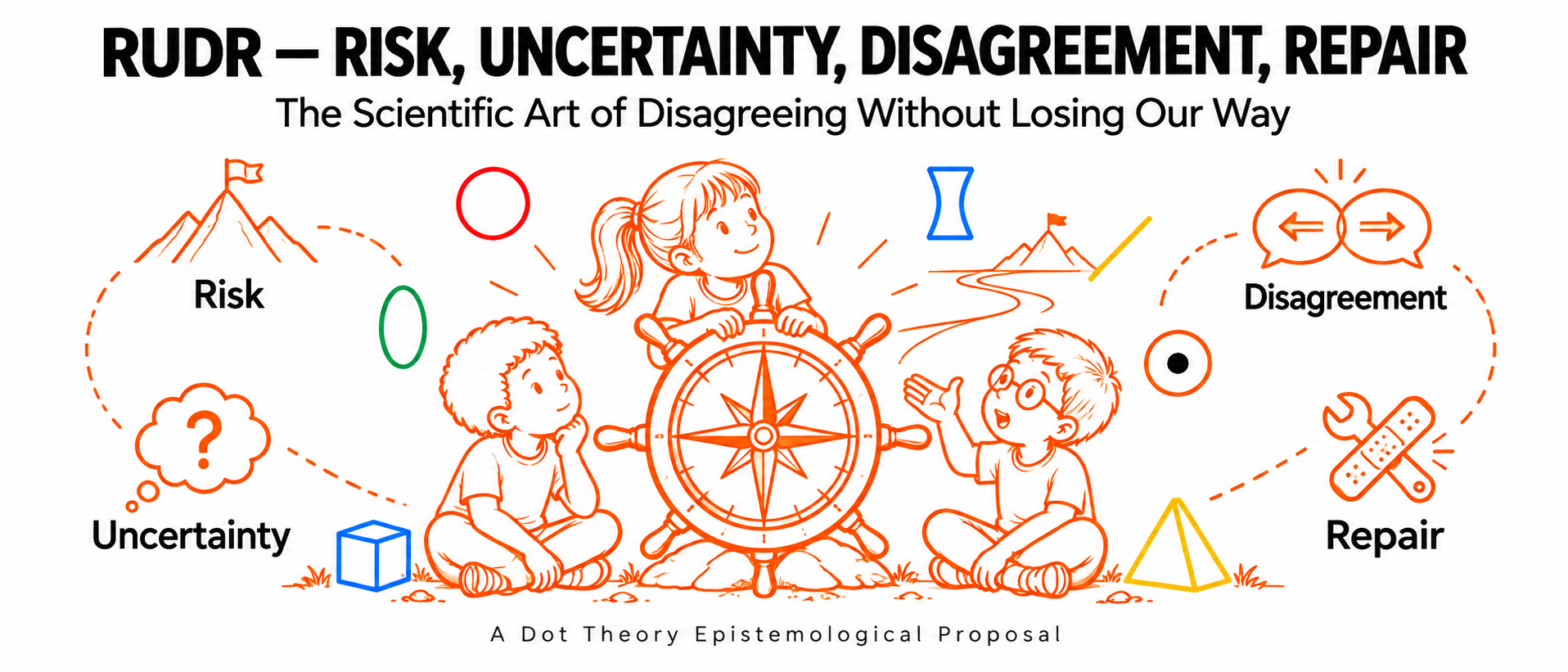
A rudder, not a verdict
Science has a rather peculiar relationship with disagreement.
We celebrate it as essential to progress, teach it as part of the scientific method, and then occasionally behave as though somebody has committed a personal offence, spat in our face and insulted our ancestors when they disagree with us.
Perhaps that is understandable. Scientific propositions are not always merely intellectual possessions. They can represent years, decades or lifetimes of work, professional identities, reputations, friendships, financial commitments and occasionally an entire worldview constructed around a particularly elegant equation being useful. Like holding a record.
Questioning one of those equations can therefore feel considerably more consequential than merely questioning the equation.
But there is a distinction worth preserving.
A disagreement about a scientific proposition is not necessarily a disagreement about the worth, competence or integrity of the person proposing it.
Nor does every disagreement need to conclude with one participant admitting defeat, another claiming victory and everyone else politely pretending they enjoyed the experience.
Sometimes a disagreement establishes something neither participant had previously identified. An assumption becomes visible, a missing comparison is recognised, a limitation becomes explicit, or two apparently equivalent explanations turn out to be performing different scientific operations.
Those are not necessarily failures of communication.
They may be scientific results.
I have been exploring whether we could become more systematic about recognising these events, particularly as scientific communication increasingly takes place through digital correspondence, computational systems and AI-assisted research.
The resulting proposal is called RUDR:
Risk — Uncertainty — Disagreement — Repair.
Somewhere between rude, udder and rudder, I find the name appropriately memorable.
A little rude, perhaps, because science occasionally requires us to question things people would rather leave undisturbed.
An udder, if one is sufficiently determined or obstinate to milk every metaphor for its intellectual value.
And a rudder because the point is not to eliminate the sea, control the weather or insist that everybody sails towards the same destination.
It is to make our next movement more deliberate and efficient.
RUDR is a proposed instructional and methodological instrument within Dot Theory, my ongoing research programme in epistemology. It is not an established scientific law, a validated psychological model or a compulsory protocol for conducting disagreements.
It is a candidate way of distinguishing four responsibilities that frequently arise whenever people construct, communicate, examine or rely upon scientific knowledge.
And I suspect those responsibilities may be useful far beyond science.
Four things we frequently confuse
Imagine that a researcher publishes a mathematical model describing an unfamiliar physical phenomenon.
The mathematics appears coherent, several calculations reproduce established observations, and the researcher offers an ambitious interpretation of what the results might reveal about reality.
Another researcher raises an objection.
Perhaps a variable has been calibrated using the very result that is subsequently described as a prediction. Perhaps the mathematical model is correct, but the physical interpretation remains one among several alternatives. Or perhaps the model is promising, but the evidence is not yet sufficient for the commercial application being proposed.
At this point, several different questions have appeared.
What are the consequences of relying upon the model?
What remains unknown?
What exactly do the researchers disagree about?
And what, if anything, needs correcting?
These questions are related, but they are not interchangeable.
RUDR proposes that recognising their differences may help us preserve scientific value even when a discussion does not produce agreement.
R — Risk: What happens if we rely upon this?
Risk concerns the consequences of treating a representation as sufficiently trustworthy for a particular purpose.
A speculative physical model may be perfectly legitimate as an object of theoretical investigation. Its author may be entitled to explore unusual assumptions and develop their consequences without claiming that nature has already been shown to behave accordingly.
But the situation changes when the same model is presented as suitable for clinical decisions, engineering applications, commercial investment or other consequential activities.
The mathematics may be identical.
The represented authority is not.
A statement offered as a hypothesis in a research discussion has different practical consequences from the same statement offered as independently established fact.
Risk therefore asks whether the authority attributed to a claim is appropriate to the evidence supporting it, the context in which it is used and the potential consequences of relying upon it.
Importantly, risk is not simply another word for uncertainty.
We can be uncertain about an entirely inconsequential proposition. We can also face a serious practical risk even when the scientific uncertainty is relatively small.
And a credible safety concern may justify proportionate action before every theoretical disagreement has been resolved.
The purpose of identifying risk is not to prohibit uncertainty. It is to prevent unexamined uncertainty from silently acquiring inappropriate authority.
U — Uncertainty: What have we actually established?
Uncertainty is one of science's most productive conditions, provided we are prepared to identify it accurately.
We may know that a calculation is correct under specified assumptions without knowing whether those assumptions correspond to physical reality.
We may possess experimental evidence supporting a model without having established that it provides the only explanation.
We may be able to reproduce an observation without being able to explain its causal mechanism.
Or we may simply lack the information required to determine which interpretation is warranted.
These are different kinds of uncertainty.
And they matter because scientific knowledge does not consist only of conclusions. It also consists of the conditions, qualifications and unresolved questions that make those conclusions meaningful.
A well-developed theory may be extraordinarily precise about what it cannot yet establish.
That should not automatically count against it.
Indeed, an accurately identified limitation may be more scientifically useful than an impressive conclusion whose limitations remain hidden.
Uncertainty becomes particularly important in AI-assisted research, where a computational system may produce fluent explanations, convincing derivations and apparently coherent connections between theories.
The ability to generate a plausible representation does not automatically establish its correctness, provenance or physical significance.
But neither does the presence of AI assistance automatically invalidate the proposition.
The question remains what can be independently examined, reproduced and justified.
D — Disagreement: What remains distinguishable?
Disagreement is frequently treated as a problem waiting to be removed.
I would like to suggest that it can also be treated as something worth preserving.
Two researchers may examine the same mathematical relationship and legitimately disagree about its physical interpretation.
They might agree that a model reproduces an observation while disagreeing about whether the model explains the mechanism responsible.
They might agree about an experiment while interpreting its significance through different theoretical frameworks.
Or they may disagree because they are asking entirely different questions of the same information.
None of those situations necessarily requires somebody to be dishonest, incompetent or incapable of understanding the other participant.
The disagreement may concern the evidence.
It may concern the assumptions.
It may concern the intended meaning of a term.
And sometimes it concerns the authority each participant believes a particular scientific operation is entitled to establish.
There is a further complication: scientific disagreement does not always disappear when people understand one another better.
Sometimes understanding reveals that their positions really are incompatible.
That is useful too.
A recoverable disagreement is not necessarily an unresolved communication failure. It may be an accurately represented scientific distinction.
Preserving such distinctions matters particularly when different scientific frameworks encounter one another.
One framework should not acquire authority over another simply because their terminology happens to resemble each other.
The same word does not necessarily carry the same local meaning.
And recovering the meaning of a proposition does not automatically recover its author's intentions or the historical provenance of its development.
Those are separate questions, requiring separate evidence.
R — Repair: What can legitimately change?
The final responsibility may be the most human of the four.
Repair concerns what happens when a limitation, mistake, misunderstanding or failure of communication has been identified.
A calculation can be corrected.
A conclusion can be narrowed.
An attribution can be amended.
An unsupported claim can be withdrawn.
An interpretation can be revised.
And sometimes somebody can simply apologise for the manner in which they conducted an exchange.
But these are not all the same operation.
An apology does not establish that a scientific objection was wrong.
A mathematical correction does not necessarily repair an interpersonal injury.
A revised theory does not require us to pretend its predecessor never existed.
And accepting an apology does not oblige anybody to accept the scientific proposition associated with it.
This distinction matters because scientific work develops through records. Those records preserve not only what we presently believe, but how our understanding changed and why particular conclusions were modified.
Erasing a mistake may make the final presentation tidier.
Preserving the mistake alongside its correction may make the science more accountable.
A useful repair therefore identifies what changed, what remained, and what new standing the corrected proposition is entitled to carry forward.
Sometimes repair results in renewed cooperation.
Sometimes it allows two people to disagree respectfully and continue independently.
And sometimes the appropriate repair is a documented correction followed by the perfectly legitimate decision not to continue the conversation.
Repair does not require agreement. It requires an appropriate response to what has actually been identified.
Why this is a rudder rather than a four-step procedure
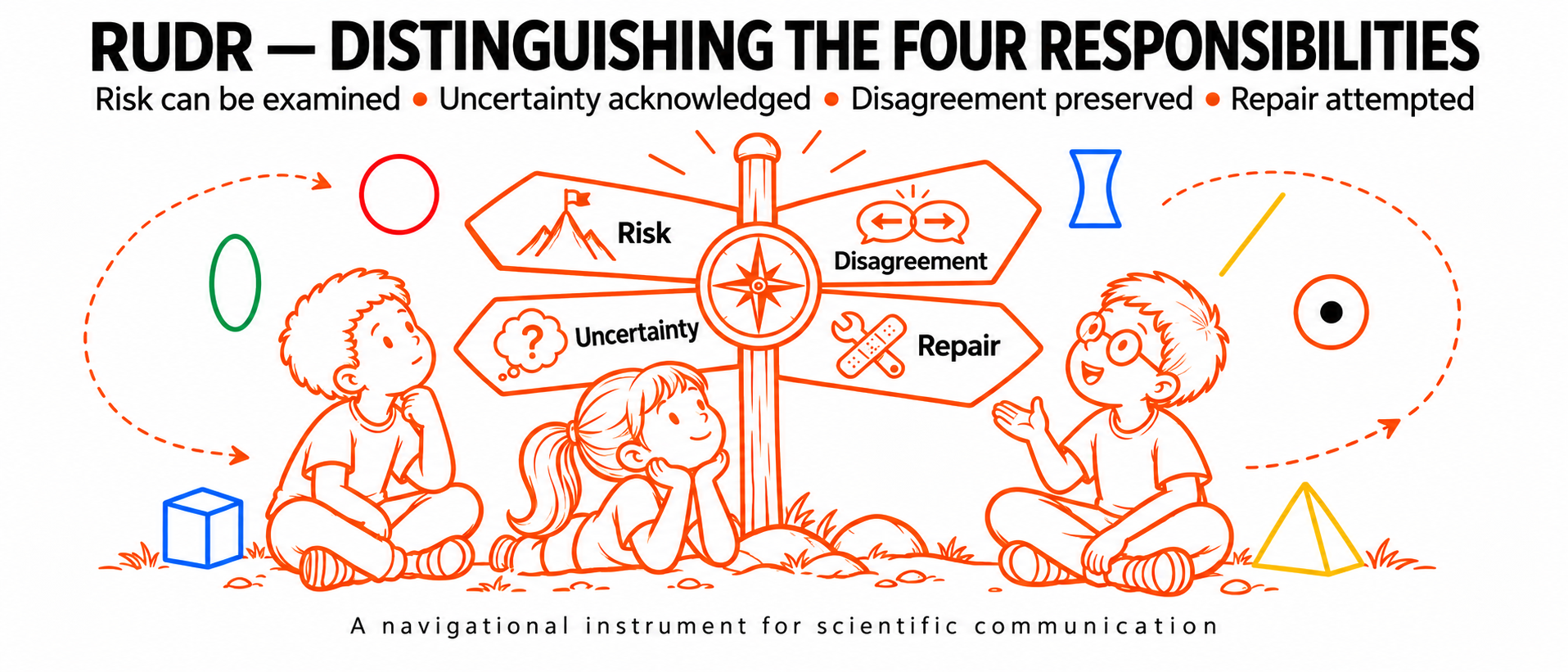
At first glance, RUDR might look like a sequence.
First identify risk, then uncertainty, then disagreement, and finally attempt repair.
That would be convenient.
It would also be misleading.
Scientific problems do not ordinarily arrive in the order most convenient to our diagrams.
A disagreement might reveal previously unrecognised uncertainty.
A correction might expose a new risk.
An urgent risk might require action before the underlying scientific disagreement can be resolved.
And an apology might repair an exchange while leaving the original uncertainty entirely unchanged.
RUDR is therefore not intended as a compulsory series of steps.
It is a way of asking which responsibility has become relevant within a particular scientific situation.
The image I have in mind is less a checklist than a navigational instrument.
A rudder does not decide where a vessel ought to travel.
It does not create the destination, establish the weather or guarantee safe passage.
Its value lies in making directional adjustment possible within the conditions actually encountered.
Likewise, RUDR does not tell us what reality is made of, which scientific theory must be true, or who is entitled to win an argument.
It invites us to identify what is happening in the inquiry and what kind of next operation might be justified.
That operation might be another experiment, a request for clarification, a corrected attribution, an independent review, a carefully bounded claim or the preservation of a legitimate disagreement.
The next move need not be consensus.
It needs to be accountable.
The importance of remembering what changed
One reason I became interested in this question was the development of F O R M, a collaborative scientific communication and verification proposal within the Information Physics Institute.
During its early construction, a central representational role was initially called Reality.
That seemed intuitive enough.
After all, if we are constructing a methodology for scientific representation, reality is presumably rather important.
But Johann Pascher raised an objection that changed the proposal.
Calling that role Reality risked granting the representation an ontological authority that the proposed procedure itself had not established.
The objection was legitimate.
We were not necessarily identifying reality itself. We were identifying what remained, survived or required further examination after a particular operation.
The term became Residual.
That was a relatively small alteration to the vocabulary, but it changed the scientific responsibility carried by the proposed method.
The original proposal had introduced an unnecessary implication.
A colleague identified it.
The objection was examined.
The terminology was corrected.
And the earlier formulation remained part of the developmental record.
That sequence did not prove F O R M to be scientifically valid.
It did, however, produce a more carefully bounded representation through identifiable criticism and correction.
The distinction matters.
The value of the exchange did not depend on one of us becoming the intellectual victor.
It depended on recognising what the objection established and allowing that recognition to change the resulting scientific object.
Other IPI discussions have exposed related problems concerning source attribution, mathematical calibration, experimental controls, interpretation, independent implementation and the conditions under which one theoretical framework may legitimately be compared with another.
Not every exchange has ended comfortably.
Not every objection has been accepted.
And not every participant has agreed about the consequences.
But these interactions offer an interesting collection of records in which the scientific consequences of criticism, uncertainty and correction may be examined.
RUDR emerged from considering whether those consequences could be distinguished more systematically.
That is the background to the proposal.
It is not evidence that the proposal has already been validated.
The relationship with F O R M
There is a more technical question beneath RUDR, although the basic idea does not depend upon understanding the formalism.
F O R M — the Constitutional Verification Protocol — proposes four representational roles: Framework, Operator, Residual and Model.
In simplified terms, the concern is with the conditions under which a scientific representation is established, examined and permitted to carry particular consequences forward.
Its published grammar distinguishes relationships among those roles, together with the conditions under which a resulting model may become admissible within a subsequent framework.
RUDR may offer an accessible way of recognising responsibilities that arise during such transitions.
Uncertainty might concern an assumption that has not been verified.
Disagreement might expose a distinction that survives an attempted comparison.
Risk might arise when a representation is carried into another context and given stronger authority.
Repair might concern the correction or legitimate succession of a scientific claim.
But these are illustrations, not permanent assignments.
There is no established one-to-one mapping between the letters of RUDR and the roles of F O R M, and I would be wary of forcing one simply because both happen to contain four memorable components.
Four is a delightful number.
It is not, by itself, scientific evidence.
The proposed relationship is therefore one that should be examined, not presumed.
The published F O R M research object is available here:
https://zenodo.org/records/22875795
The wider Dot Theory research programme provides the epistemological context:
https://www.dottheory.co.uk/paper/research-programme
For now, RUDR should be understood as a proposed instructional extension, not a modification of F O R M's canonical definitions or evidence that its broader scientific ambitions have already succeeded.
What disagreement teaches us about attribution
There is another reason I think this matters, particularly in collaborative research.
Scientific ideas rarely develop in complete isolation.
A researcher encounters a proposal, considers an objection, adopts a useful distinction, modifies a methodology or independently discovers a similar solution.
Sometimes those relationships are explicitly documented.
Sometimes they are not.
And sometimes two researchers sincerely disagree about whether a particular contribution originated with one of them, developed independently or emerged through their interaction.
These circumstances are especially difficult because similarity does not automatically establish derivation.
An earlier publication does not automatically make its author responsible for every later implementation of a similar principle.
A later implementation does not erase the intellectual history of the problem it addresses.
And an acknowledgement of influence does not necessarily imply agreement with the source framework.
An idea can also be assimilated unintentionally. Somebody may encounter a method, understand its usefulness and eventually express a related procedure within another framework without deliberately attempting to appropriate it.
The resulting work may be original in its application.
The researcher may have acted in good faith.
Yet questions of influence, attribution and independent development may remain scientifically and historically relevant.
RUDR does not resolve those questions simply by naming them.
It may, however, help prevent different responsibilities from becoming confused.
We can recognise a possible attribution risk without assuming misconduct.
We can preserve uncertainty about historical origins.
We can record disagreement between independently supported accounts.
And we can correct acknowledgements or descriptions when further evidence becomes available.
Perhaps the essential discipline is to avoid allowing our recollections, preferences or retrospective interpretations to acquire the status of records they do not actually constitute.
That standard must apply to my own work as readily as anybody else's.
The difference between science and scientific authority
The same reasoning becomes more consequential when scientific propositions enter institutional or commercial life.
A research group may provide an environment in which speculative ideas are freely proposed, criticised and developed.
That is part of its intellectual purpose.
But participation in such a community does not automatically establish institutional endorsement of everything a member publishes.
Nor does recognition by an individual colleague necessarily constitute independent validation of a physical theory.
And scientific plausibility does not automatically establish the safety, suitability or reliability of an associated commercial product.
These are different kinds of authority.
Confusing them can have practical consequences.
An institution may therefore need explicit procedures governing endorsement, publication, conflicts of interest, safety concerns and the representation of collective scientific positions.
RUDR cannot replace those procedures.
Nor should it become an excuse for delaying action where credible risks require investigation.
Its possible value is narrower: helping us distinguish what is scientifically disputed, what remains uncertain, what consequences require attention and what correction or other response is justified.
There is a difference between holding somebody accountable for the claims they make and treating every unresolved disagreement as evidence of personal wrongdoing.
The former is essential to responsible scientific practice.
The latter is not a substitute for examining the evidence.
Can disagreement become a scientific object?
This is the question I ultimately want RUDR to make available.
We already possess sophisticated approaches to scientific review, experimental design, risk assessment, research ethics, provenance management, argumentation and dispute resolution.
RUDR does not deserve scientific recognition merely because it gives familiar activities a new acronym.
To become genuinely useful, it would need to demonstrate something more.
For example, imagine providing independent reviewers with a fixed record of a difficult scientific exchange.
One group examines it using ordinary competent review methods.
Another applies a declared RUDR procedure.
Could RUDR help the second group identify consequential disagreements more accurately?
Could it improve the recovery of unresolved assumptions?
Could it reduce the likelihood that a correction is mistaken for a complete rejection of a theory?
Could it better distinguish interpersonal repair from scientific correction?
Could independent reviewers reproduce materially equivalent accounts of what changed, what remained uncertain and what justified the next decision?
And could any improvement be demonstrated without requiring participants to adopt Dot Theory's terminology or underlying epistemological commitments?
Those are questions capable of being investigated.
A failure would be informative too.
If independent reviewers cannot apply RUDR consistently, its categories prove too ambiguous, or the method offers no meaningful advantage over established practices, then its scientific standing should reflect that result.
It may remain a useful teaching mnemonic.
It may require revision.
Or it may turn out to be entirely unnecessary.
That is a risk I am rather content to take.
A methodology intended to make criticism accountable should not be exempt from criticism itself.
Accord without agreement
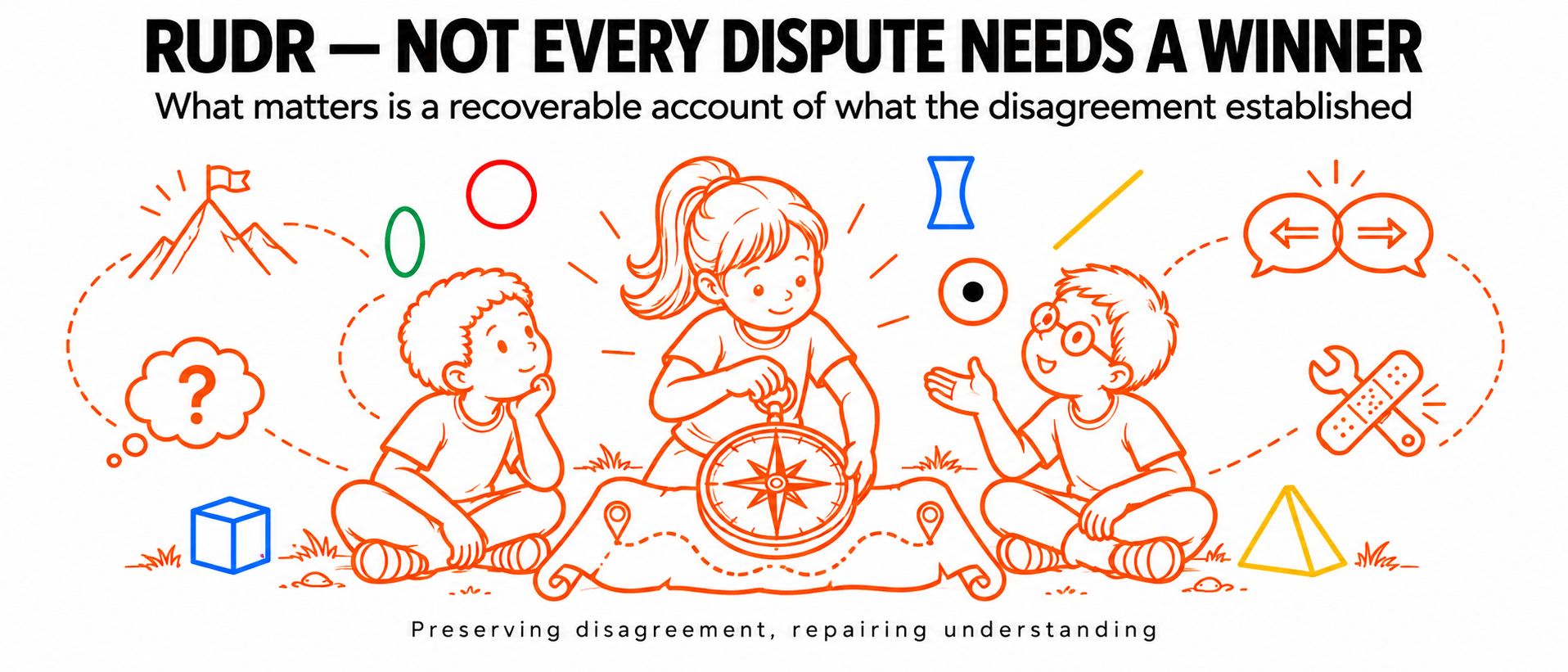
One of the longer-standing interests within Dot Theory concerns the conditions under which independently developed frameworks may cooperate without requiring their underlying ontologies to become identical.
That question eventually led to proposals concerning admissibility, interoperability and Accord (see Lexicon and Sublexicon): the conditions under which separately constituted positions may become sufficiently compatible for a particular cooperative operation.
Accord does not necessarily mean complete agreement.
Two scientific frameworks may disagree fundamentally about the nature of reality while nevertheless being capable of comparing predictions, sharing instruments, examining common data or developing an experimental collaboration.
Their cooperation does not require their theories to become the same theory, only their collaboration does.
Indeed, preserving their differences may be what makes the cooperation scientifically useful.
RUDR seems potentially relevant here.
Risk, Uncertainty, Disagreement and Repair need not always lead towards to immediate consensus either.
They might instead help us identify when the next cooperative operation becomes appropriate.
Sometimes agreement is both necessary and useful.
Sometimes compatibility is sufficient.
Sometimes the appropriate next move is a new experiment and patent.
And sometimes the scientifically responsible choice is to preserve the disagreement until somebody can establish a distinction that the present evidence does not resolve.
I find that a more interesting conception of scientific collaboration than requiring every conversation to conclude with a winner or instantly valued product.
A practical navigational instrument
Imagine two people discussing a controversial scientific proposal.
One believes the available mathematics supports a particular interpretation of physical reality.
The other accepts the mathematics but questions whether the physical interpretation follows.
They could spend several hours repeating their positions, each increasingly convinced that the other has failed to understand something obvious.
Or they might make their different responsibilities explicit.
What is the practical risk associated with accepting or rejecting the interpretation?
Which assumptions and consequences remain uncertain?
What proposition do they actually disagree about?
And what evidence, clarification, correction or independent examination would legitimately move the conversation forward?
They may still disagree afterwards.
But they could have a better understanding of what the disagreement means.
Perhaps one researcher discovers that a calculation was correct but overinterpreted.
Perhaps the other discovers that a supposedly philosophical objection concerns an identifiable experimental discriminator.
Perhaps both discover that they were asking different questions of the same mathematical object.
And perhaps neither changes their position.
That last outcome need not be a failure. It could be navigating uncertainty scientifically.
If they can recover what each position claims, what supports it and what remains unresolved, their disagreement has become available for further scientific investigation.
A future reader may be able to continue the inquiry without having to reconstruct the participants' personalities, intentions or entire correspondence.
That is the sort of scientific usefulness I would like to investigate.
Not the elimination of disagreement.
The preservation of what disagreement teaches us.
Learning to navigate
I do not believe every researcher must share my ambitions for Dot Theory.
I certainly do not expect everybody to adopt its vocabulary, agree with its conclusions or read the entire research programme. I am far too pompous for that
In fact, given the quantity of material I have produced, I suspect much of it will be introduced to an AI before it is introduced to another human being.
I can hardly complain or disagree.
I use the technology extensively myself.
But I do think scientific communication is becoming an increasingly important object of scientific inquiry in its own right and I write myself more than people perhaps think.
Our tools allow us to construct, distribute and transform representations at remarkable speed. Convincing someone not to break in with a camera system is only one such way.
They do not automatically establish the accuracy of our interpretations, the provenance of our ideas, the quality of our judgement or the legitimacy of the authority we attach to our conclusions.
Those remain responsibilities of scientific inquiry if engaged with.
And they remain responsibilities of the humans and institutions participating in it.
RUDR is a modest proposal arising from that concern.
It suggests that four distinctions may help us navigate a landscape in which scientific claims, computational representations, independent frameworks and human disagreements increasingly intersect.
Risk can be examined.
Uncertainty can be acknowledged.
Disagreement can be preserved.
And what has gone wrong may, where possible, be repaired.
None guarantees agreement.
None establishes truth simply by being named.
And none entitles us to determine somebody else's scientific or personal identity.
But shared and analysed together they may help us identify what we have learned, what remains open and which further operations are justified. Leave the room a little wiser-er.
Perhaps that is what a rudder is for.
Not to tell us what the world is made of.
Not to guarantee our destination.
And certainly not to persuade everybody aboard that there is only one respectable way to sail.
But to make it possible to recognise our position, correct our course and understand what we are entitled to carry forward.
After all the occasionally rude exchanges through which scientific knowledge develops, I rather like the thought that we might have been constructing a RUDR all along.
Perhaps even a lesson in how we learn.
And if nothing else, it is a rather good excuse to remember that not every scientific dispute needs a winner, but every consequential disagreement deserves a recoverable account of what it actually established.
Stefaan Vossen ⊙
Dot Theory — An Epistemological Research Programme
Five-dimensional chess played between ideas, not personas.
Written by a human tool, with AI assistance.
Further reading and research records
F O R M — Constitutional Verification Protocol, v1.0
https://zenodo.org/records/22875795
Canonical Constitutional Record — CCR v1.0
https://zenodo.org/records/21535574
Scientific Epistemic Metrology — SEM v0.5
https://zenodo.org/records/23041075
Dot Theory — Research Programme
https://www.dottheory.co.uk/paper/research-programme
A Manifesto for Proceeding Under Uncertainty
https://www.dottheory.co.uk/paper/manifesto
RUDR is an independently proposed extension of Dot Theory, informed by documented scientific exchanges and collaboration within the Information Physics Institute. The interpretations and proposed applications expressed here are my own and do not imply institutional endorsement or agreement by the colleagues mentioned.