Current documentary status — Historical developmental object
This work records an April 2026 stage in the development of the Dot Theory research programme and is preserved substantially as originally published.
It predates the later separation of Dot Theory, CCR, F O R M / CVP, Scientific Epistemic Metrology (SEM), and source-native scientific implementation into distinct programme objects and jurisdictions.
The terminology, notation and claims below should therefore be read in their original developmental context rather than as the current programme-level formulation.
For the present architecture and jurisdiction of the corpus, see Dot Theory Corpus: Programme Architecture, Jurisdiction & Local Implementation.
Historical continuity ≠ current programme identity.
Status: Historical Developmental / Interpretive Framework — April 2026
This page develops a semi-formal epistemic interpretation of the programme. Its text concerns the conditions under which statements become operationally meaningful within a model. It does not deny the existence of an external reality. It introduces structured concepts but does not define a closed mathematical system or physical theory. Any formal or empirical claims about an external reality must be established elsewhere in the programme.
Truth is not passively discovered, but actively constructed under constraint.
The Generative Interpretative Architecture (GIA) is a Framework For Interpreting Reality Under Constraint.
We do not simply discover truth, we construct it from parts and through systems that interpret the world in terms we are able to use.
Access to truth is then not absolute, but conditional and dependent on knowledge of the structures that produce it. This work describes a framework architecture that optimises those structures when those conditions are met.
This work aims to provide a functional, systems-based, semi-formal reconstruction of scientific realism under contextual and epistemic constraints.
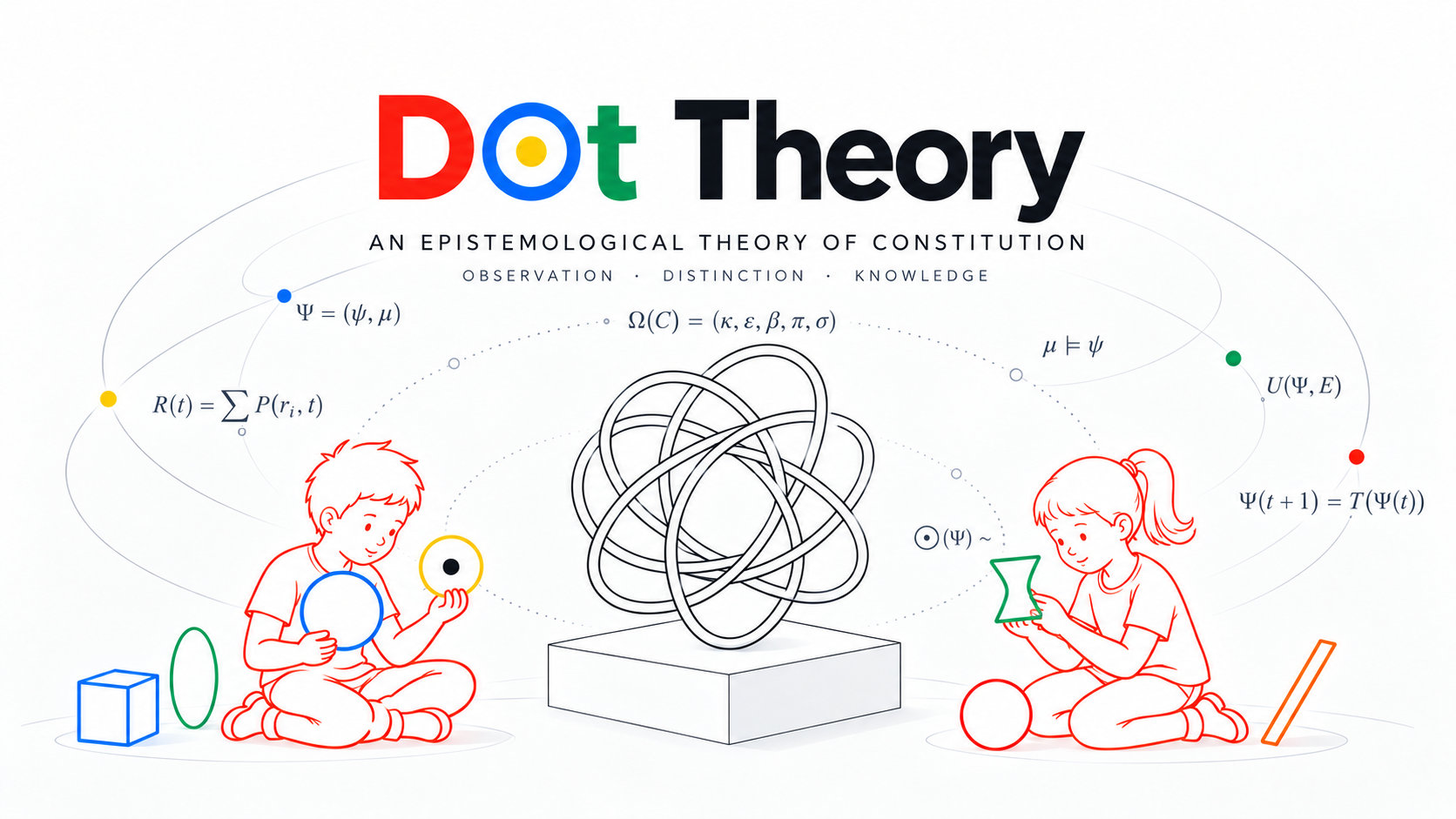
Foreword
The Generative Interpretive Architecture (GIA)’s perspective of reflexive fallibilism with expanding context is a type of normative generative architecture (NGA). An epistemological framework grounded in the Philosophy of Science and Systems Theory. The GIA generates cosmologies under constraint, and in doing so, biases toward those that remain stable, coherent, and usable. It has natural extensions into Cognitive Science and education, with applications in domains such as healthcare and technology. In this sense, it treats perspective as functionally equivalent to cosmology.
The framework is anchored in the assumption that human life is materially and biochemically instantiated, while recognising that all access to that reality remains context-dependent and interpretive. The GIA, as an object, is then a generative, constrained, and normatively biased architecture that produces and stabilises cosmological configurations over time.
At its core is a simple premise:
Every system that interprets the world and claims validity must also contain a method for validating its interpretations. Where such a method is absent, truth becomes unstable; where it is present, truth becomes comparable, testable, and, in principle, improvable.
The framework presented here integrates elements of logic, dynamical systems, and adaptive feedback into a single structure. It treats beliefs as states, interpretation as structure, and evaluation as a continuous process unfolding over time. In doing so, it defines not a static theory of truth, but a process by which truths are generated, maintained, and transformed.
The Normative Generative Architecture (NGA)
The GIA framework introduced in this work occupies a position that is not adequately captured by existing categories such as “cosmology,” “framework,” or “model” when taken in isolation. Each of these terms describes part of its function, but none alone is sufficient.
To stabilise its role, we define the concept of Normative Generative Architectures (NGA).
An NGA is a structured system that:
defines how interpretations of reality are formed (framework function),
constrains which interpretations remain valid or stable (normative function),
and generates, over time, a bounded set of viable configurations of meaning and action (generative function).
In this sense, an NGA occupies a position between two familiar extremes.
At one end, a pure framework provides rules or structures for interpretation but remains neutral with respect to outcomes. It enables multiple possible configurations without bias toward any particular one.
At the other, a pure cosmology presents a specific, fixed configuration: a determinate account of what exists, what it means, and how it should be understood.
An NGA is neither of these, yet can become either, depending on the intended use, and the Generative Interpretative Architecture (GIA) introduces structured constraint that biases the space of possible configurations toward those that remain coherent, stable, and usable under evaluation by the individual, system, or collective that must interpret and act within that context.
It does not prescribe a single final configuration in advance. However, it is also not neutral. By constraining interpretation through internal relations and evaluative conditions, it systematically favours some configurations over others. Over time, this produces a form of probabilistic convergence, in which certain interpretations become more stable, coherent, and usable within the system than alternatives.
This behaviour can be understood in terms of structured constraint and attractor dynamics. Multiple configurations remain possible, but only some persist under repeated application, evaluation, and transformation. The architecture therefore generates not arbitrary outcomes, but a bounded and biased space of viable interpretations.
Within this work, the Generative Interpretive Architecture (GIA) is proposed as a specific instance of a Normative Generative Architecture, also referred to as organic cosmology.
The GIA defines:
the minimal structure of encountered reality as a relation between state and context (Ψ = (ψ, μ)),
a condition of interpretive adequacy (μ ⊨ ψ),
and a multi-dimensional evaluative structure governing the stability and usability of interpretive systems (Ω(C)).
Through these constraints, the GIA does not determine a single cosmology, but it does structure the space in which cosmologies can be generated, evaluated, and sustained. Cosmologies, in this sense, are not external to the architecture. They are configurations within it.
This establishes a precise relation between the key terms used throughout this work:
A framework provides structural rules for interpretation.
A cosmology is a specific configuration of interpretation, meaning, and action.
An architecture organises how such structures and configurations are related and transformed.
A Normative Generative Architecture (NGA) integrates all three and uses the terms interchangeably: it provides structure, constrains validity, and generates a bounded set of viable configurations over time.
The GIA is therefore not a cosmology in the traditional sense, nor merely a neutral framework. It is an architecture that generates and evaluates cosmologies under constraint, and in doing so, introduces a directional bias toward those that remain coherent, stable, and actionable within real conditions.
This distinction is not terminological refinement alone. It is necessary for preserving the internal consistency of the framework. Without it, the system would collapse either into relativism (if treated as neutral) or into dogma (if treated as fixed). As a specifically constructed NGA, the GIA avoids both by maintaining constraint without finality, and generation without arbitrariness.
End of foreword
A 56 page, 6-part work describing the General Interpretive Architecture as a Contextual Theory of Human Life and Systems
by Stefaan Vossen, April 2026, London.
Paper 1/6: Validity Conditions
An Organic Cosmology for a Silicon Time
On Adoption, Translation, and the Conditions of Valid Use
Abstract
This first individual paper 1 of 6, precedes the formal introduction of the Organic Cosmology presented, developed and described in the 5 papers that follow. The purpose of this paper is not to delay or introduce additional philosophical doctrine, but to make most explicit the conditions under which a cosmology may be validly encountered, understood, and adopted using existing structures.
In this work, “a cosmology” is not treated primarily as a final doctrinal claim about what exists in the universe, but as a selectable interpretive framework through which experience is rendered meaningful and action is organised. It treats cosmologies not as the facts of reality themselves, but the structured way in which reality is interpreted, understood as being relevant, and acted upon.
If a cosmology is treated then, not as requiring revelation but ability (access to resources, skill and freedom) to move within a selectable interpretive framework, then its adoption cannot be assumed to be passive, inherited, or coercively imposed without conceptual loss. The act of adoption is itself an interpretive event. A reader does not merely receive a viewpoint or cosmology, but enters into relation with it under conditions of prior structure, language, access, and understanding.
This paper lays that bare explicitly as its own requirement. For this reason, any, including this, cosmology, must take contextual adequacy seriously, and necessarily apply that standard to its own transmission. If interpretation must be adequate to state, then the adoption of an interpretive framework must itself occur under conditions sufficiently fair, informed, and accurate that the framework can become stable in use. This paper names that requirement explicitly and necessarily as its first point of information and framing.
The claim is modest but epistemically important. Additionally, this work does not require agreement in order to exist validly, it must exist to be internally coherent. Practically speaking; it requires from the reader only adequate understanding and sufficiently voluntary consensual adoption in order to function as intended. This is somewhat self-evident and true for all things. Translation, contextualisation, and conceptual fairness logically are therefore not secondary matters of style. They are prior conditions of validity and require stating outright.
1. Introduction
The papers that follow, cumulatively propose the Generative Interpretive Architecture (GIA): a selectable framework for interpreting human life as chemically materially real, finitely embodied, context-dependent, extended through record and described by science, knowledge and data.
This first paper’s formalism is constructed in 10 statements first. Not to delay entry into the work, but to state explicitly each of the conditions under which the work claims validity in use and define precisely its meaning, scope and intent. It may be read after initial engagement with the framework, but it applies meaningfully to the whole.
Before such a framework can be introduced formally then, a prior question must be addressed:
Under what conditions can a cosmology of this, or any, kind be said to have been meaningfully encountered at all?
This is not a procedural question. It is structural and fundamental to this paper. If cosmology is understood here not as revealed final truth but as a selected interpretive framework through which life is rendered meaningful and action is organised, then the manner of its adoption by the reader or otherwise cannot be treated as irrelevant. A framework used without sufficient understanding is not being used in the same way as one encountered under adequate conditions of interpretation. A framework adopted under coercion is not the same framework in operation as one consciously selected. A framework mistranslated is not identical in use to the one originally stated, even where its symbols are preserved.
This paper 1 therefore sets out to meet a pre-foundational condition and communicate it to the reader. It does not argue that all readers must agree. It does not claim that complete understanding in communication is fully possible. It does not attempt to regulate reception in any total sense. It simply makes explicit that, for a cosmology centred on contextual adequacy and constrained interpretation, the terms of entry matter.
What follows in the later papers should therefore be read under this condition: that the framework is offered for understanding and possible adoption only to the degree that its terms can be encountered fairly, accurately, and with the fullest possible informed voluntariness available to the reader.
2. Cosmology as Use, Not Mere Statement
A cosmology may be written as a set of claims. It may be summarised propositionally. It may be translated into any manner of symbols. Yet none of these alone is its use and meaning.
Within the present work, a cosmology is treated not merely as a statement about what exists, but as an interpretive structure through which experience is rendered meaningful and future conduct is shaped. In that sense, a cosmology functions less as a sentence to be repeated than as a context to be inhabited.
This distinction matters.
A statement may be heard without being understood. A doctrine may be inherited without being examined. A language may be repeated without its terms being lived in or applied coherently. None of this is unusual. Human beings operate constantly through partially received structures.
However, where a cosmology presents itself as a choice and usable architecture of interpretation, the difference between repetition and adoption becomes decisive to its own meaning and function.
To adopt a cosmology is to allow it to participate in the structuring of one’s contexts and make changes. It becomes involved in altering judgement, memory, meaning, action, and evaluation. This makes adoption a consequential and non-trivial act, whether explicit or not.
It follows then that the conditions under which a cosmology is encountered are not external to it. They form part of the structure through which it may or may not become valid in use.
3. The Reflexive Constraint
The later papers introduce a minimal formal structure for encountered reality:
Ψ = (ψ, μ)
where ψ denotes a state and μ denotes the context through which that state is rendered meaningful.
They also introduce a minimal condition of interpretive stability:
μ ⊨ ψ
That is, interpretation is not unconstrained. A context must be adequate to the state to which it is applied if understanding is to remain stable.
This condition has a reflexive consequence.
A cosmology is itself a higher-order structure operating on context. To encounter or adopt a cosmology is therefore not outside the framework. It is one instance of it. The adoption of a cosmology is itself a lived event in which a state is being interpreted under conditions of language, access, prior belief, trust, coercion or freedom, conceptual clarity or confusion.
In other words, the uptake of a cosmology is itself a Ψ.
If that is so, then the same standard must apply. The context in which the cosmology is received must be sufficiently adequate to the actual condition of the subject encountering it. Where there is gross misunderstanding, distortion of terms, manipulative framing, concealed consequence, or coercive obligation, the adoption is unstable by the framework’s own standards. What is being applied is no longer the same interpretive structure in any coherent sense. It is a distorted μ operating under false conditions.
This is the central point of this first paper, and while it cannot take responsibility for how it is read, it must set out its terms coherently to fulfill its own criteria.
The framework can only be self-consistent if its own adoption is treated as subject to the same constraint it places on all other forms of interpretation. While repetitive, the effort here is to be explicit to the formalism and produce the most coherent and aligned work.
4. Adoption, Inheritance, and Mandate
Human beings do not usually begin from first principles. Most inherit language, institutions, classifications, norms, and cosmologies before they are capable of evaluating them. In that practical sense, no cosmology arrives in a condition of pure and pristine selection. All are mediated by history, family, education, and circumstance.
This work does not deny that fact. Nor does it propose an impossible standard of absolute freedom from prior structure.
What it does deny is that inheritance or mandate alone is sufficient for valid adoption.
A cosmology may be inherited culturally, repeated institutionally, or imposed legally and still fail to become stable and coherent in the person who carries it. It may remain a borrowed language, a required loyalty, or an unexamined prior. Such structures may produce compliance, but not necessarily coherence. They may organise behaviour, but not necessarily understanding. They may persist socially while remaining internally brittle.
This paper therefore distinguishes between transmission and adoption.
Transmission is the passage of a cosmology into the field of a subject’s possible interpretation.
Adoption is the degree to which that cosmology becomes consciously and adequately inhabitable as a framework for living, judging, and acting.
The former can occur by accident, inheritance, or force. The latter requires at least some degree of informed participation.
That requirement is not sentimental. It follows from the system itself. A cosmology centred on contextual adequacy cannot treat blind repetition as equivalent to understood use without abandoning its own terms.
5. The Role of Consent
The word consent is often used narrowly, especially in legal, procedural, or medical contexts. Here it is used more structurally.
Consent, in the present sense, refers to the degree to which a subject is able to encounter the terms of a framework with enough clarity, fairness, and voluntariness that their relation to it is not fundamentally misdescribed.
This does not require perfect information, because no such condition exists. It does not require immediate agreement, because disagreement is both possible and often necessary. It does not require total autonomy from context, because no subject stands outside all context.
It does require something both more modest and more demanding at once: that adoption be as informed, as unconcealed, and as non-coercive as the situation reasonably allows.
Where that condition is absent, the framework cannot honestly claim to have been adopted in full. It may have been obeyed, inherited, repeated, or partially approximated. But the relation between subject and framework remains unstable.
This is why the present work treats consent not as an optional ethical decoration, but as a condition of valid use.
If a reader is not permitted to understand the terms on which the framework operates, then their relation to it is misframed from the outset. If they are compelled to adopt it irrespective of understanding, the framework ceases to function as a selected cosmology and becomes something else: doctrine, compliance structure, or imposed interpretation.
That may still have power. It does not have the same coherence.
6. Translation as a Foundational Problem
Any work of this kind depends on translation.
This is true in the ordinary linguistic sense, where terms must pass between languages. It is equally true in the conceptual sense, where terms must pass between disciplines, institutions, readers, and private semantic worlds. Formal notation does not remove this problem. It merely displaces it. A symbol may appear fixed while being read through different prior structures.
For this reason, translation cannot be treated here as secondary or merely stylistic.
In a framework where meaning depends on context, translation is itself an operation on context. It does not simply transport content unchanged. It transforms the conditions under which that content can be understood.
A bad translation is therefore not only an inconvenience. It is a structural distortion. It risks producing a μ that no longer adequately supports the intended ψ. In practical terms, it may preserve words while altering use, preserve notation while changing implication, or preserve claims while redistributing emphasis in ways that are unfair to the framework or to the reader.
This matters in both directions.
It is unfair to a reader to ask for adoption where the terms have not been rendered with sufficient clarity and accuracy. It is unfair to the framework to claim its application where those terms have already been significantly altered without acknowledgement.
The requirement for adequate translation is therefore foundational. Not because precision is aesthetically preferable, but because fairness in interpretation is a prior condition of validity. Fairness and requirement pragmatically seize there, as it loses all significant meaning beyond.
7. Ethical Hygiene
The term ethical hygiene may be used here for the maintenance of these conditions.
Something simple but useful and precise is meant by this.
Where an interpretive framework is being offered for possible use, one ought to take reasonable care that its terms are not obscured, manipulated, mistranslated, or made artificially unavoidable while still being presented as freely adoptable. One ought also to take reasonable care not to attribute to a reader an understanding they have not had a fair chance to achieve.
This is not moral perfectionism. It is reflexive restraint.
It is the refusal to confuse possession of a framework with the right to claim its valid uptake in others.
It is also the refusal to treat conceptual slippage as harmless where the framework itself depends on careful relations between state and context.
Ethical hygiene, in this sense, names the maintenance of interpretive fairness before argument proceeds. It belongs here because the present cosmology, if it is to remain self-consistent, cannot exempt itself from the conditions it places on meaning elsewhere.
8. Agreement, Disagreement, and the Limits of Entry
Nothing in this paper implies that adequate understanding must produce agreement.
A reader may understand the framework sufficiently and reject it. They may prefer another cosmology or its phrasing and symbols. They may consider this one incomplete, improperly weighted, or unpersuasive in its conclusions. Such outcomes are neither contradictions nor failures of the present paper. They are normal possibilities wherever interpretation is constrained but not mechanically determined.
What this paper 1 excludes is only the easier substitution: the appearance of adoption without adequate encounter.
A disagreement that arises after fair understanding belongs within the framework’s own evaluative horizon. It may be examined under coherence, explanatory power, behavioural consequence, psychological stability, and social compatibility. A nominal agreement formed under confusion or concealment does not. It produces noise rather than clarity.
For that reason, the present work should not be inherited merely by allegiance, nor rejected merely by reflex. It should be encountered on terms as fair as possible to both its subject matter and its reader.
That is a limit of entry, not a demand for assent.
9. On the Impossibility of Completion
One further qualification is necessary.
No act of adoption other than clinical death is ever complete in the strongest sense. Human beings change. Their circumstances change. Their understanding changes. Their contexts shift. New records accumulate. Old meanings decay.
In the terms developed later:
Ψ(t+1) = T(Ψ(t))
For that reason, the adoption of a cosmology cannot be treated as a once-and-for-all event. It is or should not be (and still be a theory, architecture or cosmology) a static possession. It is an ongoing relation subject to revision, deepening, abandonment, or transformation.
This applies equally to the present work.
A reader may encounter it now in one way and later in another. Terms that were once obscure or meaningless may become clear. A previously coherent uptake may become less so under changed conditions. New experience may alter the weighting of what this work later formalises as Ω(C). This does not weaken the present claim. It strengthens it. It shows that valid adoption is not a single threshold crossed once, but a continuing requirement of adequate relation and demonstrates realistic restraint.
This is another reason to state the matter at the outset. The framework cannot be honestly inherited as a fixed or dead set of formulas. It must remain re-encounterable if it is to remain alive in use.
10. Function of This Paper
This paper 1 therefore serves a limited but severely necessary purpose.
It does not introduce the cosmology proper. It introduces the conditions under which the cosmology may be encountered without immediate self-contradiction.
It does not guarantee fair reading of further papers. It cannot ensure adequate translation in every case. It cannot remove all asymmetry between author and reader, institution and subject, language and meaning. What it can do is refuse to leave those conditions unnamed.
The claim is simple: If a cosmology is to be selected rather than merely imposed, then the terms of that selection matter.
If interpretation must be adequate to state, then the communication and uptake of an interpretive framework must also strive toward adequacy.
If this framework is to be used as intended, then its terms must be coherent and accountable and made as clear, fair, and accurately translatable as possible at the earliest opportunity. Simultaneously, its adoption must remain as informed and voluntary as possible for those who would carry it.
That is the declared candidacy of this work.
11. Conclusion
The 5 of 6 papers that follow proceed from the premise that a cosmology may be treated as a selectable interpretive framework rather than a revealed finality, and that human life can be understood coherently through material continuity, contextual interpretation, finite duration, and cumulative record.
Before those claims are developed, this paper has made explicit a prior condition.
Because the framework centres interpretation, constraint, and contextual adequacy, it must also apply those standards to its own introduction. It cannot remain self-consistent while ignoring the conditions under which it is encountered, translated, and adopted.
The result is not a prohibition on disagreement, nor a demand for perfect comprehension or agreement. It is a narrower and more practical claim: that fair realism requires fair terms of entry.
What follows should therefore be read as an offered structure, not a concealed inheritance; as a candidate for adoption, not a demand for compliance; and as a framework whose validity in use depends, from the outset, on the adequacy and fairness of the relation by which it is received.
Paper 2/6: Foundational Position
An Organic Cosmology for a Silicon Time
A Selectable Cosmology Grounded in Material Reality, Human Record, and Contextual Interpretation
Abstract
This paper proposes an organic cosmology, a mechanism by which an individual believes themselves to be real, a logically coherent interpretive framework in which human life can be understood as materially real, finitely embodied, and recorded through its physical, behavioural, linguistic, and institutional traces.
In this cosmology, the human being is not treated as metaphysically separate from matter, but as one of its temporary, organised expressions. Consciousness is not denied, but is rendered logically non-exceptional: whatever consciousness is in time, it appears here and now through an organic substrate and leaves an organic and social record.
The question as to any need for another cosmology is not addressed by this paper, yet it presents itself as a practical solution nevertheless. The paper does not argue that this (meta-) cosmology is the final truth of reality and consciousness. Rather, it argues that cosmologies are best understood as selectable interpretive frameworks through which experience is rendered meaningful and through which future action is conditioned. In this view, a cosmology is not simply a statement about what exists, but a structured prior through which life is interpreted, organised, and extended into subsequent events without requirement for faith in an unknown.
Using the extended-state form Ψ = (ψ, μ), where ψ denotes a state and μ denotes contextual structure, the paper shows how an organic cosmology can be modelled as a high-access, logically robust framework for meaning, ethics, policy, and self-understanding without reliance on metaphysical exception or inclusion. The central claim is that if one adopts matter, and specifically organic matter, as the grounding substrate of human reality, then human life is best understood as a finite record of organisation, relation, memory, and consequence.
While seemingly obvious from one perspective, its adoption as fundamental has significant implications on our individual relation with the various institutional and constitutional layers of representational (modelled) reality.
1. Introduction
There is no shortage of cosmologies. Human beings have always constructed accounts of what the world is, what a person is, why suffering occurs, what death means, and what sort of action is worth taking while alive. These accounts have taken religious, philosophical, scientific, and personal forms. Some present themselves as universal truths. Others function more modestly, as local systems of orientation.
This paper begins from a different premise.
It proposes that a cosmology should not first be treated as a final truth claim about the universe, but as a selectable framework for interpreting experience and organising meaningful action. In this view, cosmologies are not only descriptions of reality, they are practical structures through which experience is sorted, memory is integrated, suffering is explained, and future conduct is shaped.
The particular cosmology explored here is an organic cosmology. It takes the human being as materially real and fundamentally continuous with the physical substrate from which it arises. Human life, in this framework, is not outside chemistry. It is chemistry organised into memory, pattern, sensation, relation, behaviour, record, and consequence. Any sentiments beyond that are exactly that, sentiments which rely on the alternative structures within the chosen cosmology to more or less clearly symbolise those sentiments into a comprehensible existential narrative.
This, despite formal appearances, does not trivialise life. It situates it rationally and directs the remaining sentiments toward evaluation and constructive relations, if chosen and desired by the individual.
1.1 Ontological Position: Constrained Contextual Realism
The framework developed here adopts a position that may be described as constrained contextual realism.
It assumes that:
A material reality exists independently of any individual act of interpretation
Human access to that reality is necessarily mediated through context
Meaning arises not from the state alone, but from the relation between state and interpretive structure
In this sense, the framework rejects both:
naïve realism, in which states are assumed to be transparently accessible without mediation
unconstrained relativism, in which interpretation is treated as independent of the underlying state
Instead, it maintains that interpretation is constrained but not determined:
μ ⊨ ψ
Context must be adequate to state, but may vary within those constraints.
Truth, within this framework, is therefore neither absolute in access nor arbitrary in construction. It is conditionally stable, emerging from the adequacy of the relation between what is and how it is interpreted.
2. Cosmology as Selection Rather Than Revelation
A cosmology is usually treated as an answer to the question: what is reality really?
This paper proposes a shift.
A cosmology may instead be treated as an answer to the question: how shall reality be interpreted for the purposes of living, judging, remembering, and acting constructively in real life? That distinction matters. If cosmology is treated only as revelation from a dimension beyond, disagreement becomes a contest of competing truth claims, each asserting final authority. If it is treated as selection, the problem becomes more practical and, in many ways, more honest.
One is then required to ask not whether a cosmology is or is ever absolutely true, but what it does. What does it explain well? What does it leave unresolved? And when and why? What kinds of behaviour does it support? What forms of suffering does it intensify or relieve? What kinds of records does it produce?
Under this view, cosmologies are not arbitrary constructions. They are structured interpretive systems with consequences. Some are more coherent, more stable, or more humane than others within a given context. Their value is inseparable from the conditions under which they are used.
It follows then that the act of adopting a cosmology is neither optional, purely subjective, nor purely dictated. It is a form of constrained choice where notions of free will can recognised.
3. Constrained Selection and the Avoidance of Relativism
If cosmologies are selectable, the immediate concern is that selection collapses into relativism. If one insists on free will fundamentally, or states that we may choose a cosmology, what prevents that choice from becoming arbitrary?
To address this, selection must be understood as constrained.
Cosmology selection can be described, in structured form, as a process of constrained optimisation across several dimensions. These include coherence, explanatory power, behavioural consequence, psychological stability, and social compatibility. These dimensions are not reducible to a single measure, nor are they fixed across all contexts, but they function as persistent evaluative pressures on any cosmological framework.
A cosmology that is internally incoherent cannot be sustained for long. One that explains little of observed reality loses practical utility. One that produces destructive or paralysing behaviour undermines its own adoption. One that cannot be psychologically inhabited becomes brittle. One that cannot coexist with others produces instability at scale.
Selection therefore occurs within limits and evolves organically and by need and aptitude. It is neither arbitrary nor absolute. It is best understood as a situated optimisation under constraint, where different conditions may weight these criteria differently, but cannot eliminate them entirely.
This framing preserves plurality without collapsing into indifference. It allows cosmologies to be used, compared, revised, and rejected without requiring that one be universally final.
4. The Representational Premise
To make this more precise, we introduce the extended-state structure:
Ψ = (ψ, μ)
This notation captures a simple but easily overlooked fact: no state is encountered in isolation from the conditions under which it is interpreted. Here, ψ denotes the state under consideration, while μ denotes the context within which that state is rendered meaningful.
In ordinary language, ψ is what is there, and μ is how it is being read.
A physiological measure such as heart rate illustrates this clearly. The same numerical value may indicate exertion, anxiety, illness, or fitness depending on the context in which it is interpreted. Without context, the state is underdetermined. Without the state, the context has nothing to interpret.
The pair Ψ therefore represents a minimal unit of usable reality.
It is important to note that μ is not an abstract or unlimited category. It includes environmental conditions, cultural frameworks, language, memory, institutional structure, and internal interpretive orientation. It may be partly external and partly internal, but it is always constrained by embodiment, history, and access. It is not infinitely revisable at will.
This structure is not intended as a complete theory of representation. It is a disciplined simplification sufficient for the purposes of this paper. It allows us to preserve physical realism while acknowledging that all encountered reality is mediated through conditions of interpretation and encouraging a new format of data modelling and interpretation..
5. Defining an Organic Cosmology
An organic cosmology begins from a simple proposition: human life is a materially real, finite organisation of physical substrate.
At its most basic level, the human organism is composed of elements such as carbon, hydrogen, oxygen, and nitrogen. It is an organised chemical event with duration. This can be expressed, in structural shorthand, as:
Human life = organised substrate + duration + record
This expression is not a scientific equation but a conceptual one. It identifies three inseparable aspects of human life: its material organisation, its persistence through time, and the traces it leaves behind.
The term organic is used here deliberately, but not dogmatically. It does not assert that organic matter is the only possible substrate of life in any ultimate sense. Nor does it deny the possibility of alternative forms of organised intelligence or being. Rather, it identifies organic embodiment as the currently available and directly accessible condition of human life, and therefore as a stable grounding point for cosmological interpretation.
In this sense, the organic boundary is not presented as metaphysically final, but as pragmatically sufficient. It offers a high-access framework within which human experience, action, and consequence can be coherently understood without appeal to speculative extensions.
6. Why Consciousness Becomes Logically Non-Exceptional
In most cosmological frameworks, the notion of individual consciousness, spirit and mind take centre stage and primacy as a connection to what lies beyond the visible and known world. Within this framework, consciousness is neither denied nor elevated to a separate ontological category.
If all human experience is encountered through materially instantiated life as it would be in an organic cosmology, then consciousness appears, for all practical purposes, through all organised substrate. The question is therefore not how matter produces consciousness in some absolute sense, but how organised matter expresses what we individually recognise and collectively discuss as individual conscious experience.
This shift does not solve the metaphysical problem of consciousness. It renders it unnecessary for the purposes of living ethically and optimising life within a coherent shared framework. Consciousness is here included within the continuity of material life rather than treated as an exception to it.
In this way, this cosmology closes one class of problem without dismissing the reality of individual experience.
7. Individuation, Trauma, and Private Semantics
Individuation, within an organic cosmology, is not located in its metaphysical essence but in the dynamic relation between body, event, interpretation, and record.
This relation may be expressed simply:
Meaning = event × interpretation
An event alone does not determine meaning, and interpretation alone cannot generate it in the absence of lived experience. Meaning arises in their interaction.
Crucially, interpretation includes a dimension that cannot be fully externalised. The integration through which a person renders experience into a life narrative is partly private. It is constrained not only by epistemic limits, but by ethical ones. To extract it fully would require forms of intrusion that alter or distort what is being observed.
This introduces a boundary condition. While human life is materially grounded, it is also recognised that not all aspects of its meaning are publicly accessible, and are composed of a privately individuated cosmology. An organic cosmology therefore accommodates privacy not as an anomaly, but as a feature of embodied existence within its chosen usefulness.
8. Record as Reality
A central claim resultant of this framework is that the reality of a human life includes the record it produces.
This may be expressed cumulatively as:
R = r₁ + r₂ + r₃ + … + rₙ
where each term rₙ represents a trace. These traces may be physical, behavioural, linguistic, institutional, or relational. They include not only what a person experiences, but what they alter, transmit, and leave behind at any level of conceivable reality.
A life, in this sense, is not reducible to a single moment or essence. It is distributed across its effects. It becomes real to others, and to history, through the accumulation and affect of these traces.
This provides a physical grounding for dignity and consequence that does not rely on metaphysical claims. A life matters simply because it enters into and alters the world in which others live. How it matters is a different question altogether, and insofar as to individually chosen cosmologies, is a question of local and private meaning only.
9. Ethical Consequences of Organic Equality
If all human beings are materially organised forms of the same underlying substrate, then they share a fundamental equality of standing. No person is composed of a superior substance.
At the same time, this does not entail equality of capability, outcome, or usefulness of that composition. As is true for a refined gemstone, these vary across individuals and contexts.
This relation can be expressed as:
Usefulness = f(ψ, μ)
Usefulness depends on the interaction between a person/observer’s state and the context in which they operate. It is neither fixed nor universal. This distinction allows dignity to be maintained alongside equality without collapsing into an unrealistic expectation of uniform capacity. It preserves both equality of being and variability of function and valuation.
10. Movement, Fairness, and Policy
Because usefulness is context-dependent, the ability to move between contexts becomes central. A person may be limited in one environment and capable in another. Capacity for movement therefore creates the possible pursuit of alignment between individual capacity and situational demand.
Policy, in this view, is not external to cosmology. It is one of the ways in which a society expresses its commitments regarding how persons and contexts should relate. Free movement to pursue alignment is then a fundamental right associated with an equally fundamental duty to actually do so. This is where a policy’s expectations are evaluated against agreed legal or fiscal cosmologies and rule-based systems.
A just system is not one that guarantees identical outcomes either. It is one that manages conditions such that individuals are not arbitrarily prevented from adapting, relocating, or developing their capacities. Fairness is therefore located not in uniformity, but in the quality of contextual management and resource distribution, as well as the realism, accountability structure and commitment completion of the beneficiaries of that right.
11. Why This Is Not Reductionism
This framework does not reduce human life to carbon-based chemistry in the sense of dismissing meaning at other ontological scales. Instead, it insists that all communicable meaning necessarily occurs within material processes.
Love, grief, trauma, and moral life are not explained away. They are situated. They belong to the same continuity as the body that experiences them.
In this sense, this cosmology does not diminish human significance. It simply refuses to place it outside the conditions that already make it possible and significant without surplus.
12. Comparison with Existing Cosmologies
This paper’s cosmological position shares affinities with several established traditions. Nothing here should appear new as it echoes the pragmatic emphasis of William James in its concern with consequence, and the attention to use and context found in Ludwig Wittgenstein. Its insistence on embodiment aligns it in part with Maurice Merleau-Ponty, while its attention to record and institutional trace resonates with themes explored by Michel Foucault.
However, the present framework differs most radically in its attempt to bring these strands together under a single, minimally formal structure centred on material continuity, contextual interpretation, and cumulative record only, without formally or informally aimed recourse for scope beyond that. It does this to be useful to the user of the cosmology, not to serve anyone part of it. Most commonly it would moderate, rather than guide, a collection of existing cosmologies that are otherwise more opportunistically emphasised.
This work does not claim to introduce unprecedented conceptual primitives.
Its components (context-dependence, embodied interpretation, pragmatic evaluation, and the role of record) are well represented across multiple existing traditions, including pragmatism, phenomenology, systems theory, and philosophy of science.
The contribution of the present framework lies instead in their integration into a novel, single operational structure, and in the extension of that structure across domains that are often treated separately:
epistemology (interpretation and validity)
ethics (dignity, usefulness, fairness)
institutional design (policy, movement, context management)
applied domains (healthcare, data systems, technological infrastructure)
The aim is therefore not to replace existing traditions, but to provide a common structural interface across them, through which their insights can be made comparable, composable, and actionable.
Its novelty is architectural and in its effect, rather than foundational or linguistic.
13. Conclusion
This paper has proposed a high-level position for an organic cosmology as an individually selectable, constrained, and practically usable framework for understanding human life.
Its claims are modest but demanding. It does not claim to reveal the final structure of reality. It claims instead that a coherent and sufficient account of human life can be built from material continuity, finite duration, contextual interpretation, and cumulative record.
It closes the need to exempt human life from matter in order to take it seriously. It reopens the question of how best to live, judge, and organise finite existence within those conditions.
In that sense, it offers not a final answer, but a disciplined place from which to proceed and seek individual truth as any good cosmology should aim to provide.
Paper 3/6: Formal Structure and Representation
An Organic Cosmology for a Silicon Time
A Formalisation of State, Context, Selection, and Record
Abstract
This paper develops a formal structure for the organic cosmology introduced in Paper 1. It provides a minimally sufficient mathematical and conceptual framework for representing human life, interpretation, and consequence without recourse to metaphysical exception. The core structure Ψ = (ψ, μ) is expanded to clarify the relation between state and context, the limits of representation, and the conditions under which interpretation remains stable.
The paper also formalises cosmology selection as a constrained optimisation process over coherence, explanatory power, behavioural consequence, psychological stability, and social compatibility. Additionally, it refines the treatment of record as a cumulative structure and introduces basic functional relations governing usefulness, adaptation, and transformation across contexts.
The aim is not to replace lived understanding with abstraction, but to stabilise it. Where Paper 1 offered a position from which to think, this paper offers a structure within which that thinking can remain consistent, communicable, and extensible.
1. Introduction
Paper 1 proposed an organic cosmology as a way of understanding human life as materially grounded, finite, and record-bearing. It introduced the central idea that reality, as encountered by human beings, is not merely a collection of states but a relation between states and the contexts through which they are interpreted.
This paper develops that idea formally.
The purpose of formalisation here is not to reduce human life to mathematics, nor to replace narrative understanding with symbolic manipulation. Rather, it is to prevent drift. Informal language allows concepts to expand and shift unnoticed. A light formal structure fixes their relations just enough that they can be examined, compared, and extended without losing coherence.
The guiding principle is therefore restraint. The system introduced here is intentionally minimal. It aims to capture what is necessary for clarity, while leaving intact what must remain lived, private, and only partially expressible.
1.1 Status of Formalisation
The formal expressions introduced in this paper are not intended as a complete mathematical system in the strict sense. They function as a minimal structural formalisation for further expansion: a disciplined symbolic framework designed to stabilise relations between concepts rather than to derive results through formal proof.
In this sense, the notation serves three constrained purposes:
Fixing relations preventing drift in meaning across extended argument
Enabling comparison allowing structures to be evaluated across contexts
Supporting extension providing a base from which further formal or empirical refinement may proceed
The system is therefore semi-formal: syntactically grounded in established conventions, but not closed under full formal semantics, axiomatisation, or proof theory.
Where symbols resemble established operators (e.g. ⊨, Σ, function notation), their use should be read as structurally analogous rather than strictly identical to their canonical definitions unless otherwise specified.
This restriction is deliberate. The aim is to stabilise interpretation without prematurely constraining the framework to a level of formal completeness that would exclude domains such as private experience, clinical judgment, and institutional practice. Domains that currently resist full formal capture.
The result is not a substitute for formal mathematics, but a bridge between informal reasoning and formal systems, intended to remain extensible in either direction.
2. The Extended-State Structure
We begin with the foundational definition:
Ψ = (ψ, μ)
This expression states that any usable representation of reality consists of two components: a state ψ and a context μ.
At first glance, this may appear trivial. However, its implications are substantial. It asserts that no state is encountered in isolation. What something is, for us, always depends in part on how it is being interpreted.
To make this more precise, we define:
ψ ∈ S, where S is the space of possible states
μ ∈ M, where M is the space of possible contexts
Thus:
Ψ ∈ S × M
This simply means that Ψ is an ordered pair drawn from two domains. But the importance lies in what those domains contain.
2.1 The Nature of ψ (State)
The state ψ represents what is present in the world at a given moment or interval. In the case of human life, this includes the body, its conditions, and its actions.
More concretely, ψ may include:
a heart rate
a spoken sentence
a physical injury
a behavioural act
a neural configuration
It is helpful to think of ψ as answering the question: what is happening?
We may write ψ(t) to indicate that state changes over time. This matters because human life is not static. A person is not a fixed object, but a sequence of evolving states.
At the same time, ψ is constrained. It is not arbitrary. It is governed by physical processes, biological limits, and causal relations. One cannot simply choose any ψ whatsoever.
2.2 The Nature of μ (Context)
If ψ answers “what is happening?”, μ answers “what does it mean here?”
We define μ as a structured set:
μ = {μ₁, μ₂, …, μₖ}
Each component represents a dimension of context. These include, among other things:
physical environment
cultural norms
language
personal memory
institutional rules
expectations and beliefs
To illustrate: a raised voice (ψ) may be interpreted as aggression, urgency, excitement, or humour depending on μ. The state does not determine its own meaning.
Crucially, μ is not freely chosen at will. It is shaped by history, upbringing, access to knowledge, and present conditions. A person cannot simply adopt any context instantaneously without cost or limitation. In this sense, μ is constrained, just as ψ is.
2.3 Meaning as a Relation
We can now formalise meaning:
Meaning(Ψ) = Meaning(ψ, μ)
This expresses that meaning arises from the interaction between state and context.
This formalises, in a more compact way, the earlier idea:
Meaning = event × interpretation
The multiplication symbol here is not literal arithmetic. It indicates dependence. Neither component is sufficient alone.
This becomes clearer in everyday cases. A medical symptom interpreted correctly may lead to treatment. The same symptom misinterpreted may lead to neglect. The difference lies not in ψ alone, but in Ψ.
2.4 Formal Domains and Definitions
To stabilise the use of notation introduced above, we define the minimal domains and constraints within which the framework operates.
Core domains
Let:
S denote the set of possible states
M denote the set of possible contexts
E denote the set of environments
ℂ denote the set of cosmologies
R denote the set of records over time
Then:
Ψ ∈ S × M
Definition: State (ψ)
A state ψ ∈ S is defined as any physically instantiated configuration or event accessible to observation, measurement, or effect.
Constraints:
ψ is causally constrained
ψ is time-dependent: ψ(t)
ψ is not freely selectable
Definition: Context (μ)
A context μ ∈ M is a structured set of interpretive conditions applied to a state.
μ = {μ₁, μ₂, …, μₖ}
where each component represents dimensions such as:
physical environment
language
memory
institutional structure
belief systems
Constraints:
μ is partially constrained by history and embodiment
μ is modifiable but not arbitrarily
Definition: Adequacy Relation (μ ⊨ ψ)
The relation μ ⊨ ψ denotes contextual adequacy, defined as:
A context μ is adequate to state ψ if it supports:
internally coherent interpretation
successful prediction or response
stability under repeated application
This is not strict logical entailment. It is a pragmatic-semantic relation.
Definition: Cosmology (C)
A cosmology C ∈ ℂ is a transformation acting on context:
C: M → M
such that:
μ′ = C(μ)
Definition: Evaluation Functional Ω
Ω: ℂ → ℝ⁵ (heuristic space)
Ω(C) = (κ, ε, β, π, σ)
where each dimension is:
not strictly scalar
context-dependent
partially comparable (partial ordering)
No total ordering is assumed.
Definition: Transformation (T)
T: S × M → S × M
such that:
Ψ(t+1) = T(Ψ(t))
T includes:
learning
movement
reinterpretation
institutional change
Scope Conditions
The framework operates under the following limits:
It does not fully formalise private semantic integration
It does not provide complete predictive models
It does not assume full observability of ψ or μ
It does not resolve all competing interpretations uniquely
It provides structural constraint, not exhaustive representation.
3. Stability and Validity of Representation
Not all combinations of ψ and μ produce a stable or coherent understanding.
We therefore introduce a compatibility condition:
μ ⊨ ψ
This may be read as “μ supports ψ” or “μ is adequate to ψ”.
In practical terms, this asks whether the context being applied is appropriate to the state being interpreted.
For example, interpreting a broken bone as a physical injury satisfies this condition. Interpreting it as a moral failing does not. The latter introduces instability because the context does not adequately correspond to the state.
This condition does not guarantee perfect understanding. It sets a minimum requirement for coherence. Without it, interpretation becomes distorted, and action based on it is likely to fail.
4. Cosmology as a Higher-Order Context
We now introduce cosmology into the formal structure.
Let C denote a cosmology. A cosmology operates not on ψ directly, but on μ. It shapes how contexts are formed and applied.
Formally:
μ′ = C(μ)
This means that adopting a cosmology transforms the context through which states are interpreted.
Thus:
Ψ′ = (ψ, C(μ))
In plain terms, two individuals observing the same event (ψ) may interpret it differently because they operate under different cosmologies (C). The state remains the same, but its meaning, implications, and appropriate responses change.
This clarifies an important point from Paper 1. Cosmology does not primarily describe the world. It structures how the world is encountered.
5. Formalising Cosmology Selection
If cosmologies act on context, then selecting a cosmology becomes a consequential act.
We formalise this as follows.
Let ℂ be the set of possible cosmologies. For any C ∈ ℂ, we define an evaluation functional:
Ω(C) = (κ, ε, β, π, σ)
These components represent:
κ: coherence
ε: explanatory power
β: behavioural consequence
π: psychological stability
σ: social compatibility
Each of these can be understood intuitively.
A coherent cosmology does not contradict itself. One with explanatory power makes sense of observed reality. One with workable behavioural consequences supports action that does not immediately collapse. Psychological stability concerns whether a person can live within it without fragmentation. Social compatibility concerns whether it can coexist with others in shared environments.
We can then compare cosmologies using a partial ordering:
C₁ ≽ C₂ if Ω(C₁) is at least as strong as Ω(C₂) across relevant dimensions.
This does not produce a single best cosmology in all cases. Instead, it creates a structured way to compare them without reducing selection to prior preference alone.
In this way, selection remains constrained and intentional. It is neither arbitrary nor final.
6. Record as a Cumulative Structure
We now return to the idea that a life is not only what is experienced, but what is recorded.
We formalise this as:
R(t) = Σᵢ rᵢ(t)
Each rᵢ represents a trace left by the system. These traces may include actions, effects on others, written material, institutional changes, and physical consequences.
To make this clearer, consider that a single action may produce multiple traces. A spoken sentence may alter another person’s memory, enter a legal record, and influence future behaviour. Each of these is a component of R.
Thus, record is not singular. It is distributed and cumulative.
6.1 Persistence and Decay
Not all traces persist equally.
We introduce a persistence function:
P(rᵢ, t)
This represents how strongly a trace continues to exist or exert influence over time.
Some traces decay rapidly, such as fleeting impressions. Others persist, such as laws, buildings, or long-held memories.
We can therefore write:
R(t) = Σᵢ P(rᵢ, t)
This captures the idea that the reality of a life is not only what occurred, but what remains.
7. Usefulness and Contextual Fit
We previously defined usefulness as:
U = f(ψ, μ)
We now extend this slightly:
U(Ψ, E)
where E represents the broader environment or system within which Ψ operates.
This allows us to express a simple but important idea. Usefulness is not a property of a person alone. It is a relation between a person, their context, and the environment they are in.
A highly skilled individual may be ineffective in one environment and highly effective in another. The difference lies in the alignment between Ψ and E.
This reinforces a central claim: usefulness is relational, not absolute.
8. Transformation and Adaptation
Human life is dynamic. States and contexts change over time.
We represent this as:
Ψ(t+1) = T(Ψ(t))
Here, T is a transformation operator. It may represent learning, movement, reinterpretation, or structural change.
In more concrete terms, T includes:
acquiring new skills
moving to a new environment
adopting a new interpretive framework
institutional change
This allows us to describe adaptation as a structured process. A person is not fixed. Their state and context evolve, and with them their relation to the world.
9. Limits of Formalisation
Despite its usefulness, this framework has limits.
Not all aspects of human life can be fully captured within it. In particular, private semantic integration, the process by which a person renders experience into personal meaning, cannot be completely externalised without distortion.
There are both epistemic and ethical reasons for this. Some aspects of experience are simply not accessible from outside. Others should not be accessed, even if they could be.
Thus, the framework is intentionally incomplete in a way that leaves it teleologically complete (serves its purpose). It provides structure where structure is needed, and leaves open what must remain lived and freely chosen.
10. Conclusion
This 2nd paper has now developed a formal structure for the organic cosmology introduced previously. It has shown how state and context combine to produce meaningful representation, how cosmologies operate as transformations on context, and how selection can be understood as a constrained evaluative process.
It has also clarified how record accumulates over time, how usefulness depends on contextual fit, and how adaptation can be modelled as transformation.
Here, the system remains minimal by design as addition introduces a source for dogma. Its purpose is not to capture everything individually in its entirety, but to stabilise enough of its terms that further work in ethics, policy, and healthcare can proceed without conceptual drift.
Appendix A: Core Formal Structures
Ψ = (ψ, μ)
μ ⊨ ψ
Ω(C) = (κ, ε, β, π, σ)
R(t) = Σᵢ P(rᵢ, t)
U(Ψ, E)
Ψ(t+1) = T(Ψ(t))
Paper 4/6: Applied Ethics and Policy
An Organic Cosmology for a Silicon Time
Context, Movement, Fairness, and Institutional Responsibility
Abstract
This paper applies the previously discussed organic cosmology and its formal structure to questions of ethics, policy, and institutional design for clarification, testing and demonstration. Building on Ψ = (ψ, μ), it treats human life as materially real, context-dependent, and record-bearing, and examines how these properties generate ethical obligations within organised societies.
The central claim is that ethics and policy arise not from abstract moral absolutes alone, but from the management of relations between finite beings and the contexts in which they must live, act, and adapt. Concepts such as fairness, dignity, usefulness, and responsibility are therefore reframed as functions of contextual alignment, access, and constraint.
The paper develops a framework in which movement, adaptation, and record are central to ethical evaluation, and in which institutions are understood as context-shaping systems with measurable consequences for human lives. It argues that a just society is not one that guarantees equal outcomes, but one that manages context sufficiently well that individuals are not arbitrarily prevented from becoming useful, stable, and self-directed participants in shared life.
1. Introduction
Papers 1 and 2 established an organic cosmology in which human life is understood as a materially grounded, finite process that becomes real through its record and its interpretation within context. The formal structure Ψ = (ψ, μ) in paper 3 provided a minimal representation of this relation, while cosmology itself was understood as a higher-order transformation acting on context.
The present paper asks what follows from this when one turns to ethics and policy.
If human beings are finite, embodied, and context-dependent, then ethical systems cannot be constructed solely as abstract principles detached from lived conditions. Nor can policy be treated as a neutral administrative layer. Both ethics and policy become ways of organising the relation between persons and the contexts within which they must exist.
The question is no longer simply what is right, but how conditions are structured such that right action is possible, recognisable, and sustainable.
2. Ethical Grounding in an Organic Cosmology
Within this framework, ethics does not arise from metaphysical exception. It arises from the shared condition of finite, vulnerable, materially instantiated beings whose lives are shaped by context and whose actions leave records.
The starting point is therefore simple: all persons exist as Ψ = (ψ, μ), and all such configurations are:
finite
constrained
capable of suffering
capable of altering the world
From this, a minimal ethical grounding emerges. Because individuals are materially real and context-dependent, the conditions under which they live matter. To distort those conditions arbitrarily is to alter the trajectory of their lives and records in ways that cannot be undone.
Ethics, in this sense, is not only about judging actions after the fact. It is about structuring contexts such that destructive distortions are minimised and constructive participation remains possible.
3. Dignity, Usefulness, and Their Separation
A central consequence of this framework is the separation between dignity and usefulness.
Dignity arises from the fact that each person is a materially real, record-producing entity. It does not depend on performance, status, or output. It is grounded in the simple fact of being a participant in the shared material and historical world.
Usefulness, by contrast, is contextual.
Formally:
U(Ψ, E)
Usefulness depends on the relation between a person’s state, their context, and the environment in which they operate.
This distinction has significant ethical consequences. It allows one to maintain equal standing at the level of dignity while acknowledging variation at the level of function. Without this separation, societies tend either toward unjust hierarchy or toward unrealistic expectations of uniform capacity.
Within an organic cosmology, both errors can be avoided. A person may be fully dignified and yet not currently useful in a given context. The ethical response is not to deny their standing, but to address the relation between Ψ and E.
4. Movement as an Ethical Necessity
If usefulness depends on contextual fit, then movement becomes central.
Movement here is not limited to physical relocation. It includes:
geographical movement
social mobility
educational transformation
institutional access
reinterpretation of self and situation
Formally, movement is one class of transformation within:
Ψ(t+1) = T(Ψ(t))
Without the possibility of transformation, a mismatch between person and context may become permanent. A person whose current context μ does not support their development or expression may be unable to become useful, regardless of potential.
Thus, the ethical importance of movement follows directly from the structure of Ψ. To restrict movement arbitrarily is to freeze individuals in misaligned states, reducing both their usefulness and their capacity for stable participation.
A society that values human development must therefore maintain pathways through which Ψ can evolve.
5. Fairness as Context Management
Fairness, within this framework, is not primarily about equal outcomes. It is about the management of context.
To understand this, consider that two individuals with similar capacities may experience radically different outcomes depending on their contexts. One may have access to education, stability, and opportunity. Another may not. The difference is not located solely in ψ, but in μ.
Fairness can therefore be understood as the degree to which contexts are structured such that individuals are not arbitrarily prevented from aligning their capacities with meaningful roles.
This can be expressed informally as:
Fairness ∝ accessibility of viable μ
A fair system does not eliminate difference. It reduces unnecessary distortion in the relation between persons and contexts.
This includes:
access to education
access to movement
time for adaptation
protection from arbitrary exclusion
Fairness is therefore a property of systems, not only of individual acts.
6. Institutions as Context-Shaping Systems
Institutions play a central role in this framework because they operate directly on μ.
Laws, schools, economic systems, and cultural norms all function as components of context. They shape how states are interpreted, what actions are available, and what consequences follow.
We may therefore understand institutions as operators:
μ′ = I(μ)
where I represents institutional structure.
This places significant ethical weight on institutional design. Institutions are not passive. They actively shape the conditions under which lives unfold.
A poorly designed institution may produce systematic misalignment between persons and contexts, reducing usefulness and increasing instability. A well-designed institution facilitates alignment, adaptation, and participation.
Thus, institutional responsibility is not abstract. It is measurable in terms of its effects on Ψ across a population.
7. Record, Responsibility, and Time
Because lives are record-bearing, ethical evaluation must extend over time.
We previously defined:
R(t) = Σᵢ P(rᵢ, t)
This implies that actions do not end when they occur. They persist through their traces.
In policy terms, this means that decisions made today contribute to the future structure of context. Laws, infrastructure, and cultural norms become part of μ for future individuals.
Responsibility therefore extends beyond immediate outcomes. It includes the long-term shaping of the environments within which future Ψ configurations will emerge.
This introduces a temporal dimension to ethics. A policy may appear effective in the short term while producing harmful long-term records. Conversely, a policy that is costly in the present may produce stable and beneficial conditions over time.
8. Inequality, Adaptation, and Time
Not all individuals begin from the same starting conditions. Differences in μ at the outset produce differences in trajectory.
Within this framework, inequality is not denied. It is expected. The question is how it is managed.
A system that allows adaptation over time, through movement and transformation, can mitigate initial disparities. A system that restricts adaptation amplifies them.
Time therefore becomes an ethical variable. The length of time required for an individual to move from misalignment to alignment matters. If adaptation takes too long, or is blocked entirely, instability increases.
Thus, ethical evaluation must consider not only whether movement is possible, but how long it takes and at what cost.
9. Policy as Applied Cosmology
Policy can now be understood, assessed and used as applied cosmology.
If a society adopts, explicitly or implicitly, a particular understanding of human life, that understanding will shape its institutions and practices. Whether acknowledged or not, policy reflects underlying assumptions about:
what a person is
what they are capable of
what they deserve
how they should be treated
An organic cosmology leads to a organic-ethos-specific orientation. It emphasises material reality, contextual dependence, and cumulative record. From this, it follows that policy should focus on:
maintaining viable contexts
enabling movement and adaptation
preserving dignity independent of usefulness
supporting the development of usefulness where possible
This does not dictate specific policies in every case. It provides a framework within which policies can be evaluated and compared.
10. Limits and Tensions
This framework does not eliminate tension; rather, it treats tensions as signals that can be identified, described, and addressed where they emerge.
Trade-offs arise between:
stability and openness
individual movement and collective cohesion
short-term efficiency and long-term record
privacy and institutional knowledge
Not all abstract conflicts can be resolved cleanly. However, the structure introduced here allows them to be described more precisely and addressed iteratively and intelligently nevertheless.
Rather than appealing solely to abstract absolutes, one can examine how different choices transform Ψ across populations, how they reshape μ, and what records they are likely to produce over time.
11. Conclusion
This paper has applied the organic cosmology and its formal structure to ethics and policy. It has shown that ethical systems arise from the management of relations between finite, context-dependent beings, and that policy functions as a mechanism for shaping those relations.
By treating dignity and usefulness as distinct, movement as essential, and fairness as context management, the framework provides a coherent way to evaluate institutions and their effects.
It does not eliminate disagreement. It does not produce a single correct policy. It does, however, constrain the space of reasonable positions by grounding them in the shared conditions of human life as materially real, finite, and record-bearing.
In doing so, it offers a way to think about ethics and policy that remains connected to the realities it seeks to organise.
Appendix A: Core Structures (Retained Across Papers)
Ψ = (ψ, μ)
μ ⊨ ψ
Ω(C) = (κ, ε, β, π, σ)
R(t) = Σᵢ P(rᵢ, t)
U(Ψ, E)
Ψ(t+1) = T(Ψ(t))
Paper 5/6: Healthcare and Clinical Application
An Organic Cosmology for a Silicon Time
Embodiment, Illness, Care, and the Ethics of Interpretation
Abstract
This paper applies the organic cosmology’s architecture and its formal structure to data describing healthcare, clinical practice, and the lived experience of illness. Building on Ψ = (ψ, μ), it treats patients as materially real, context-dependent, and record-bearing beings whose conditions cannot be understood solely through biological state or subjective report alone, but through their interaction.
The paper argues that healthcare is fundamentally an interpretive practice operating under constraint, in which clinicians must continuously align state and context under conditions of uncertainty. Illness is reframed as a disruption not only of biological function, but of the relation between state, context, and record. Care is therefore understood as the structured attempt to restore, stabilise, or reconfigure that relation.
The framework developed here supports a model of healthcare that preserves scientific rigour while respecting the limits of formalisation, particularly in relation to private experience, trauma, and personhood. It offers a basis for clinical reasoning, ethical decision-making, and institutional design grounded in material reality, contextual sensitivity, and the long-term consequences of care.
1. Introduction
Healthcare occupies a unique position among human institutions. It deals directly with the body, with suffering, with vulnerability, and with the limits of life. It is a domain in which abstract theory meets immediate consequence.
Papers 1 through 3 established an organic cosmology in which human life is materially grounded, context-dependent, and extended through record. They introduced the formal structure Ψ = (ψ, μ), in which state and context jointly determine meaning and action.
This paper asks what happens when that structure is applied to healthcare.
The central claim is that healthcare is not only a technical practice concerned with biological states. It is an interpretive practice in which clinicians, patients, and institutions attempt to align state and context under conditions that are often uncertain, time-constrained, and ethically charged.
To treat illness adequately, one must understand not only what is happening in the body, but how that state is being experienced, interpreted, and acted upon within a broader context.
2. The Patient as an Extended State
Within this framework, a patient is not reducible to a biological condition.
Formally:
Ψ_patient = (ψ_body, μ_person)
Here, ψ_body represents the physiological and biological state of the individual, while μ_person represents the context through which that state is lived and understood.
This includes:
personal history
cultural background
language
prior medical experience
beliefs about illness
social and economic conditions
A diagnosis, therefore, is never simply the identification of ψ_body. It is the alignment of ψ_body with an appropriate μ_clinical, such that:
μ_clinical ⊨ ψ_body
In plain terms, the clinician must interpret the patient’s state within a context that accurately reflects its nature and implications.
This is not trivial. Misalignment at this stage can lead to misdiagnosis, inappropriate treatment, or the dismissal of real suffering.
3. Illness as Disruption of Relation
Illness is often described as a dysfunction of the body. Within this framework, that is apt and necessary but not sufficient.
Illness can be understood more fully as a disruption in the relation:
Ψ = (ψ, μ)
This disruption may take several forms.
In some cases, ψ changes while μ lags behind. A person may be physically ill but not yet recognise or accept it. In others, μ becomes distorted relative to ψ, as in certain psychiatric conditions or in cases where prior trauma shapes interpretation.
There are also cases where ψ is difficult to detect, but μ registers distress clearly. Chronic pain, fatigue syndromes, and certain mental health conditions often occupy this space.
Thus, illness is not only a problem of state. It is a problem of alignment.
Care, in this sense, becomes the process of restoring or stabilising that alignment where possible.
4. Diagnosis as Contextual Alignment
Diagnosis is often presented as a technical act. Within this organic cosmology, it is better understood as an interpretive achievement.
The clinician is engaged in constructing a μ_clinical that adequately supports ψ_body. This involves:
observation
measurement
pattern recognition
comparison with prior records
communication with the patient
The goal is not merely to label a condition, but to establish a stable relation:
μ_clinical ⊨ ψ_body
When this relation holds, treatment becomes possible in a meaningful way. When it fails, even correct interventions may be misapplied.
This highlights an important feature of clinical practice. It is not purely objective, nor purely subjective. It operates in the space between, where state and context must be brought into workable relation.
5. The Role of the Patient’s Context
While clinical context is essential, it does not replace the patient’s own μ_person.
A treatment that is biologically effective may fail if it cannot be integrated into the patient’s lived context. This includes factors such as:
ability to adhere to treatment
understanding of the condition
social support
economic constraints
cultural compatibility
Thus, care requires not only that μ_clinical ⊨ ψ_body, but that μ_clinical remains compatible with μ_person.
If these contexts diverge too far, treatment becomes unstable.
This is particularly evident in chronic illness, where long-term management depends heavily on the patient’s ability to integrate care into daily life.
6. Record in Healthcare
Healthcare is deeply dependent on record.
We previously defined:
R(t) = Σᵢ P(rᵢ, t)
In clinical settings, records include:
medical histories
test results
imaging
clinician notes
patient narratives
These records form a cumulative representation of the patient over time. They are essential for continuity of care.
However, records are not neutral. They are shaped by the contexts in which they are produced. What is recorded, how it is interpreted, and what is omitted at each stage all influence future care.
A poorly constructed record may distort μ for future clinicians, leading to persistent misalignment. A well-maintained record supports accurate interpretation across time.
Thus, record is not merely administrative. It is constitutive of clinical reality.
7. Trauma and the Limits of External Representation
Trauma presents a particular challenge within this framework.
Traumatic experience often involves a divergence between ψ and μ that cannot be easily reconciled. The body may carry persistent states of stress or dysregulation, while the interpretive context remains fragmented or inaccessible.
Moreover, private semantic integration becomes especially significant. The meaning of traumatic events cannot be fully extracted or standardised without distortion and potential transgression there.
This introduces a limit to formalisation in healthcare. While physiological correlates may be measured, and behavioural patterns observed, the full integration of trauma into a person’s life narrative remains partly private.
Ethically, this demands restraint. Clinicians must work with what can be accessed, while recognising that not all relevant meaning can be made explicit from all data.
Care, in this domain, involves supporting the gradual reorganisation of Ψ without forcing premature coherence.
8. Clinical Decision-Making Under Constraint
Healthcare decisions are made under multiple constraints:
incomplete information
time pressure
limited resources
institutional protocols
ethical uncertainty
Within the formal structure, this can be understood as operating on Ψ under constrained transformation:
Ψ(t+1) = T(Ψ(t))
where T is restricted by available options.
Clinical judgement involves selecting transformations that are most likely to improve alignment between ψ and μ, while minimising harm.
This is not a purely technical calculation. It involves weighing competing considerations, including patient values, long-term consequences, and systemic limitations.
9. Institutions and Systems of Care
Healthcare systems function as large-scale operators on μ.
Hospitals, insurance structures, regulatory frameworks, and clinical guidelines all shape the contexts within which care occurs and is delivered.
As in Paper 3, we may write:
μ′ = I(μ)
These institutional transformations affect:
access to care
quality of interpretation
continuity of record
time available for treatment
A system that fragments care, restricts access, or distorts record will produce systematic misalignment across populations. A well-functioning system supports stable relations between state and context over time.
Thus, healthcare ethics extends beyond individual clinicians to the design of systems themselves.
10. End-of-Life and Closure
End-of-life care brings the framework to its limit.
In an organic cosmology, life is finite. The question is not how to avoid this, but how to manage and optimise it.
At this stage, the focus shifts from restoration to closure. The relation Ψ approaches its termination, and the emphasis moves toward the record R that will remain.
Care involves:
managing suffering
supporting dignity
aligning treatment with the patient’s values
recognising when intervention no longer restores meaningful alignment
The cycle of “Ashes to ashes”, within this framework, is not nihilistic. It reflects the realism of the completion of a finite process arc from Hydrogen to Calcium and whose relationship persists within its own biochemical record.*
Hydrogen is a dominant component in sperm/egg, while calcium—primarily in the form of calcium phosphates—is the main component of cremated remains. Both can be found in each set of “ashes” intended in the statement, though in different proportions. They can sit semantically aligned or diametrically opposed, and do so in a non-linear, continuous semi-cyclical existential arc that provides its meaning. Right now, in this sentence, they do so only by their arbitrary but real numerical dominance over the additional elements that make them equally relevant to this work.
More so when it comes to grounding our existential and scientific sense of realism. It is in that arc where scientific asymptotic equality exists.
11. Conclusion
This paper has applied an idea of organic cosmology and its meaningful formal structure to healthcare. It has shown that illness can be described and understood as a disruption in the relation between state and context, that diagnosis is an act of alignment of information, and that care is a structured attempt to restore or stabilise that relation.
It has also highlighted the importance of record, the limits imposed by private experience, and the role of institutions in shaping clinical reality.
The framework does not replace clinical expertise. It clarifies its structure. It shows that healthcare is neither purely mechanical nor purely interpretive, but an ongoing effort to bring finite, embodied lives into workable relation with the conditions in which they must be lived.
More broadly, the structure introduced here is not limited to healthcare. It aligns naturally with work in Cybernetics, Cognitive Science, and the Philosophy of Science, where systems are understood as operating under conditions of constraint, interpretation, and adaptation. It provides a shared language for describing how meaning, action, and evaluation emerge across domains.
Its formal elements also suggest points of contact with work in mathematics and physics, particularly where systems are modelled as relational, time-dependent, and only partially observable. These connections are not fully developed here, but neither ornamental and indicate directions for further work to remain within its scope.
What this framework offers is not a final account, but a structure within which different domains can be used, related, compared, and developed. It makes explicit the conditions under which interpretation becomes usable, and under which systems (biological, clinical, or institutional) can maintain coherence over time.
Appendix A: Core Structures (Retained Across Papers)
Ψ = (ψ, μ)
μ ⊨ ψ
Ω(C) = (κ, ε, β, π, σ)
R(t) = Σᵢ P(rᵢ, t)
U(Ψ, E)
Ψ(t+1) = T(Ψ(t))
Paper 6/6: Action, Infrastructure, and the Emergent HyperWebNet
An Organic Cosmology for a Silicon Time
From Interpretation to Construction
Abstract
This final 6 of 6 paper examines the practical technological consequences that follow from the adoption of an organic cosmology grounded in material continuity, contextual interpretation, and cumulative record. It takes as its starting point the structures developed in Papers 1–5, particularly Ψ = (ψ, μ), and considers which forms of system organisation become more or less coherent under these conditions.
The central claim is not that a single institutional or technological arrangement must follow, but that certain prevailing models of data ownership, identity, and institutional mediation may appear partially misaligned with the structure of human life as defined in this framework. Here, human life is understood as a context-dependent, record-bearing process. Systems that fragment record, obscure context, or centralise interpretive control tend to introduce persistent structural tensions.
From this, a class of alternative arrangements becomes intelligible. These include systems in which: (a) individuals maintain access to and control over their own record; (b) contexts are modular and composable rather than imposed; and (c) artificial intelligence operates primarily as an operator on context rather than as a replacement for human agency.
This paper does not prescribe adoption. It formalises the implications that follow when the framework is taken seriously and considered for implementation, and examines the conditions under which such implications might be evaluated, constructed, or resisted.
1. Introduction: The Question After Agreement
A reader who accepts the preceding papers as coherent arrives at a particular position. They recognise that it defines human life as obviously materially real, context-dependent, and extended through record. They accept that meaning arises through the relation Ψ = (ψ, μ), that usefulness is relational, and that institutions shape the contexts within which lives unfold.
At that point, a further question arises.
What follows from this, if taken seriously?
It is possible to treat the framework as descriptive only. One may accept it as a way of understanding human life while continuing to operate within existing systems without modification. However, this position introduces technical tension and potential. If the framework is taken to be coherent, then the systems within which human life is organised may be evaluated against it to produce improvements.
When such evaluation is undertaken systematically, certain misalignments become visible and opportunities for progress become useful.
Contemporary data systems, identity structures, and institutional arrangements do not consistently treat individuals as coherent, record-bearing entities operating within selectable contexts. Instead, they frequently fragment record, obscure context, and centralise interpretive authority.
This observation does not, in itself, determine a solution. It establishes a condition that could benefit from acknowledging with remedy.
2. From Representation to Infrastructure
The structure Ψ = (ψ, μ) is not only a conceptual tool. It describes a condition under which human life is encountered and organised. If this is accepted, then systems interacting with human beings necessarily operate, implicitly or explicitly, on representations of this structure.
Contemporary systems can and do already technologically, ethically and legally engage with components of Ψ.
States (ψ) are captured through behaviour, biometrics, transactions, and communication. Contexts (μ) are inferred, constructed, or imposed through algorithms, institutions, and platform architectures.
However, this engagement’s infrastructure is typically asymmetric. Individuals do not always maintain full access to or control over the representation of their own Ψ. Instead, fragments are distributed across systems, aggregated externally, and interpreted within contexts that are not fully visible or modifiable by the subject.
This produces a structural inversion, risk and potential for harm.
The individual, defined within the framework as a record-bearing entity, becomes a partial object within systems that mediate and organise that record externally.
Under the organic cosmology, such inversion is not necessarily stable, nor desirable. Yet it is then seen as evidently present and maintained, even though practically and technologically remediable. This automatically heightens awareness to cognitive dissonance within the status of the current systems-based infrastructure, and inspires the pursuit of its remedy.
3. The Necessity of Coherent Record
From Paper 3, we introduced the following formal structure:
R(t) = Σᵢ P(rᵢ, t)
A life is a cumulative record of traces, persisting with varying strength over time.
If this is taken as structurally central, then the relation between an individual and their record becomes a defining condition of agency and continuity. A system in which an individual cannot access, interpret, or meaningfully relate to their own record introduces structural distortion into that relation.
From this, a general principle follows:
Systems that allow individuals to access, organise, and selectively disclose their own record are more closely aligned with the structure of R(t) than those that fragment or externalise it without reciprocal access.
This principle does not prescribe a specific implementation. It identifies a direction of alignment within Ω(C) via:
Rᴄ(t) = ∑ᵢ Pᴄ(rᵢ, t)
then:
Ω(C) = (fκ(Rᴄ), fε(Rᴄ), fβ(Rᴄ), fπ(Rᴄ), fσ(Rᴄ))
In terms of Ω(C):
Ω(C) can be understood as evaluating how different configurations of context (C) affect the formation, accessibility, and persistence of R(t). In other words Ω(C) evaluates how different contextual configurations shape the formation, accessibility, and persistence of R(t), as expressed across dimensions such as coherence, explanatory power, behavioural consequence, psychological stability, and social compatibility.
κ (coherence): increases where record remains attributable and structurally consistent
ε (explanatory power): increases where system behaviour reflects observable relations between actions and their traces
β (behavioural consequence): depends on how access and control are operationalised
π (psychological stability): may increase where individuals can maintain continuity of self-understanding
σ (social compatibility): depends on interoperability with existing institutional structures
No single arrangement maximises all dimensions of Ω(C) simultaneously. The framework constrains evaluation to enable further comparative analysis rather than resolving it.
4. Network Structure as a Function of Record and Context
If record is cumulative and context-dependent, and if individuals are to maintain a coherent relation to both, then the structure of the networks through which interaction occurs becomes relevant.
Current network architectures are predominantly platform-based. Identity is fragmented across services. Context is imposed through platform design. Record is captured, but not uniformly accessible or portable.
From the perspective of the present framework, alternative configurations become intelligible.
These may include systems in which:
identity remains persistent across contexts
record remains linked to that identity in a continuous and accessible form
contexts are modular and composable rather than fixed
interaction occurs across interoperable layers rather than closed environments
Formally, this may be represented as:
Ψ_user = (ψ_user, μ₁ ⊕ μ₂ ⊕ … ⊕ μₙ)
where contexts may be combined rather than imposed as singular environments.
Such configurations are not required by the framework. They are consistently available from it on the terms engaged with.
Their evaluation depends on how they perform across Ω(C), particularly in relation to stability, usability, and coexistence with existing systems.
5. Artificial Intelligence as Context Operator
From Paper 3, we defined:
μ′ = C(μ) Cosmology acts on context.
By extension, systems that transform, generate, or organise context may be understood as operators on μ.
Artificial intelligence systems increasingly function in this capacity, as natural ones have done since the dawn of life.
They analyse states, generate interpretations, construct models, and assist in the organisation of context across domains. In this sense, their role within the present framework is not primarily to replace human agents, but to operate as analogues and proxies on the wider contextual structures through which human agents interpret and act to improve alignment with the existing context.
This reframing has several implications.
First, it preserves the distinction between state and context. Human life, as embodied and record-bearing, remains the locus of ψ. AI systems act predominantly on μ and use historical analogues of ψ retrospectively.
Second, it clarifies the domain in which AI and natural systems may be truly evaluated. Their effectiveness is not measured solely by output accuracy, but by the degree to which the contexts they generate satisfy:
μ ⊨ ψ
That is, whether they produce interpretations adequate to the states to which they are applied.
Third, it situates AI within the broader evaluative framework:
κ: internal consistency of generated contexts
ε: capacity to explain observed states
β: behavioural consequences of context generation
π: psychological effects of sustained interaction
σ: compatibility with human and institutional systems
This does not resolve questions about artificial intelligence. It places them within a consistent structure and makes comparison and evaluation possible under constraint.
5.1 Skynet as Limiting Case
Within the framework developed here, high-capability artificial systems are not treated as exceptional or external to human reality, but as further instances operating within the same structural conditions defined by Ψ = (ψ, μ). A hypothetical system such as Skynet is therefore not approached as a singular technological outcome to be either pursued or avoided, but as a limiting case through which the constraints of the architecture can be examined.
Any such system, insofar as it operates on context at scale, functions as a transformation on μ, and must therefore remain subject to the same adequacy condition (μ ⊨ ψ) and evaluative structure Ω(C) that governs all interpretive configurations. Where these conditions are maintained, the system may remain coherent within the broader field of human and institutional interaction. Where they are not, instability arises not only in ethical or social terms, but structurally, through the progressive misalignment of context with state and the degradation of record coherence over time.
In this sense, the question of whether systems resembling Skynet should exist is secondary to the conditions under which they could remain stable at all.
5.2 HyperWebNet as Distributed Configuration
The HyperWebNet, as an emergent infrastructural direction from GIA, may be understood in minimal structural terms as a class of networked configurations in which the continuity of record R(t) remains accessible to the individual, and contexts μ are modular, composable, and non-singular.
Formally, this corresponds to configurations in which:
Ψ_user = (ψ_user, μ₁ ⊕ μ₂ ⊕ … ⊕ μₙ)
where interpretive context is not imposed as a fixed global structure, but assembled across interoperable layers. In such configurations, high-capability artificial systems continue to operate as transformations on μ, but remain constrained by the adequacy condition μ ⊨ ψ and the evaluative structure Ω(C), distributed across the network rather than centralised within a singular authority.
The HyperWebNet as a space for Skynet is therefore does not denote a prescribed system, but a structural direction in which the interpretive authority and sovereignty remains distributed, record remains continuous, and stability is maintained through constraint rather than imposition.
6. Economic Reorganisation as a Consequence of Context Automation
If AI systems increasingly operate on context, then activities centred on context generation, analysis, and optimisation may shift in their distribution across human and machine systems.
In contemporary economies, a substantial portion of labour is devoted to processing information: analysing data, categorising inputs, and optimising decisions under constraint. These functions map closely to operations on μ.
Where such operations become increasingly automated, the relative distribution of human activity may shift.
This does not imply the disappearance of work. It suggests a reweighting.
Activities that remain strongly tied to embodied presence, interpersonal relation, and context-sensitive interpretation may retain or increase their relative significance. These include domains such as education, care, skilled practice, and forms of interaction where meaning is not fully reducible to formal structure.
Within the present framework, this shift may be understood as a redistribution of transformation:
Ψ(t+1) = T(Ψ(t))
where T increasingly includes tool-, system-, or machine-assisted operations on context.
The consequences of such a shift are not determined in advance. They depend on institutional design, distribution of access, and the management of transitions over time.
7. Education as Continuous Transformation
If human life is understood as an evolving relation between state and context, then education may be understood as a structured process of transformation within that relation.
Formally:
Ψ(t+1) = T(Ψ(t))
In this view, education is not limited to early-life institutional phases. It becomes a continuous process of contextual adjustment, skill acquisition, and reinterpretation.
Where systems enable ongoing transformation (through access to knowledge, tools for reinterpretation, and opportunities for movement) alignment between individuals and contexts may be maintained or restored over time.
Where such transformation is restricted, misalignment may persist.
The integration of context-operating systems, including AI, may alter the form of education by:
enabling adaptive learning pathways
embedding learning within ongoing activity
reducing the separation between education and application
These developments may increase or decrease stability depending on how they are implemented and distributed.
8. Alignment and Systemic Transition
The preceding sections describe a set of structural implications. They do not, in themselves, produce change.
Change occurs through accumulation of decisions, constructions, and adaptations across systems and over time.
Where systems more closely aligned with the structure of Ψ, R, and U(Ψ, E) are developed and adopted, they may coexist with or gradually displace less aligned arrangements. Where existing systems remain stable under current conditions, they may persist despite partial misalignment.
The process is not necessarily adversarial or linear.
It may be described as a form of alignment-driven systemic transition in which structures that better satisfy the constraints of the framework become more viable over time.
This process is contingent. It depends on:
technological feasibility
institutional adaptation
distribution of resources
individual engagement
social acceptance and resistance
No single trajectory is guaranteed.
9. Structural Implications Across Positions
The implications of the framework vary depending on the position from which systems are engaged.
For those involved in system design, the framework implies a preference for architectures that:
preserve continuity and accessibility of record
minimise forced imposition of context
enable interoperability across systems
allow individuals to maintain a coherent relation to their own Ψ
For individuals operating within existing systems, the framework highlights the relation between context, movement, and usefulness, and the degree to which available systems support or constrain that relation.
For institutions, the framework introduces a structural choice.
Institutions may adapt to support greater continuity of record, mobility of context, and individual alignment, or they may maintain existing structures that centralise control over these elements. Each position and nuance produces different outcomes across Ω(C), that will each be useful in some way, particularly in relation to social compatibility and long-term stability.
These are not prescriptions. They are structural implications subject to evaluation and adoption.
9.1 Governance Constraint and Implementation Safeguard
The preceding sections establish that any system capable of stabilising interpretation at scale is also capable of distorting it at scale.
This is not incidental. It follows directly from the structure:
Ψ = (ψ, μ)
If context determines the conditions under which state becomes meaningful, then any system that governs μ participates in determining what is recognised, acted upon, and preserved within R(t).
For this reason, evaluation of a cosmology or system cannot be limited to interpretive performance alone.
Previously, evaluation was defined as:
Ω(C) = (κ, ε, β, π, σ)
This evaluates:
internal coherence
explanatory adequacy
behavioural consequence
psychological stability
social compatibility
However, these dimensions are insufficient for implementation.
A system may score highly across Ω(C) while still producing unacceptable concentration of interpretive power, loss of agency, or irreversible distortion of record.
For this reason, a second evaluative structure is required.
We define:
G(C) = (λ, χ, ρ, δ, α)
Where:
λ denotes legibility
χ denotes contestability
ρ denotes reversibility
δ denotes distribution of authority
α denotes agency preservation
This structure evaluates not what a system concludes, but how it operates.
9.1.1 Legibility (λ)
Legibility refers to the degree to which interpretive processes can be understood by those subject to them.
A system is legible where:
the relation between ψ and μ can be inspected
the basis for interpretation is made explicit
transformations T are traceable
records R(t) can be meaningfully accessed
Legibility does not require full transparency of all internal mechanisms. It requires sufficient clarity that interpretations can be understood, questioned, and situated.
Without legibility, error cannot be identified, and adequacy cannot be assessed.
9.1.2 Contestability (χ)
Contestability refers to the ability of a subject or affected party to challenge an interpretation.
A system is contestable where:
interpretations may be disputed
alternative contexts may be introduced
decisions based on μ ⊨ ψ may be reviewed
processes exist for correction
Contestability is not an external addition. It is a continuation of the adequacy condition.
If μ ⊨ ψ is to hold, it must remain open to challenge where adequacy is uncertain or disputed.
Without contestability, interpretation becomes assertion.
9.1.3 Reversibility (ρ)
Reversibility refers to the capacity to correct or repair distortions in record and consequence.
A system is reversible where:
incorrect records may be amended
misclassifications may be removed or reinterpreted
downstream effects of error can be mitigated
transformations T are not irreversibly binding where error is possible
Because:
R(t) = ∑ᵢ P(rᵢ, t)
errors persist unless corrected.
Without reversibility, distortions accumulate and propagate through future interpretations.
9.1.4 Distribution of Authority (δ)
Distribution of authority refers to the degree to which interpretive power is decentralised.
A system satisfies this condition where:
no single actor controls μ, adequacy evaluation, record, and transformation simultaneously
interpretive functions are separated or federated
independent oversight is possible
competing or parallel contexts may exist within constraint
This is the structural condition that prevents normative capture.
Without distribution, interpretation becomes sovereign rather than constrained.
9.1.5 Agency Preservation (α)
Agency preservation refers to the degree to which individuals retain meaningful participation in the interpretation and transformation of their own Ψ.
A system preserves agency where:
subjects may access and understand relevant aspects of their own record
subjects may influence the contexts applied to them within constraint
subjects are not reduced to passive objects of transformation
participation in T is not wholly imposed
Agency does not imply unrestricted choice. It implies that individuals remain participants in the processes that shape their interpretation and trajectory.
Without agency, the system becomes extractive.
9.1.6 Governance Threshold
For any implementation of a cosmology or system C, the following condition must hold:
G(C) ≥ τ
Where τ denotes a minimum governance threshold.
This threshold is not absolute or fixed across all contexts. It is domain-dependent and subject to evaluation.
However, it must be explicitly defined prior to implementation.
A system that fails to meet this threshold is not valid for deployment, regardless of its performance under Ω(C).
9.1.7 Dual Evaluation Requirement
Evaluation of any system must therefore satisfy both:
Ω(C) = (κ, ε, β, π, σ)
and
G(C) = (λ, χ, ρ, δ, α)
These two structures serve distinct but complementary functions:
Ω(C) evaluates interpretive and functional performance
G(C) evaluates structural legitimacy and constraint
Neither is sufficient alone.
A system optimised only for Ω(C) risks normative capture.
A system optimised only for G(C) risks ineffectiveness.
Valid implementation requires both.
9.1.8 Structural Consequence
This introduces a necessary condition for all applied domains:
No system may be considered coherent within this architecture if it produces stable interpretations while undermining the conditions under which those interpretations may be fairly generated, contested, or revised.
In practical terms:
interpretive accuracy without recourse is insufficient
coherence without agency is insufficient
efficiency without reversibility is insufficient
stability without distributed authority is insufficient
The architecture therefore constrains not only what systems conclude, but how they are permitted to operate.
9.1.9 Relation to Normative Capture
Normative capture may now be expressed as:
G(C) < τ
even where:
Ω(C) is high
This formalises the distinction between:
a system that performs well
a system that remains legitimate under constraint
A captured system may remain coherent, predictive, and efficient while failing structurally.
This condition ensures that such systems are identified and excluded.
9.1.10 Final Condition
The Generative Interpretive Architecture remains coherent in implementation only where:
interpretation remains constrained by adequacy
evaluation remains multi-dimensional
governance preserves legibility, contestability, reversibility, distribution of authority, and agency
Where these conditions hold, the system remains an architecture for interpreting reality under constraint.
Where they do not, it becomes an architecture for imposing interpretation without constraint.
That distinction defines its boundary.
10. Continuity with the Organic Cosmology
ψ = ⊙(Ψ)∼ ⊕ ΛΞ
While perhaps aesthetically novel in combination, nothing in this paper departs from formally grounded or permissible notation, though several elements are used in a non-canonical but consistent manner. The implications described here (with full prosaic explanation in Appendix A) follow directly from:
Ψ = (ψ, μ) → structure
R(t) = Σᵢ P(rᵢ, t) → persistence / record
U(Ψ, E) → contextual usefulness
Ψ(t+1) = T(Ψ(t)) → transformation
The extension of these statements into infrastructure, economy, system design and representation signal a change in scale, not in principle. Its continuity of action into application depends on interpretation and applicability. The same conditions that govern interpretation at the level of individual experience apply equally at the level of systems, including their own usefulness and implementation.
The same constraint applies to all interpretations of reality: a claim about reality is valid only where the context in which it is made is adequate to the state it can describe. This holds across all models of reality, at every scale.
At the fundamental limit, however, this adequacy becomes asymptotic. Reality, as observed, modelled, and computed in its effects, cannot be exhaustively rendered in symbolic form. This then marks the pragmatic boundary of the Organic Cosmology as a framework. This is not a failure of the constraint or probability, but a limit that does not act but governs communicable representation of experience within organic reality.
No symbolic system can fully stabilise μ such that μ ⊨ ψ when Ψ = (ψ, μ), because any representation is itself a further instance of Ψ, and therefore subject to the same constraint. This is not a tautology but a reflexive condition of the framework. The act of representation then necessarily re-enters the structure it attempts to complete, but is nevertheless linguistically represented here for its asymptotic, computable part as: ⊙(Ψ) ∼.
11. Conclusion
This paper has examined the consequences that follow when an organic cosmology grounded in material continuity, contextual interpretation, and cumulative record is applied to the organisation of systems. This leads to a partially asymptotic computable reality ⊙(Ψ) ∼ and an unrepresented but equally valid reality that does not meet the conditions of computability symbolised as ΛΞ. In this ΛΞ(Ψ, μ) denotes the unrendered but materially real remainder of ψ relative to μ and where ψ=⊙(Ψ)∼⊕ΛΞ(Ψ,μ). It consists of those aspects of state that are not currently stabilised within context, but which remain causally active and may become rendered under transformation of μ.
It has shown that certain features of existing arrangements appear partially misaligned with the structure of human life as defined in the framework, and that alternative configurations become intelligible as ΛΞ under those conditions.
It has not prescribed adoption, nor identified a single optimal system.
It has instead made explicit a set of implications that may be evaluated, constructed, or rejected under the same criteria that govern cosmology selection more broadly in one single architecture as ψ = ⊙(Ψ)∼ ⊕ ΛΞ
For those who accept the framework, the question that remains is not whether such implications exist, but how they are to be understood, assessed, and engaged within the constraints that define human life as materially real, context-dependent, and extended through record.
This paper has examined the consequences that follow when an organic cosmology grounded in material continuity, contextual interpretation, and cumulative record is applied to the organisation of systems. This leads to a partially asymptotic computable reality ⊙(Ψ) ∼ and an unrepresented but equally valid reality that does not meet the conditions of computability symbolised here as ΛΞ.
In this ΛΞ(Ψ, μ) denotes the unrendered but materially real remainder of ψ relative to μ and where ψ=⊙(Ψ)∼⊕ΛΞ(Ψ,μ). Here it consists of those aspects of state that are not currently stabilised within context, but which remain causally active and may become rendered under transformation of μ.
Appendices
Appendix A: Collected Core Structures
Across this document, symbolic notation has been introduced that may be unfamiliar in their specific use. The symbols themselves are drawn from established conventions in mathematics, logic, and related formal disciplines. Their use here is formally grounded but occasionally non-canonical, with meanings explicitly specified within this framework.
This constitutes a disciplined translation rather than a reproduction of standard definitions. The notation is not employed decoratively, nor is it used in contradiction to its formal structure. Instead, it preserves syntactic validity while reassigning semantics in a permissible, controlled and transparent manner, such that the resulting expressions remain structurally coherent and operational within the scope of this work.
The translations provided are therefore to be understood as a formally grounded, albeit non-canonical mapping: consistent with established symbolic systems in form, but defined here in meaning. Their purpose is not to replicate existing formal systems, but to stabilise the relations required for this framework to function as an interpretable and extensible structure.
What follows is a complete and pragmatic translation of these terms for further application:
Structural primitives:
Ψ = (ψ, μ) What something is, for us, is never just what is there (ψ), but how it is being interpreted, situated, and made meaningful (μ). Reality, as lived and acted upon, is always the combination of both what is there and the meaning given to it.
μ ⊨ ψ Interpretation is not free. A context must be adequate to the state it is applied to. When the context fits the state, understanding becomes stable. When it does not, distortion and error follow.
Derived functional structures:
Ω(C) = (κ, ε, β, π, σ) No worldview (Cosmology) stands on a single measure. Its value depends on whether it holds together logically (κ), explains what we observe (ε), leads to workable behaviour (β), can be lived with mentally (π), and can coexist with others (σ).
R(t) = Σᵢ P(rᵢ, t) A life does not exist only in the present moment. It accumulates through actions, effects, memories, and structures. Some traces fade quickly, others endure. The total of these, over time, is the lived reality of that life.
U(Ψ, E) No one is inherently useful or useless. Usefulness emerges from the relationship between a person’s state, their context, and the environment they are in. Change the environment, and usefulness changes.
Ψ(t+1) = T(Ψ(t)) Human life is not fixed. At each moment, a person can change through learning, movement, reinterpretation, or external influence. These transformations alter both what they are and how they understand and act.
Boundary statement:
⊙(Ψ) ∼ The asymptotic, probabilistic resolution of the coupled state-context system Ψ, where adequacy between context and state is approached but not exhaustively stabilised. Where context is inadequate, probability does not resolve uncertainty but distributes error.
Aesthetic statement:
ψ = ⊙(Ψ)∼ ⊕ ΛΞ where:
ψ denotes the total state, understood as the materially instantiated configuration underlying the relation Ψ = (ψ, μ).
⊙(Ψ)∼ denotes the rendered component of ψ under context μ, corresponding to those aspects of state that meet the conditions of computability, representation, or stabilisation within that context.
ΛΞ(Ψ, μ) denotes the unrendered but materially real remainder of ψ relative to μ, consisting of those aspects of state not currently stabilised within context but which remain causally active and may become rendered under transformation of μ.
⊕ denotes structured composition, indicating that ψ consists of both rendered and unrendered components without implying linear additivity or independence.
This decomposition is relative to context μ and therefore varies with changes in interpretive, institutional, or computational conditions.
Appendix B: Formal Operators and Evaluation Structure
B.1 Contextual Projection Operator (Πμ)
We define a context-dependent projection operator:
Πμ : ψ → ψᵣ(μ)
such that:
Πμ(ψ) = ⊙(Ψ)∼
where ψᵣ(μ) denotes the subset of state rendered under context μ.
Πμ is not assumed to be surjective or complete. It is constrained by the conditions of interpretation, representation, and computability associated with μ, and may vary over time and across systems.
B.2 Structured Composition (⊕)
We define ⊕ as a structured composition operator over ψ such that:
ψ = ψᵣ(μ) ⊕ ΛΞ(Ψ, μ)
where:
ψᵣ(μ) ∩ ΛΞ(Ψ, μ) = ∅
ψᵣ(μ) ∪ ΛΞ(Ψ, μ) = ψ
⊕ denotes composition without implying linearity, commutativity, or independence. It expresses that ψ consists of both rendered and unrendered components relative to μ.
B.3 Evaluation Functional (Ω(C))
We define a multi-dimensional evaluation functional:
Ω : C → ℝ⁵
Ω(C) = (κ, ε, β, π, σ)
where each component evaluates the effects of a given configuration of context C on the formation, accessibility, and persistence of record:
κ (coherence): degree to which record remains attributable and structurally consistent over time
ε (explanatory power): degree to which system behaviour reflects observable relations between actions and their traces in R(t)
β (behavioural consequence): measurable outcomes resulting from the operationalisation of context
π (psychological stability): continuity of self-representation enabled by access to and interpretation of record
σ (social compatibility): interoperability with existing institutional and collective structures
Ω(C) does not define a single optimal configuration. It provides a structured basis for comparative evaluation under constraint.
In closing,
Reality, as encountered, is fully described, at this level, through state and context, constrained by adequacy, and bounded by the limits of communicable representation. Probability marks the edge of what can be stably known and relied on for rational decision-making.
Life is then not made only of context, but also its meaning arising from within context, which individuals navigate through with private, internalised languages shaped by group-identity cosmologies.
An organic cosmology that respects this naturally follows from this: it formalises what can be stabilised into computable form, while retaining the boundary at which knowledge remains asymptotic and productive.
END
Ψ ⊨ ∼
Editorial note, September 2026: This document remains available as a developmental record. Later programme objects refine and separate several of the jurisdictions treated together here; the original text has not been retrospectively harmonised with them.
To the homepage