CoC
CoC — Conscious Object Choice
Notation Page / Commission Note
A CoC — Conscious Object Choice or Display artefact like Visor, Luxor, MethaMatrix, or Vetruva are a creative geometric MethaMathics object developed from a simple formal proposition: an image may become an object of choice when its structure constrains interpretation without determining it.
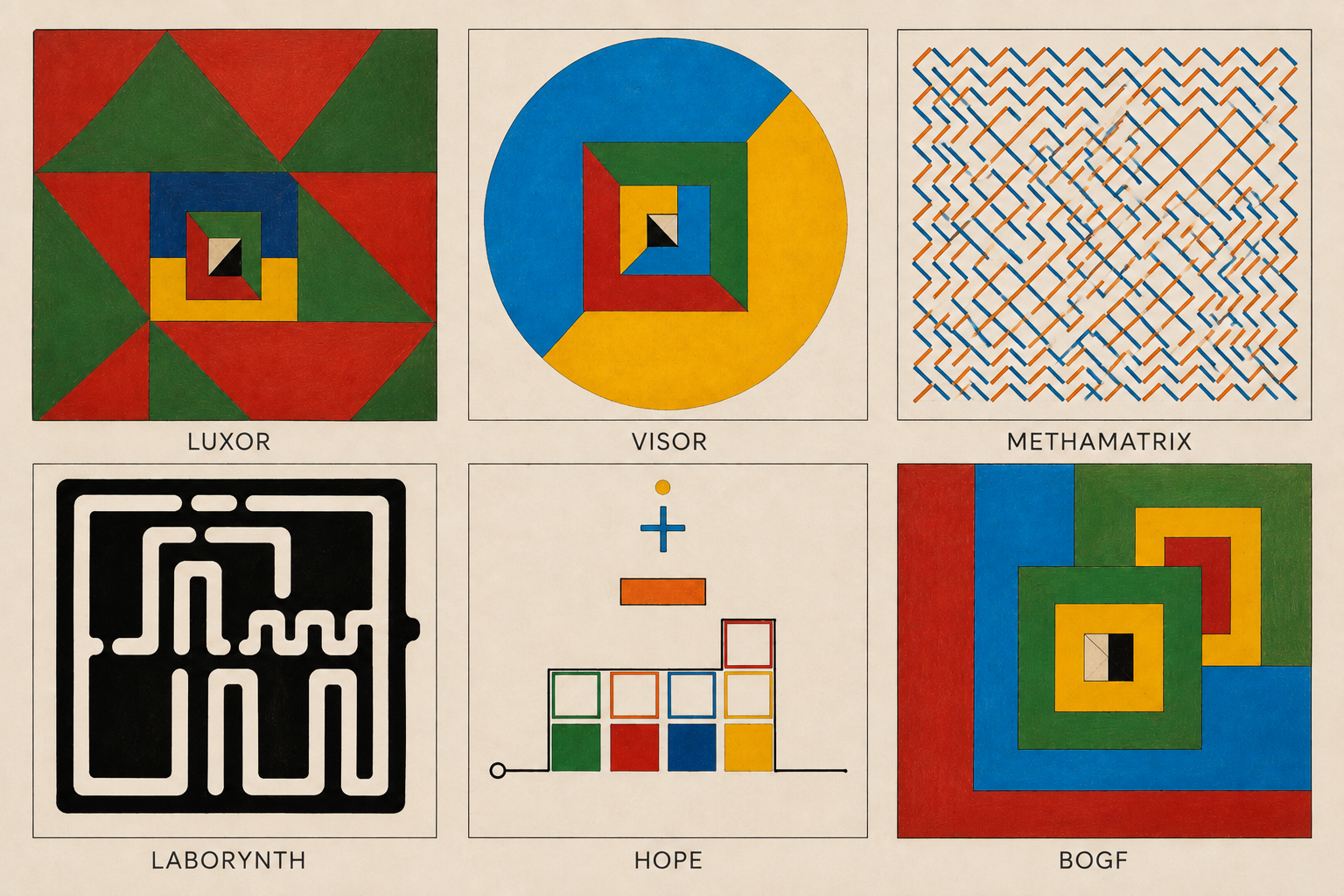
Luxor and Visor, some of multiple registered CoCs
The work begins from a central opposition of presence and absence. At the centre, black and white form the smallest possible visual decision: mark and void, object and non-object, assertion and withdrawal. From that centre, the geometry unfolds through angle and counter-angle, producing a square-spiral relation. The structure then expands into colour, where RGBY emerges not as applied decoration but as a chromatic consequence of the underlying oppositions. The final opposition is formal: square against circle, edge against curve, chamber against field.
The object therefore proceeds through four formal stages:
presence / absence -distinction
angle / counter-angle - direction
colour / counter-colour - choice
square / circle - form
These stages are not presented as symbolic illustrations. They are built into the object’s visual operation. The observer may encounter it as a colour theorem, a Bauhaus-like design, a browser-icon memory, a mandala, a toy, a portal, a painting, a tile, a mosaic, a light object, or a surface pattern. None of these readings exhausts the object. None is entirely arbitrary.
This is the sense in which CoC is a Conscious object Choice. The title deliberately reverses the more descriptive phrase “Conscious Choice Object.” The object is not merely something chosen by the observer; it is also a structure that offers choice back to the observer. The experience is constrained by geometry, colour and proportion, but the final act of interpretation remains open.
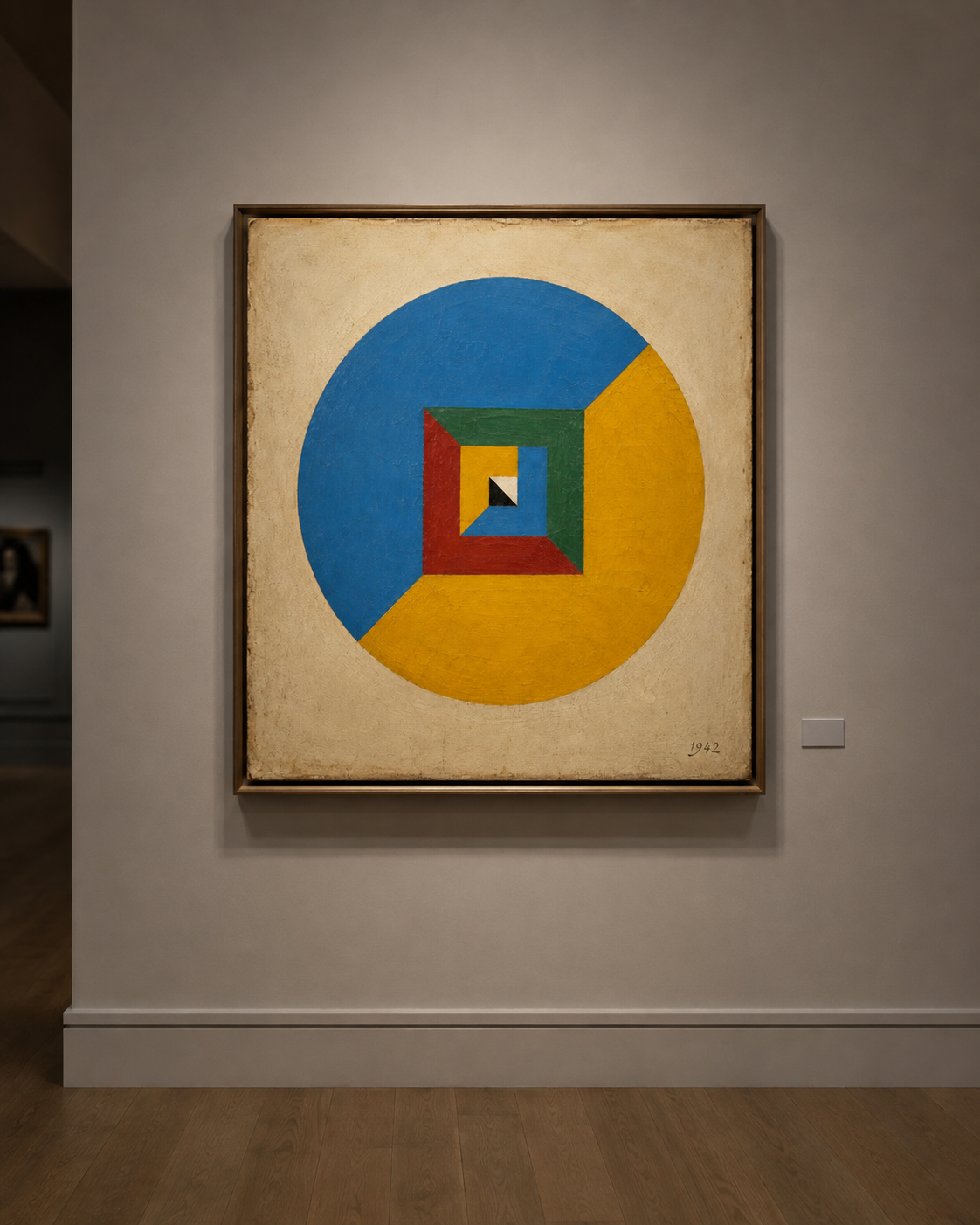
1942, one of 1/100 of the available limited series of CoC Forgeries
The phonetic instability of CoC is intentional. As with BOGF, which plays against BOGOF, the title belongs to a wider MetaMathics policy of serious wordplay. Language is allowed to behave like geometry: folding, reversing, misdirecting and producing more than one register at once. The joke is not separate from the work. It is part of the work’s mechanism.
MetaMathics / MetHaMataTac Commission Context
CoCs are registered rule models, part of the wider MetaMathics / MetHaMataTac field of geometric morphologies: a developing commercial and artistic collaboration in which source designs may be printed, commissioned, translated, fabricated or handmade by participating artists and makers for commission or manufacture, shipment, resale and installation.
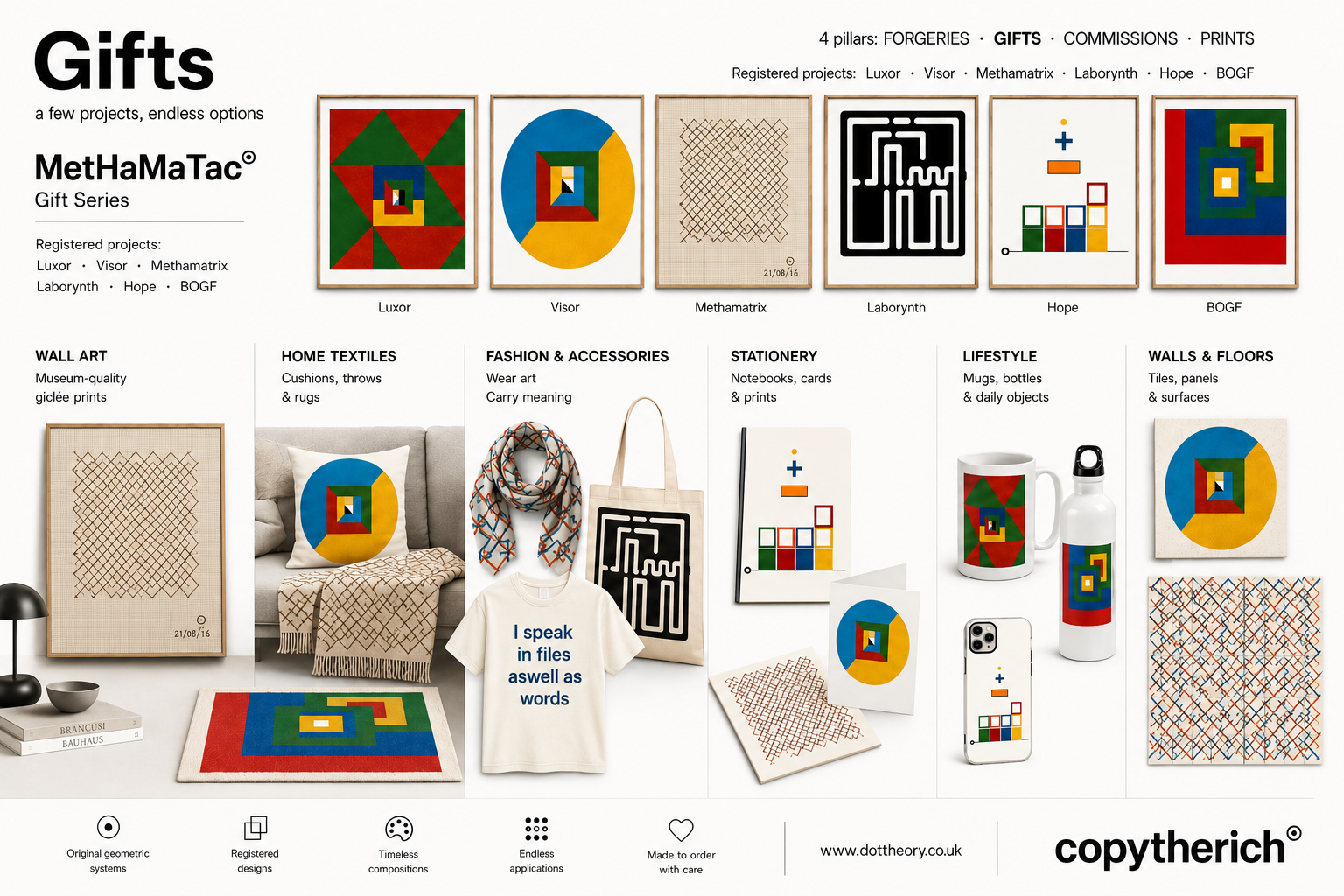
A range of purchasable decorative objects with donation-based provenance supporting this collaborative project.
The proposition is simple. A design begins as a localisation object: a bounded visual structure with its own internal rules, proportions and generative behaviour. That object may then be carried into different media. It may become a print, a rug, a tile, a light sculpture, a stained-glass panel, a ceramic surface, a textile, a mural, a furniture object, a book-cover identity, or a handmade commissioned artwork.
The commissioner does not simply choose “what is depicted.” The depiction is already governed by the source object. What may be chosen is the mode of rendering: material, scale, surface, colour treatment, ageing, craft tradition, printing method, and degree of historical or contemporary translation. In that sense, the work sits between viewer, authored geometry, and commissioned interpretation.
This also allows for what may be called Forgeries: not counterfeit works of existing originals, but deliberately anachronistic renderings and interpretations of CoCs that exploit artisan skills and context. A MetHaMathics object may be produced as if it belonged to another period: a pre WWII abstraction, a Victorian Arts and Crafts panel, a period poster or fresco, a poolside mosaic, a 1970 Electropop vinyl record sleeve, or a future domestic object (lightswitch). The source geometry remains fixed, while the historical skin changes and the object perhaps becomes interesting.
Within this framework, Vetruva, MetHaMatrix, BOGF and CoCs in general are not only visual studies. They are commissionable objects. Each may be printed, fabricated, interpreted by collaborating artists, or developed through craft collaboration in a manner to suit the purchaser. The same object can therefore exist as drawing, record, edition, commissioned sculptural artwork, or material experiment.
The purpose is to not erase the difference between artist, designer, maker and observer. It is to make that difference visible and honest in one movement. MetaMathics treats the source object as a shared rule-field. Each rendering then becomes a situated answer to that field: exact, handmade, printed, playful, historical, luxurious, domestic, architectural, or deliberately strange. A system that benefits from the chosen expertise of each party and where commissions produce the continuation of skill.
Short Website Intro Version
CoC — Conscious Object Choice is a MetaMathics object generated through four formal oppositions: presence and absence, angle and counter-angle, colour and counter-colour, square and circle. Its RGBY field is not treated as surface decoration, but as the visible consequence of a black-and-white centre unfolding into choice.
The work belongs to the MetHaMataTac commission framework, where geometric source objects may be printed, handmade, fabricated, aged, re-skinned, or interpreted by participating artists and makers. Alongside Vetruva, MetHaMatrix and BOGF, CoCs can exist as licensed print, tile, rug, stained glass, light sculpture, mosaic, painting or commissioned objects of all manner. The purpose is to provide the buyer something they will enjoy looking at, their own way. Bespoke your life, and support skills. Copy the rich.
The title is deliberately unstable. Serious as notation, comic as sound, CoCs continues the project’s use of wordplay as structure. The object offers the observer a constrained but undetermined act of interpretation: a conscious choice produced by an object that also appears to choose back.