Perspectival Dexterity
Perspectival Dexterity: Can We Learn to Move Deliberately Between Ways of Being in Reality?

A testable proposal for metacognitive navigation between immersive, analytic and culturally constituted frames
Imagine being asked to write a laboratory report in English with your left hand while writing a heartfelt poem in Italian with your right.
Now imagine doing both in mirror-writing when showing off.
The remarkable thing would not be that either activity is possible, we are accustomed to their independent presence and human beings already write scientific reports, compose poetry, speak different languages and use both hands. The remarkable thing would be the dexterity required to maintain two different systems of rules deliberately, move between them without confusing them, and know which system one is operating in at any particular moment.
There may be a psychological equivalent. The simple physical one is rubbing your stomach while tapping your head.
So nothing novel, human beings routinely move between different ways of experiencing and describing reality. We become absorbed in films, music, sport, relationships, religious ritual, games and imagination. We can experience fear while knowing that the play is fictional. We can become emotionally possessed by an argument and later analyse the same argument almost as though it belonged to somebody else. Scientists learn to turn experience into observations. Clinicians move between another person's suffering and differential diagnosis. Actors deliberately enter and leave constructed worlds. Bilingual speakers move between languages that do not divide experience in precisely the same way. Artists alternate between making, feeling and criticising.
Most of these capacities have substantial literatures of their own.
What appears less well developed is the expression of the possibility that navigating between such modes is itself a variably licensed innate and developed human skill.
I propose calling that skill perspectival dexterity.
It is not simply intelligence, emotional control, objectivity, empathy, imagination or cognitive flexibility. It is the capacity to recognise a currently operative perspective; deliberately enter, sustain or leave it; adopt another perspective governed by different assumptions or representational rules; and preserve enough metacognitive awareness not to mistake one frame's local interpretation for the only possible description of what occurred.
That proposition is expansive in implication but surprisingly simple to test.
We already know many of the component abilities exist
Psychology has, in fact, approached the phenomenon repeatedly from different directions.
Research on decentering describes the capacity to shift experiential perspective from being within a subjective experience to taking that experience itself as an object of awareness. Bernstein and colleagues locate this capacity in meta-awareness, reduced identification with internal experience and reduced reactivity to thought content. It is sufficiently established that state and trait measures of decentering have subsequently been developed.
Self-distancing research makes a related distinction between reflecting on an event from an immersed perspective and viewing it from greater psychological distance. A systematic review and meta-analysis of experimental studies found a modest advantage for self-distanced reflection in particular circumstances.
There is neurological evidence that different forms of self-reference can also be experimentally distinguished. Farb and colleagues contrasted narrative self-reference with attention to immediate experience and reported different patterns of neural recruitment; importantly, mindfulness training altered participants' ability to differentiate these modes.
Executive-function research gives us cognitive flexibility: the readiness to switch selectively between mental processes in response to changing demands. Task-switching research has consequently spent decades measuring switching costs, interference, preparation and control.
Emotion research distinguishes affectively loaded “hot” cognition from relatively non-affective “cold” cognition. The distinction is not absolute, but different neural systems and task demands are sufficiently reproducible for it to be useful experimentally.
At the opposite pole from distancing lies absorption. People vary in their propensity to become deeply immersed in sensation, imagination and narrative. Narrative transportation combines attention, imagery and affect and can be experimentally influenced; absorption is also a measurable individual-difference variable.
Language gives an unusually tangible example. Bilingual humans continually select between representational systems. Language switching recruits cognitive-control processes, and repeated experience can shape how those processes operate.
Culture provides another. Bicultural frame-switching research has demonstrated that culturally meaningful cues can bring different interpretive frameworks into operation.
And philosophy has been here too. Contemporary work on perspectival flexibility describes active perspectives that can shift rapidly while being constrained by more slowly changing cognitive, perceptual, emotional and agential structures. Schellenberg's recent account is particularly close to the territory considered here.
Phenomenology goes further by turning the change of standpoint into a disciplined method. The Husserlian epoché or “bracketing” asks the investigator to suspend the ordinary natural attitude and redirect attention toward experience and the manner in which it appears. In psychological phenomenology this is explicitly something researchers learn to practise; neurophenomenological approaches have even proposed training experimental participants in a “practical epoché”.
None of these literatures is identical.
That is precisely the point.
They appear to describe different regions of an underdefined larger navigational landscape.
From flexibility to dexterity
Calling this phenomenon merely “cognitive flexibility” loses something important.
A person may switch efficiently between sorting numbers by colour and sorting them by shape while remaining poor at stepping outside an emotionally engulfing argument.
Someone may be extremely capable of decentering from emotion but comparatively incapable of allowing themselves to become absorbed in fiction, music or intimacy.
A scientist may be excellent at analytic abstraction but have difficulty recovering the first-person significance of what a patient is describing.
An actor may enter a fictional perspective with extraordinary fluency without necessarily possessing unusual formal reasoning ability.
A bilingual interpreter may perform rapid language and cultural switching while another person of equal general intelligence finds such translation exhausting.
The interesting property is therefore not simply flexibility.
It is dexterity across frames.
For present purposes, a frame can be understood modestly as a locally coherent representational system containing some combination of:
what counts as an object;
which distinctions matter;
which evidence is salient;
what language is appropriate;
which relations are meaningful;
which emotional or bodily signals are privileged;
and which inferences are legitimate.
In ordinary speech we might call some of these “world views”. Philosophy might call them perspectives or ontologies. Psychology may describe them as task sets, schemas, construals or modes of processing.
The proposal does not require those vocabularies to be equivalent.
It requires only that human beings can sometimes recognise and navigate the differences between them.
A testable construct
Perspectival dexterity should not initially be reduced to a single score.
It can instead be treated as a multidimensional ability.
Consider an event O, experienced or represented under frame F₁. The resulting description D under generating function/operator G is:
D₁ = G(O | F₁)
The same event encountered under another admissible frame F₂ may yield:
D₂ = G(O | F₂)
The critical operation is not D₁ or D₂.
It is transition T:
T₁→₂ : F₁ → F₂
—the controlled transition between them.
That transition can be measured.
At least six dimensions appear immediately plausible:
1. Access
Can the person actually enter both requested perspectives?
2. Switching cost
How much time, cognitive effort or performance loss occurs during the transition?
3. Frame fidelity
Once the new frame is adopted, can the individual reason according to its rules rather than merely relabelling the previous interpretation?
4. Cross-frame contamination
How much of the previous frame remains inappropriately embedded in the next?
5. Meta-awareness
Does the individual recognise which perspective is currently active and what assumptions accompany it?
6. Translation fidelity
Can information be carried between frames without either pretending the frames are identical or losing what should legitimately be preserved?
These are behavioural questions.
They do not require a speculative new brain module.
The experiment is almost embarrassingly straightforward
A participant could encounter the same underlying situation repeatedly under different instructions.
One condition might ask them to experience a short narrative or VR scenario as fully and personally as possible.
Another might ask for an emotionally neutral observational report.
Another might require interpretation from the position of another participant.
Another might ask for a scientific description.
Another could require a legal, artistic or culturally unfamiliar frame.
Participants could then be instructed to switch between them, sometimes predictably and sometimes without preparation.
Measurements might include:
switching latency;
accuracy;
linguistic markers;
recall;
physiological arousal;
eye tracking;
confidence;
metacognitive calibration;
emotional carry-over;
and, where justified, EEG or neuroimaging.
Critically, immersion and distancing should both be measured.
The hypothesis is not that emotionally detached analysis represents a superior human condition.
A person who can leave an emotional experience but cannot genuinely enter one may be no more dexterous than someone who can become deeply immersed but cannot step outside it.
Mastery should therefore look more like:
controlled bidirectionality.
Handedness as metaphor
This is where the handedness analogy becomes useful.
Most people can use both hands, but not equally well. Preference, practice, development and biological constraints interact. A practised musician, surgeon or craftsperson may develop capacities unavailable to an untrained person without thereby changing species.
Perspective may work in an analogous way.
Some people may possess a strong immersive preference.
Others an analytic preference.
Some may be competent in both but incur a large switching cost.
Others may switch rapidly but poorly, carrying assumptions from one frame into another.
A smaller group still perhaps may develop something approaching ambidexterity: the ability to enter either mode deeply and move between them deliberately.
The analogy should stop there. Nothing presently establishes a neurological equivalent of left- or right-handedness for this proposed construct.
But it suggests an experimentally useful distinction between:
preference,
proficiency, and
switching skill.
Those are often mistakenly treated as the same thing.
Training should matter
If perspectival dexterity is a skill, experience should alter it.
There is already reason to take that possibility seriously.
Cognitive flexibility develops over childhood and can be trained, although transfer effects are heterogeneous.
Mindfulness and metacognitive interventions train decentering and meta-awareness.
Bilingual experience repeatedly exercises language selection and switching.
Phenomenological researchers explicitly train changes of attentional stance.
Actors, musicians, writers, clinicians, scientists, interpreters and meditators may therefore provide naturally occurring expert populations in whom different components of perspectival dexterity could be investigated.
Importantly, expertise should not be expected to produce one universal profile.
The expert scientist may have unusually high analytic frame fidelity.
The actor may demonstrate exceptional immersive access.
The interpreter may show reduced switching costs.
The clinician may demonstrate unusual bidirectional movement between empathic engagement and analytic classification.
These become empirical questions rather than personality stereotypes.
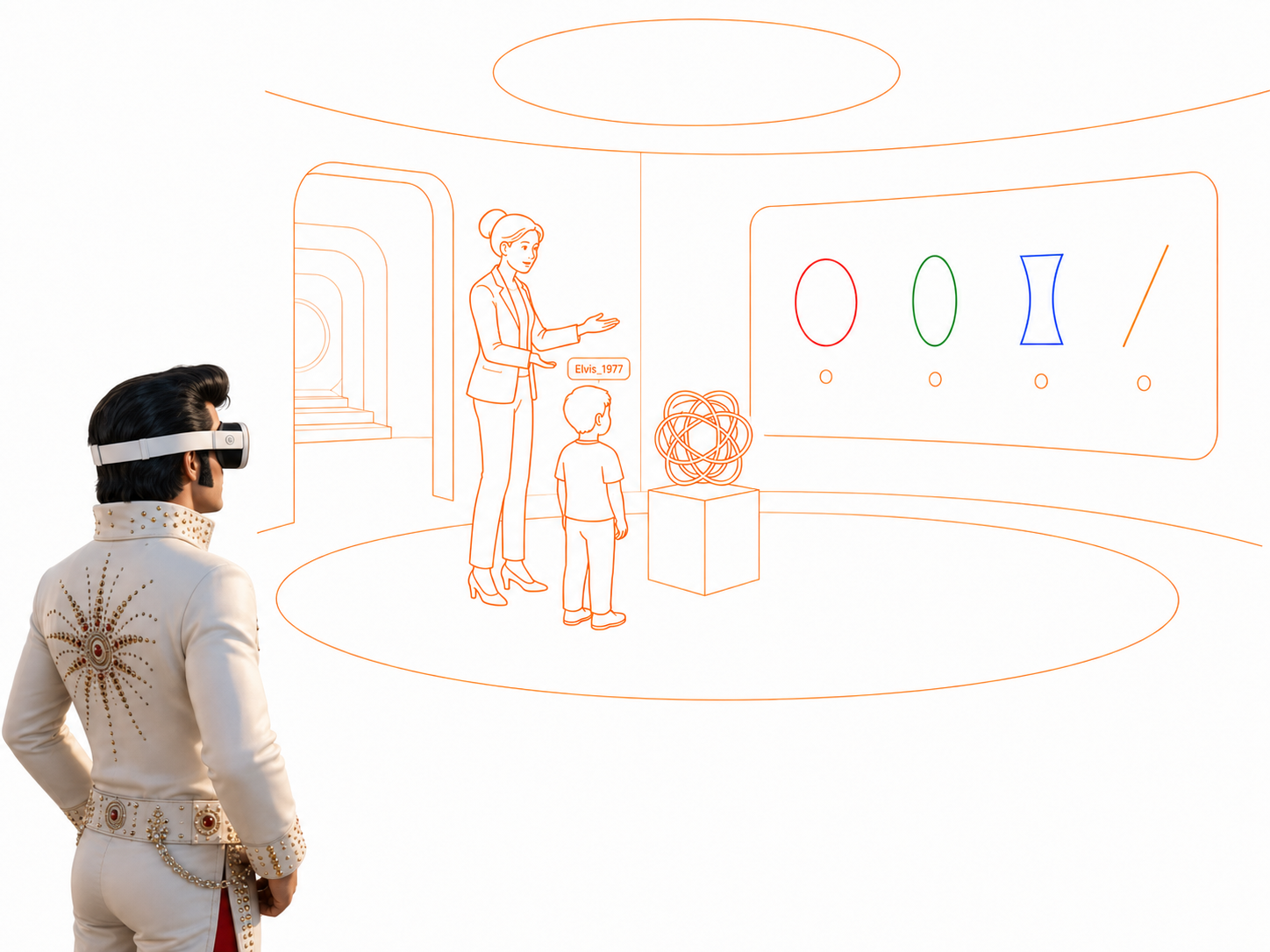
Metaverse-sized maps
The idea becomes particularly interesting when frames become much larger than laboratory task sets.
Entering a language is not simply substituting vocabulary.
Entering a discipline is not simply learning terminology.
Entering a culture, game, religion, legal system, scientific field or virtual world can mean learning an interconnected system of objects, rules, expectations and meanings.
Those are, figuratively, metaverse-sized maps.
The skilled navigator does not need to believe that every map is equally true.
They need to know which map they are currently using.
This suggests a distinction with immediate relevance to education.
Education usually measures whether somebody has learned the content of a discipline.
Perspectival dexterity asks whether they can enter its epistemic stance.
Can a student move from:
“I feel that this happened”
to:
“This is what I observed”
to:
“This is what the evidence licenses me to infer”
and then return to:
“This is what the experience meant to me”
without confusing those statements?
That is not merely knowledge.
It is navigation between kinds of knowing.
Research on epistemic cognition already studies how people think about what they know, how knowledge is justified and how epistemic standards vary across contexts.
Perspectival dexterity adds a motor-like question:
How well can the person actually move between those epistemic positions?
A clinical implication—and a warning
The clinical possibilities are obvious, but so are the dangers.
Excessive immersion may contribute in some circumstances to rumination, emotional capture or inability to distance from thoughts.
Excessive detachment may be maladaptive too.
Distancing is not automatically healthy, and immersion is not automatically pathological.
The relevant construct would therefore be context-sensitive control, not maximal detachment.
This aligns with broader work on psychological and regulatory flexibility, which increasingly emphasises appropriate adjustment to circumstances rather than declaring any single strategy universally superior.
Psychedelic research provides an instructive caution. Although changes in psychological or cognitive flexibility are frequently proposed as mechanisms of psychedelic effects, systematic reviews report mixed findings, particularly during acute states. “More flexible” cannot safely be treated as a synonym for “better”.
The same restraint should govern perspectival dexterity.
A skilled navigator is not someone permanently liberated from a perspective.
It is someone capable of using the appropriate one and knowing enough to leave it when required.
What this would permit us to systematise
If the construct survives experimental testing, it offers something useful even without becoming a new clinical trait scale.
It gives systematic reviews a common classification problem.
Existing studies could be mapped according to whether they measure:
entry into a frame;
depth of immersion;
exit from a frame;
switching cost;
perspective fidelity;
meta-awareness;
or
translation between frames.
Research presently distributed across executive function, mindfulness, narrative psychology, bilingualism, phenomenology, clinical psychology, social cognition, VR, education and consciousness studies could then be compared without pretending that their existing constructs are interchangeable.
That is perhaps the most conservative version of the proposal.
It is a classification architecture before it is a psychological theory.
If the classifications subsequently predict common individual differences, training effects or neural constraints, the construct earns stronger standing.
If they do not, the proposed unification should be abandoned or restricted.
The information-theoretical consequence
There is one further implication.
Our digital systems increasingly collect descriptions of people without adequately distinguishing the standpoint from which those descriptions were generated.
A frightened patient's report, a clinician's observation, a wearable measurement, an AI inference and a retrospective reflective account can all become database fields.
They are not the same kind of object.
If perspectival state matters, then the conditions under which information was produced become part of the information required to interpret it.
This does not mean computers should diagnose users as “subjective” or “objective”.
Quite the opposite.
The ethical implementation would treat perspective as state and provenance, not essence.
A system might allow an individual to provide:
an experiential description;
an analytical description;
an external measurement;
and a later reflection,
while preserving the distinction between them.
An AI system could similarly be instructed:
listen with me;
analyse this with me;
show me the difference;
or:
translate what I said in one mode into the questions that become relevant in another.
The user would remain sovereign over whether those representations were connected.
In healthcare, education and future immersive environments, that may prove far safer than collapsing every representation into one supposedly comprehensive digital person.
A provocative but falsifiable proposition
The proposal can therefore be stated quite narrowly:
Humans differ not only in the perspectives they habitually adopt, but in their ability to deliberately enter, sustain, exit and translate between differently constituted experiential and epistemic frames. This perspectival dexterity is partly trainable, constrained by identifiable cognitive and biological processes, and measurable independently of proficiency within any single frame.
That statement could be wrong.
Perhaps the apparent commonality will disappear once general executive function, intelligence, personality, language proficiency and absorption are controlled.
Perhaps there is no domain-general dexterity at all—only a collection of separately learned skills.
That is an especially important alternative hypothesis.
Perhaps a scientist's ability to alternate between clinical empathy and analysis predicts nothing whatsoever about their capacity for cultural frame-switching, immersive VR or self-distancing.
If so, the grand construct should fail.
But if individual differences in switching itself recur across sufficiently different domains—and especially if those differences change predictably with training—then something interesting has been identified.
Not another ontology.
A human ability to navigate among them.
And that would make the metaphor of two-handed writing rather less fanciful.
The virtuoso would not be the person who always sees the world objectively, nor the person who experiences it most deeply.
It would be the person capable of becoming absorbed in the poem, stepping outside it to examine its construction, translating it into another language, returning to the experience—and knowing, throughout, which operation they are performing.
That is a skill often referred to as left and right “brainedness”.
The open scientific question is whether it is also a measurable one.
Selected references
Bernstein, A., Hadash, Y., Lichtash, Y., Tanay, G., Shepherd, K. & Fresco, D. M. (2015). Decentering and related constructs: A critical review and metacognitive processes model. Perspectives on Psychological Science, 10, 599–617.
Dajani, D. R. & Uddin, L. Q. (2015). Demystifying cognitive flexibility: Implications for clinical and developmental neuroscience. Trends in Neurosciences, 38, 571–578.
Farb, N. A. S. et al. (2007). Attending to the present: Mindfulness meditation reveals distinct neural modes of self-reference. Social Cognitive and Affective Neuroscience, 2, 313–322.
Green, M. C. & Brock, T. C. (2000). The role of transportation in the persuasiveness of public narratives. Journal of Personality and Social Psychology, 79, 701–721.
Hong, Y.-Y., Morris, M. W., Chiu, C.-Y. & Benet-Martínez, V. (2000). Multicultural minds: A dynamic constructivist approach to culture and cognition. American Psychologist, 55, 709–720.
Kross, E. and related self-distancing literature, synthesised in the 2022 systematic review and meta-analysis of self-distanced versus self-immersed reflection.
Luk, G., Green, D. W., Abutalebi, J. & Grady, C. (2012). Cognitive control for language switching in bilinguals: A quantitative meta-analysis of functional neuroimaging studies. Language and Cognitive Processes, 27, 1479–1488.
Schellenberg, S. (2025). The flexibility and stability of perspectives. Proceedings of the Aristotelian Society, 125, 62–83.
Wong, V. C. & Wyer, R. S. (2016). Mental traveling along psychological distances: The effects of cultural syndromes, perspective flexibility, and construal level. Journal of Personality and Social Psychology, 111, 17–33.