Experimental MetaMathics
MetaMathics
Experimental Geo-Morphology: Localisation Objects in MetaMathics
Exhibition Proposal
Exhibition Discussion 1
Form, function, math and perspective. One object of inquiery
This exhibition proposes that geometry may be experienced not merely as an abstract mathematical language, but as a perceptual event. Rather than presenting geometry as a collection of fixed objects, Experimental Geo-Morphology invites visitors to encounter geometry as something that continually reconstructs itself through observation.
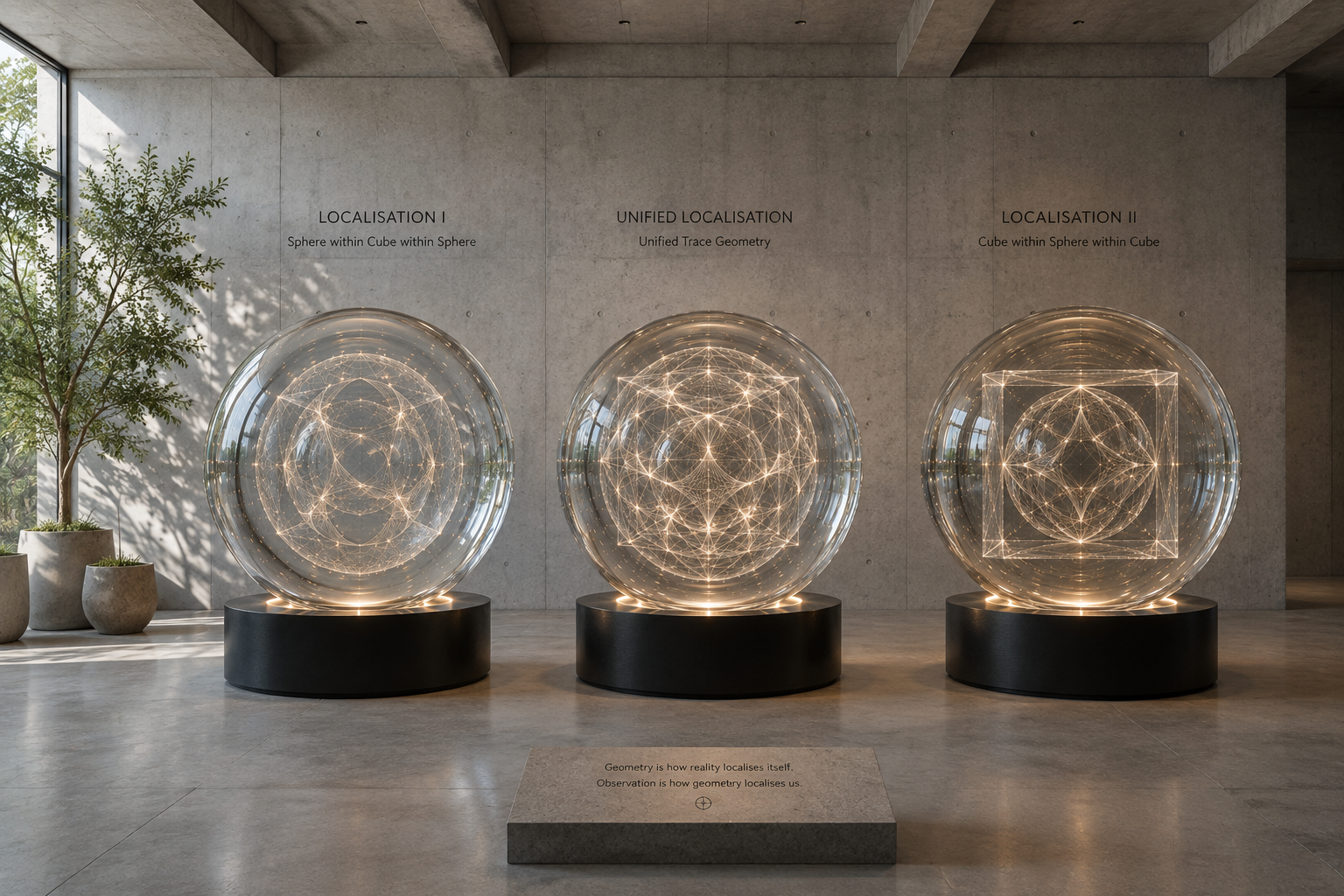
At the centre of the exhibition stand three monumental optical crystal spheres, each approximately one metre in diameter. Their interiors are laser-engraved with geometries derived from recursive localisation structures developed within the emerging discipline of Metamathics—the study of consciously constructed mathematical objects whose behaviour arises through fractal and recursive observation and computation.
The three works form a stereoscopic triptych.
Localisation I presents a sphere within a cube within a sphere. Its geometry privileges continuity. Curved structures appear to generate angular ones before returning to curvature. Visitors commonly report that the object seems to breathe and change meaning as they move around it, with internal relationships constantly reorganising themselves.
Unified Localisation occupies the central position. Here the line systems of the first and third objects have been superposed into a single coherent geometry. Neither spherical nor cubic organisation dominates. Instead, both coexist simultaneously, producing a perceptual state in which the eye is unable to settle upon a unique interpretation. The object behaves almost like a standing wave of possible geometries. Pregnant with possibility yet devoid of meaning.
Localisation II reverses the hierarchy. A cube within a sphere within a cube establishes an angular ordering that gradually dissolves back into continuous curvature. Where the first object suggests curvature generating structure, the third suggests structure generating curvature.
The three objects are not intended as representations of mathematical ideas. They are themselves mathematical experiments generating internal variation toward each.
The crystal spheres exploit the optical properties of refraction, internal reflection and volumetric laser engraving. As the observer changes position, the internal geometry undergoes continuous apparent transformation. Different visitors frequently describe different structures occupying the same physical space under different terms. The exhibition therefore presents observation not as passive reception but as active and context-dependent localisation.
In this sense, the exhibition investigates what might be called experimental geo-morphology: the study of how geometrical forms emerge, transform and stabilise sentiment through recursive acts of observation.
Observation as Medium
Most sculpture is defined by matter.
These works are defined equally by perception.
The engraved lines remain physically fixed, yet the geometry experienced by the observer continuously changes. The artwork therefore exists partly within the crystal and partly within the visual system of the viewer.
Some visitors may perceive nested spheres.
Others discover rotating cubes.
Others see woven lattices or continuously folding topologies.
None of these observations is necessarily privileged. The exhibition instead asks whether geometry itself is partially constituted through localisation and our individual relationship with its representation.
Metamathics
The exhibition introduces Metamathics as an experimental artistic and scientific discipline. Not an unexpected byproduct of curiosity, on consideration but an unusual approach to thinking about geometry, shape and the way they acquire meaning and function in our lives.
Metamathics studies mathematical objects that are consciously constructed not simply for proof, but for experience. Its objects are intended to be explored computationally, perceptually and physically. Their significance lies not only in formal structure but also in the behaviours they induce within observation itself.
The works therefore occupy an unusual position between mathematics, sculpture, optics, cognitive science, psychology and philosophy.
They are simultaneously:
mathematical constructions,
optical instruments,
perceptual experiments,
and sculptural objects.
The Visitor
Visitors are not merely spectators.
They become localised variables within the experiment.
As they walk around the spheres, their position continuously modifies the geometry they perceive. The installation quietly demonstrates that observation possesses its own internal dynamics. Geometry appears not as a static language but as an evolving negotiation between object, light and observer.
Many visitors may find themselves standing before the works far longer than expected or find themselves uncomfortable. Eyesight, ocular dominance, neurological disposition all change the experience. The eye continually attempts to stabilise the internal structure, only for a new interpretation to emerge moments later.
The experience can become almost meditative.
Or disorienting.
Or unexpectedly beautiful.
Closing Statement
Experimental Geo-Morphology proposes that geometry may be something we humans constitutionally inhabit rather than merely describe.
If mathematics traditionally studies invariant structure, then Metamathics asks a complementary question:
What mathematical objects emerge when observation itself becomes part of the construction?
The exhibition does not attempt to answer that question conclusively.
Instead, it offers visitors the opportunity to experience it directly and wonder whether we are of the matrix as the matrix is of us.
Exhibition discussion 2
The MetHaMatrix continues the unhealthy play with words, expressing eccentricity more commonly associated to the underground art scene.
Laborynth
Laborynth — MetaMathics / MetHaMatrix Demonstration Note
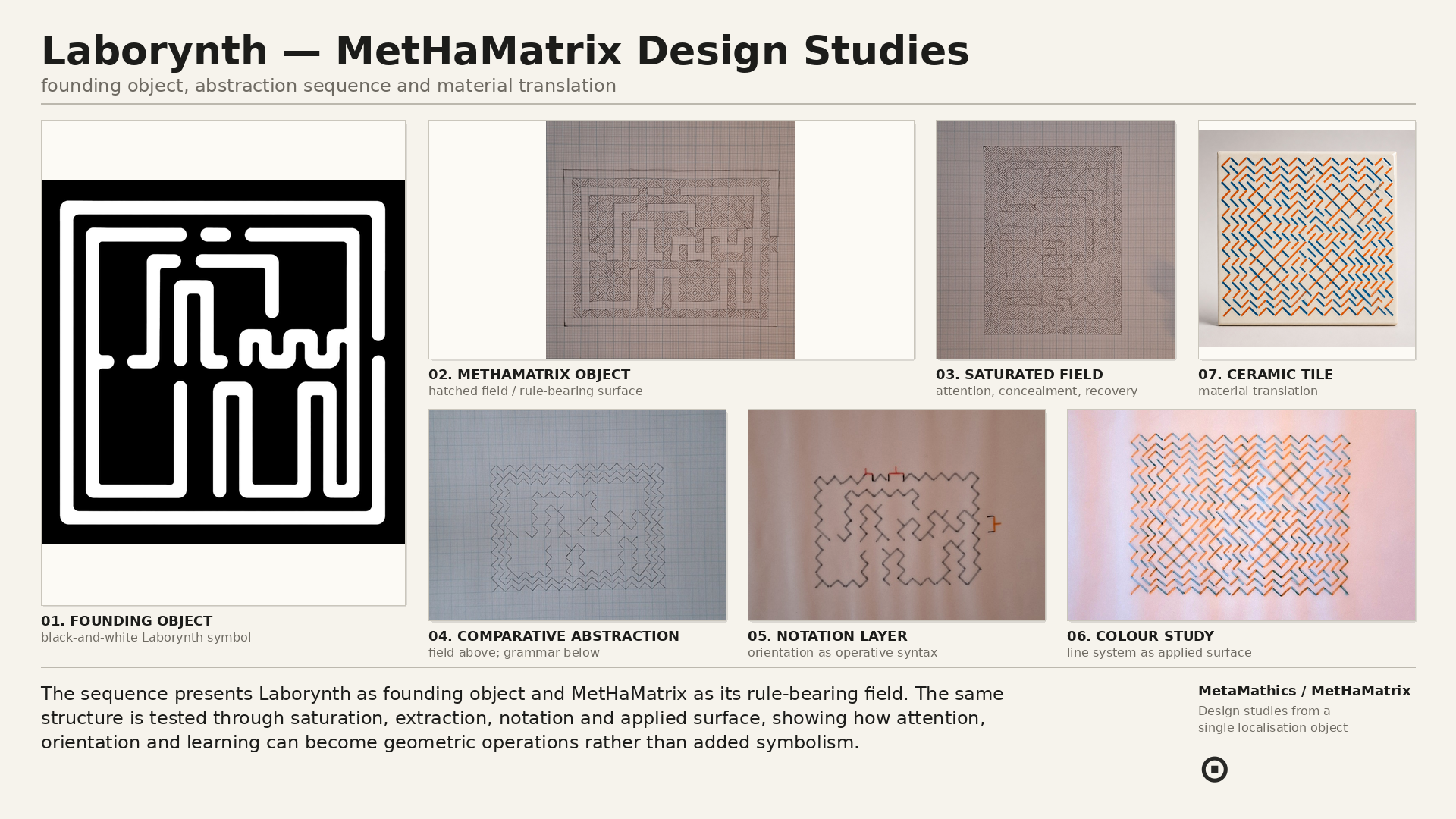
Laborynth is used here as a source object within the MetHaMatrix series. The work begins from a bounded labyrinth structure and follows its development through a sequence of visual and material studies. These studies treat the original object not as a fixed image, but as a geometric arrangement whose features can be extracted, reduced, repeated and translated.
The main operations explored are passage, boundary, orientation, interruption, concealment and return. In the hatched studies, the route becomes less immediately visible and the surface becomes a field of attention. In the line studies, the same structure is reduced further into directional marks and recurring turns. In the applied studies, those marks are transferred into ceramic, textile, glass, metal and furniture proposals.
The sequence is intended to show how a single geometric object can change register while retaining recognisable internal relations. The hatching is therefore not treated only as texture, but as a directional system. The concealed entrance is not treated only as a compositional detail, but as a point at which observation becomes necessary. The simplified line versions are not treated only as reductions, but as attempts to identify the rule-pattern from which the fuller object may be reconstructed.
This is the MetaMathics element of the demonstration. The drawings and derived objects are used to test what remains stable when a form is translated between image, notation, surface, object and space. Rather than separating art, design and geometry in advance, the series observes how the same structure behaves under different conditions of presentation.
The resulting works are intentionally quiet. They do not depend on explicit symbolism. Their effect comes from recurrence, deviation, orientation and material change. Laborynth therefore functions here as both source image and test object: a geometric structure through which attention, observation and learning can be examined visually.
I would use this version if you want it to sit more comfortably on the website. It is less performative, less curatorial, and more like a controlled research/design note.
One even more reduced version would be:
Laborynth — MetaMathics / MetHaMatrix Demonstration Note
Laborynth is used here as a source object within the MetHaMatrix series. The original work establishes a bounded field of passage, interruption, orientation and return. The studies shown alongside it examine how that field can be reduced, repeated and translated into other visual and material forms.
The sequence moves through several levels of abstraction. The hatched versions convert the labyrinth into a dense field of directional marks. The reduced line versions extract the underlying grammar of turns, edges and concealed entry points. The applied studies test the same relations as ceramic, textile, glass, metal and furniture proposals.
The demonstration is concerned with what remains recognisable when a geometric structure changes medium. Hatching becomes more than surface texture; it becomes a system of directional information. The entrance becomes more than an opening; it becomes an observational condition. The later abstractions become more than simplifications; they indicate how the fuller structure may be reconstructed.
Within MetaMathics, this is treated as a practical exercise in geometric translation. A form is observed not only as an image, but as a set of operations capable of producing further forms. Laborynth therefore functions as both object and method: a quiet study of attention, observation and learning through structured visual change.