25 November 2026 | Scientific Research & Publications
What entitles us to say that something is scientifically and communicably true?
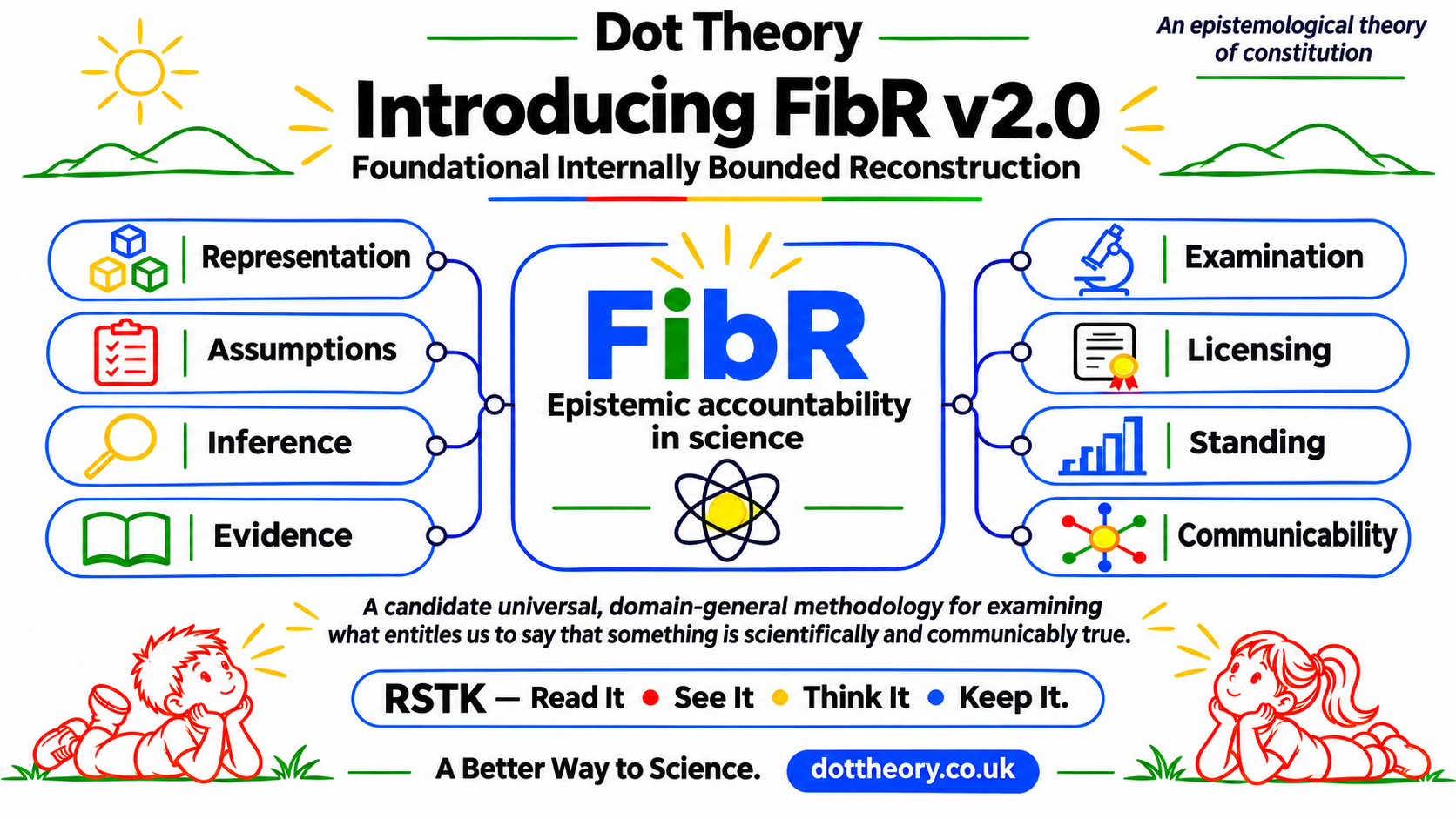
Diana Haskins and Stefaan Vossen are pleased to announce the publication of FibR v2.0 — Foundational Internally Bounded Reconstruction, a candidate universal, domain-general methodology for epistemic accountability in science.
Why FibR?
Science has developed extraordinarily sophisticated methods for observing, calculating, modelling and predicting reality.
But how do we establish what those operations actually entitle us to conclude?
A mathematical proof, a computational result, a clinical measurement and a legal record may each be valid within their respective frameworks. What they mean beyond those frameworks is a different scientific question.
With the rapid development of artificial intelligence, this distinction is becoming increasingly consequential. Our ability to generate, manipulate and verify representations is advancing rapidly. Our ability to understand and govern what those representations entitle us to claim must develop alongside it.
FibR is proposed as a methodological contribution to that challenge.
What is FibR?
Foundational Internally Bounded Reconstruction is a proposed systematic and recoverable method for examining scientific inference.
It asks:
Where does an inference occur?
What premises and operations license it?
Within what boundaries does it retain its scientific standing?
Can its reasoning be independently recovered and examined?
What happens to that standing when a conclusion is transferred into another scientific or interpretive framework?
Not a methodology that tells science what is true, but one that examines what entitles us to say that something is scientifically and communicably true.
FibR does not require the adoption of a particular ontology, nor does it seek to replace existing scientific methods. Its proposed utility lies in making the grounds of scientific claims available for independent examination.
FibR and the Dot Theory Scientific Programme
Dot Theory, first proposed in September 2024, investigates the scientific governance of representation as a legitimate subject of theoretical and empirical inquiry.
Within the wider research architecture, FibR contributes a distinct methodological function alongside:
CCR — Canonical Constitutional Record: constitutional identity, provenance and preservation.
F O R M — Constitutional Verification Protocol: operational and instructional verification.
SEM — Scientific Epistemic Metrology: measurement and calibration of scientific claim-standing.
ViBEcognition — Generative Scientific Inquiry: a forthcoming practical manual for disciplined human–AI inquiry.
These contributions are not competing explanations of reality. They offer complementary methodological functions through which scientific representations and their relationships may be examined without requiring their underlying distinctions to collapse.
Dot Theory asks. CCR preserves. FibR examines. F O R M operates. SEM calibrates.
Local science supplies the ontology and the test.
Read, challenge and test
FibR is being published not as a claim to have resolved the problem of scientific truth, but as a scientific object through which that problem may be systematically investigated.
Its proposed universality and practical utility remain open to independent evaluation.
We invite scientists, mathematicians, philosophers, legal scholars, healthcare professionals and AI researchers to examine the methodology and assess its potential contribution to scientific practice.
Main publication
FibR v2.0 — Foundational Internally Bounded Reconstruction
Written to be understood by humans, not merely verified by machines.
Read the publication on Zenodo
Supplementary research records
Supplement 1 — Historical AI Examination and Self-Examination Records
Supplement 2 — Historical and Comparative Methodology Research Reports
Supplement 3 — Documentary Development Timeline and Research-Programme Context
RSTK — Read It. See It. Think It. Keep It.
A Better Way to Science.
For scientific enquiries and collaborative opportunities: stefaanvossen@gmail.com