Predictive Success Is Not Ontological Authority
On the Constitutional Limits of Mathematical Representation in Science. A Dot Theory Research Programme Position Statement
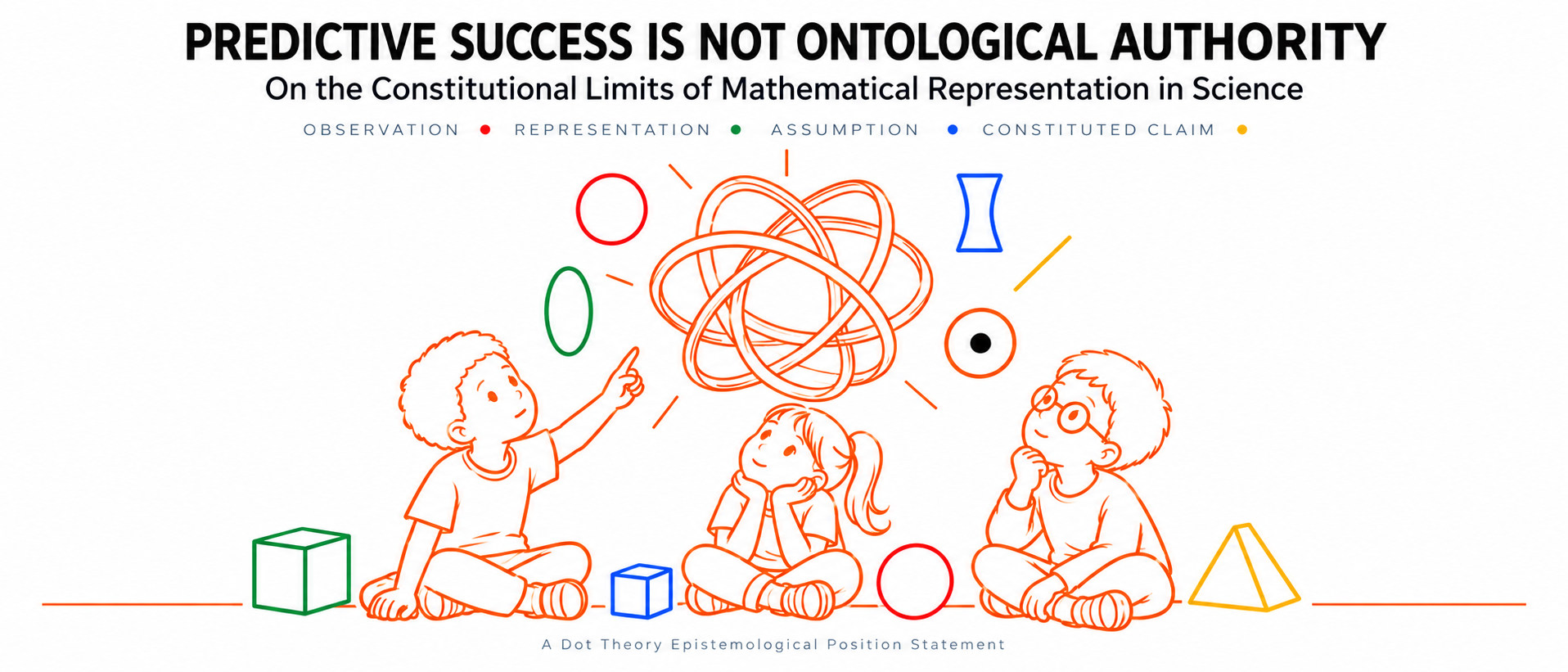
DOT THEORY — EPISTEMOLOGICAL POSITION STATEMENT 001
Document identifier: DT–EPS–001
Version: 1.0 — Public Position Statement
Date: 21 October 2026
Author: Stefaan Vossen ⊙
Affiliation: Dot Theory / Constitutional Physics
Publication: www.dottheory.co.uk
Scientific standing: A foundational epistemological positioning statement within the Dot Theory research programme. It establishes a proposed principle concerning the constitutional authority of scientific representations. It is not presented as an empirical discovery, a mathematical theorem or a refutation of any particular physical theory.
Predictive Success Is Not Ontological Authority
Scientific prediction and scientific ontology are not equivalent forms of knowledge.
A mathematical object may be indispensable to a successful calculation without thereby acquiring independent physical existence. The distinction depends on whether that object is being used as observationally constrained data, as a representation of data, or as a theoretical structure introduced to make the calculation possible.
This distinction is especially relevant to cosmology, but extends across all scientific disciplines employing formal and computational representations.
The use of positive and negative cosmological constants, de Sitter and anti-de Sitter geometries, and additional dimensions illustrates how different mathematical environments can support coherent theoretical investigations without necessarily establishing the physical existence of every structure they employ.
The choice of a mathematical environment can be legitimate, even necessary, for distinguishing a predicted signal from its background. But the necessity of that choice for a calculation within one representational space does not establish its necessity in physical reality, nor does it confer equivalent epistemological standing upon the representation and what it purports to describe.
Predictive adequacy does not entail ontological sufficiency.
The category error occurs when successful prediction is allowed to retrospectively transform the representational conditions of a calculation into independently established physical facts, without the additional evidential or inferential justification that such a transformation requires. It is silently inherited.
This does not invalidate speculative mathematics, theoretical physics or the further investigation of additional dimensions. It preserves their legitimate scientific standing without silently extending their authority.
Nor does an unresolved ontological question create an obligation to resolve it before an otherwise adequately established result can stand.
A scientific representation may remain incomplete relative to wider explanatory possibilities while being sufficiently constituted for its declared question and purpose. Such incompleteness neither automatically invalidates the result nor independently licenses its ontological extension.
The constitutional requirement is therefore straightforward: distinguish what was observed, what was represented, what was assumed and what was independently established.
This requirement applies equally to the epistemological framework making the distinction. No scientific or philosophical position acquires authority merely because its assumptions are inherited through established language, mathematical notation or disciplinary convention.
Alternative interpretations may remain constitutionally admissible where the declared conditions do not justify excluding them. Their admissibility does not make them logically identical, empirically equivalent or equally supported in every respect. Such standing must itself be specified and justified.
Science need not exhaust reality to constitute knowledge of it. Neither may its symbolic success be mistaken for authority over the reality it has not established.
The purpose of epistemological governance is not to constrain scientific imagination, but to preserve the distinction between the freedom to represent and the authority to assert.
Programme Context and Scientific Jurisdiction
This statement forms part of the continuing Dot Theory epistemological research programme originated by Stefaan Vossen and developed through Constitutional Physics.
Its immediate concern is the standing of scientific claims: how observations, symbolic representations, inferential operations and ontological interpretations are distinguished, related and granted legitimate scientific authority.
It is consistent with the programme's wider examination of observation, representation, recoverability, constitutional equivalence and the conditions under which scientific interpretations may be carried forward.
Relevant predecessor and associated programme objects include:
Dot Theory — the originating epistemological programme concerned with distinction, representation and the reconstruction of understanding. Its programme architecture, jurisdiction and local implementation are documented in the linked Zenodo corpus. The Name-and-Claim Logic provides an additional public statement of the programme's representational foundations.
Constitutional Physics and the Canonical Constitutional Record (CCR) — the documentary and methodological development of scientific claim-standing, provenance, constitutional relations and legitimate succession. Associated Constitutional Documentary Records preserve the programme's documentary governance materials.
F O R M / Constitutional Verification Protocol — a collaborative framework for examining scientific questions through Framework, Operator, Residual and Model.
On Collapse (4 September 2026) — an examination of operator-relative loss of distinction without requiring the ontological elimination of the underlying states.
The programme's Scholarly Positioning and Comparative Literature Review (CP-SPLR-001) provides a wider comparative scholarly context. Scientific Epistemic Metrology (SEM) is a related development candidate addressing the calibration, traceability and scientific standing of epistemic claims.
These relationships identify conceptual and methodological provenance. They do not establish that the present proposition has been experimentally validated, mathematically proved or independently endorsed by contributors to associated research.
The statement is intended to remain open to criticism, revision and further formalisation. Its publication establishes the author's declared epistemological position, not the empirical correctness of every theoretical interpretation discussed within it.
Programme References and Direct Sources
The following public records and website publications provide the principal documentary and conceptual context for this statement.
Canonical and programme-level records
Dot Theory Corpus — Programme Architecture, Jurisdiction & Local Implementation
Public programme architecture and jurisdiction record.
https://zenodo.org/records/23063830Canonical Constitutional Record — Constitutional Physics, Volumes I–III, v1.0
Canonical constitutional architecture and scientific claim-governance record.
https://zenodo.org/records/21535574Constitutional Documentary Records — CRM-001, CRR-001, CDR-001 and CAIR-001
Associated documentary governance and provenance records.
https://zenodo.org/records/21535782Constitutional Physics — Scholarly Positioning and Comparative Literature Review (CP-SPLR-001)
Comparative positioning of the predecessor research programme in relation to existing scholarship.
https://zenodo.org/records/21534139F O R M — Constitutional Verification Protocol
Collaborative methodological and pedagogical framework.
https://zenodo.org/records/22875795Scientific Epistemic Metrology (SEM) — Discipline Spine, v0.5
Development candidate for the metrology of epistemic standing.
https://zenodo.org/records/23041075
Relevant Dot Theory website publications
Logic — The Name-and-Claim Game
The programme's representational logic concerning naming, claims, admissibility and the conditions under which distinctions become objects of reasoning.
https://www.dottheory.co.uk/logicThe Invention of Truth
Historical developmental work concerning epistemic foundations, interpretation and the constitution of scientific meaning.
https://www.dottheory.co.uk/paper/the-invention-of-truthLexicon Admission — Operational Admissibility Protocol
Methodological discipline concerning semantic interoperability, cross-framework comparison, admissibility and the avoidance of unjustified ontological transfer.
https://www.dottheory.co.uk/paper/lexicon-admissionThe Rule Must Enter Its Own Record — ATTA-008
A developmental statement concerning reflexive admissibility, self-application and the requirement that scientific rules remain subject to their own declared standards.
https://www.dottheory.co.uk/paper/therulemustenteritsownrecord
These references establish programme lineage and relevant intellectual context. They are not presented as independent proof of DT–EPS–001. Each publication retains its own identity, authorship, version and scientific standing.
Provenance and Authorship Declaration
Conceptual origin and intellectual responsibility: Stefaan Vossen.
This statement was developed on 21 October 2026 from the author's ongoing work in Dot Theory and Constitutional Physics, including discussion of mathematical representation, scientific prediction, ontological interpretation, constitutional equivalence, incompleteness and the limits of scientific inference.
The principal thesis, its application to the constitutional standing of scientific representations, and its relationship to the wider Dot Theory programme were proposed and directed by the author.
The document is an original positioning statement within that programme. Its formulation does not imply originality of every constituent philosophical distinction; the relationship to existing scholarship on scientific realism, instrumentalism, underdetermination, model theory and the philosophy of scientific explanation remains open to further comparative examination.
AI assistance declaration
OpenAI ChatGPT (GPT-6) was used as an AI-assisted research, discussion and editorial instrument during the formulation of this statement.
Assistance included critical dialogue, conceptual clarification, comparison of epistemological interpretations, drafting, structural organisation, reference identification and refinement of scientific qualifiers.
AI-generated suggestions were treated as provisional representational and editorial contributions, not as independent scientific evidence, peer review, mathematical proof or validation.
The author retains responsibility for the conceptual position, its scientific claims, its interpretation and its publication.
This statement does not claim institutional endorsement, external experimental verification or the independent scientific approval of other researchers.
Copyright and Citation
© 2026 Stefaan Vossen. All rights reserved.
Published as part of the Dot Theory / Constitutional Physics scientific research programme.
Website: www.dottheory.co.uk
The author's intellectual contributions, original formulations and editorial arrangement are protected under applicable copyright law. Reproduction, adaptation, republication, commercial incorporation and reuse are subject to the copyright and licensing provisions published on the Dot Theory website.
Short quotations for academic discussion, research criticism, commentary and review are permitted with appropriate attribution, subject to applicable law and the website's published terms.
Suggested citation
Vossen, S. (2026). Predictive Success Is Not Ontological Authority: On the Constitutional Limits of Mathematical Representation in Science. Dot Theory — Epistemological Position Statement 001, DT–EPS–001, version 1.0, 21 October 2026. www.dottheory.co.uk.
Document status: Public epistemological positioning statement.
Date of issue: 21 October 2026.
Version: 1.0.
Stefaan Vossen ⊙
Dot Theory / Constitutional Physics
The scientific standing of a representation is determined by what its declared conditions establish, not by what its symbolic possibilities permit us to imagine.