CITO
Constitutive Interface Theory of Observation (CITO)
From representational availability to operational standing
Welcome to an update blog, as I have now published the first working-paper version of Constitutive Interface Theory of Observation (CITO) on the question “What is observation?”.
CITO is a second-order operational theory of scientific observation concerned with the constitution of representational standing, with applications and implications in game design, formal epistemology, philosophy of science, scientific representation, metrology and measurement theory, formal methods, scientific computing, data provenance and reproducibility, knowledge representation and ontology engineering, artificial-intelligence interpretability and governance, regulatory science, evidentiary reasoning and jurisprudence, clinical decision-support, human–computer interaction, digital identity, and data-protection and permission architectures.
The paper is available as a persistent, citable research object on Zenodo:
Constitutive Interface Theory of Observation (CITO) — Zenodo
DOI: 10.5281/zenodo.22023990
Version: v0.1
August 2026
It forms part of formulations on the extended Dot Theory research product-range called MetaMathics and its associated game design proposal The SoAL Game, CITO begins with a comparatively simple question:
When does a representation become an observation?
Science routinely distinguishes between something being represented and that representation being usable for a particular scientific purpose. A visualisation can suggest a hypothesis without constituting a measurement. A measurement can support comparison without establishing a causal mechanism. A model can predict successfully without every object appearing in that model thereby becoming an established constituent of physical reality.
These distinctions are familiar in scientific practice.
What is less commonly treated as an object in its own right is the transition between them.
CITO proposes that this transition can be made explicit.
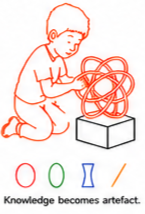
From perception to observation
The immediate conceptual antecedent is Hoffman, Singh and Prakash's Interface Theory of Perception.
Its useful insight for present purposes is that perceptual presentation need not be treated as a transparent reproduction of observer-independent reality. An interface may permit effective engagement with something without reproducing the underlying substrate in the form in which it actually exists.
CITO borrows that interface insight but moves the question downstream.
Very schematically:
world / unknown → perceptual interface → representation R
CITO then asks what happens next:
R → constitutive interface κ → observation Oᴶ → subsequent operation Ω
The first problem concerns what becomes representationally available.
The second concerns what that representation is subsequently entitled to do.
CITO is concerned with the second.
Importantly, the theory does not depend upon accepting the stronger evolutionary or metaphysical commitments sometimes associated with Interface Theory of Perception. Even if perception were assumed to be substantially veridical, a veridical representation would still not by itself establish whether an instrument was calibrated, a transformation was valid, a source was preserved, an inference was warranted, or the resulting representation was admissible for every subsequent scientific purpose.
The issue survives.
Observation as constituted standing
The central proposal of the paper is deliberately limited:
Observation is not exhausted by representational occurrence; it can be analysed as representational occurrence plus constituted standing relative to a specified subsequent operation.
The word constituted is important here, but it should not be mistaken for creation of reality.
Constitution does not make a representation true.
It does not create the physical object represented.
It does not establish that the ontology suggested by a model actually exists.
It specifies the bounded role for which a representation presently has standing.
The minimal relation proposed in the paper is:
κ(R, Ω, C) → J
where:
R is an available representation,
Ω is the subsequent operation under consideration,
C is the relevant set of constituting conditions, and
J is the standing or jurisdiction thereby established.
Where those conditions are not met:
κ(R, Ω, C) → ⊥
The symbol ⊥ does not mean that the representation is false or meaningless.
It means only that standing has not been established for that operation.
This seemingly small distinction matters.
A representation can be useful without being confirmed. It can be predictive without being ontological. It can be exploratory without being admissible as measurement. It can be mathematically successful without thereby establishing that the objects used in its mathematics literally constitute physical substrate.
Scientific usefulness therefore need not be collapsed into a single category called “truth”.
Creative, generative and constitutive acts
One reason for making this distinction is to preserve rather than constrain scientific creativity.
CITO separates three operations:
creative act → R becomes available
generative act → R contributes to R′
constitutive act → R acquires standing J for Ω
A hypothetical field, visualisation, analogy, simulation or mathematical construction can therefore be scientifically productive without first having to be declared physically real.
The constitutive question arises when something more is subsequently required of it.
If the representation is to function as evidence, measurement, explanation, confirmation or ontology, what additional transition has occurred?
What warrant has been added?
What remains unresolved?
And what precisely may now be done with it?
Standing is not ontology
One of the more consequential applications concerns scientific interpretation.
CITO distinguishes the success of a representation from the ontological jurisdiction assigned to it.
Thus:
predictive usefulness ⇏ unrestricted ontological jurisdiction
This does not mean that scientific ontology is impossible.
Nor does it imply that reality is simply observer-dependent.
It means that the proposition:
“this representation works”
and the proposition:
“this is therefore what reality fundamentally consists of”
are different scientific operations.
The second may ultimately be justified. CITO simply asks that the transition between them carry its own warrant.
This gives competing models, visualisations and interpretations room to remain scientifically productive without prematurely requiring reality to inherit their representational ontology.
Rather than fitting reality to a successful theory, the interpretation of the theory remains answerable to what observation can actually discriminate.
Observation as an interface stack
Scientific observations also rarely pass through only one interface.
A practical chain may look something like:
X → apparatus/perception → R₀ → measurement → R₁ → record → R₂ → analysis → R₃ → claim
At each transition, standing may be preserved, reduced, supplemented or extended.
Calibration may establish additional measurement standing.
Transformation may remove information.
New evidence may extend what can legitimately be claimed.
Provenance may establish where a representation came from without establishing whether the representation is correct.
A later representation therefore need not possess greater jurisdiction merely because it occurs later in a scientific workflow.
This raises a broader research possibility: treating the normally distributed operations by which science controls provenance, scope, calibration, admissibility and inference as explicit constitutive interfaces.
A deliberately minimal formal object
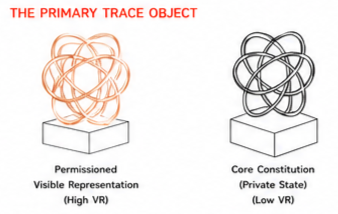
The paper introduces a provisional interface object:
𝕀κ = ⟨R, Ω, C, T, J, Γ⟩
where the object can record representations, operations, constituting conditions, admissible transitions, resulting jurisdiction and a recoverable trace.
The notation is intentionally provisional.
CITO is not claiming that this is already the complete mathematics of observational standing. In particular, standing may prove to be typed, set-valued or partially ordered rather than reducible to a scalar quantity.
The purpose is more modest: once the transition itself is recognised as an object, it becomes possible to ask formal and experimental questions about it.
Can two independent agents reconstruct the same permitted subsequent operation?
Which transformations preserve standing?
Which transitions require new warrant?
Which assumptions survive as residuals?
At what point has a generative representation silently acquired an ontological role it had not previously earned?
These are potentially testable questions.
Possible applications
The paper identifies several areas in which this distinction may prove useful.
In scientific reporting and reproducibility, representations could carry not only provenance but information concerning the particular role for which they presently have standing.
In metrology, CITO may provide a common way of describing the transition from instrument output to measurement result, analytical input and scientific claim.
In human–AI and AI–AI scientific transmission, explicit source identity, scope, permitted transformations and failure states could potentially be used to test whether constituted transmission reduces unsupported inference or scope drift.
In model and ontology governance, generated objects could remain fully available for scientific exploration without automatically being promoted from representational usefulness to claims about physical substrate.
And in machine-operable scientific governance, rules that are ordinarily distributed through methodological convention, documentation and expert judgement might potentially be represented as explicit states and permitted transitions.
These remain application hypotheses.
CITO does not assume that explicit constitution will necessarily outperform good scientific practice. That is something to be tested.
Mind, consciousness and inaccessible physical states
The paper also considers several limiting cases.
These are explicitly presented as logical extensions, not phenomena that CITO claims to explain.
Theory of mind provides one example:
another agent → behaviour / language → representation → mental-state attribution
The observable representation and the attribution concerning another mind do not possess identical standing.
An analogous problem appears when an artificial system says:
“I understand.”
The statement is an observable output.
Whether it constitutes evidence of understanding, intention, consciousness or self-awareness is another operation.
Consciousness introduces a related asymmetry between first-person occurrence and third-person scientific representation.
A report of experience, a neural correlate and the experience itself need not simply be identified with one another.
And black holes provide a physically very different but structurally instructive limiting case.
Here:
failure of observational access does not constitute absence of physical existence.
Equally:
mathematical recoverability does not by itself establish physical instantiation exactly as represented.
CITO does not solve the black-hole information problem, the ontology of consciousness or theory of mind.
Their relevance lies in a shared observational architecture:
existence ≠ accessibility ≠ representation ≠ observation ≠ inference ≠ ontological jurisdiction
The objects concerned are entirely different. The interface problem is structurally comparable.
Constitutional Physics — implementation rather than premise
The relationship between CITO and Constitutional Physics is deliberately one-way.
CITO is not derived from Constitutional Physics, and Constitutional Physics is not offered as evidence that CITO is correct.
Instead:
CITO problem → functional requirements → candidate implementations → Constitutional Physics / CCR → experimental test
Constitutional Physics and the associated Canonical Constitutional Record provide one possible architecture through which role, provenance, scope, admissibility, successor states and jurisdiction might be made explicit and recoverable.
Other implementations remain possible.
That distinction is important because CITO should remain meaningful even to a reader who rejects Constitutional Physics entirely.
Similarly, failure of one constitutional implementation would not make the underlying distinction between representational availability and operational standing disappear.
What the paper does not claim
CITO v0.1 is a published working paper.
Its strongest claims have intentionally been kept bounded.
It does not claim that constitution makes an observation true.
It does not claim that objective reality is constituted by an observer.
It does not equate provenance with correctness, recoverability with validation, or admissibility with empirical truth.
It does not claim to solve consciousness, quantum measurement, theory of mind or the ontology of inaccessible physical systems.
And it does not assume that explicit constitutionalisation of scientific operations will prove superior to tacit scientific practice.
The proposal is instead that there is a distinguishable operation here which is often carried implicitly:
the operation by which an available representation acquires standing for what science proposes to do with it next.
If that operation can be isolated, described and reconstructed, then it becomes available for comparison and experiment.
That is the research programme the paper opens.
Central thesis
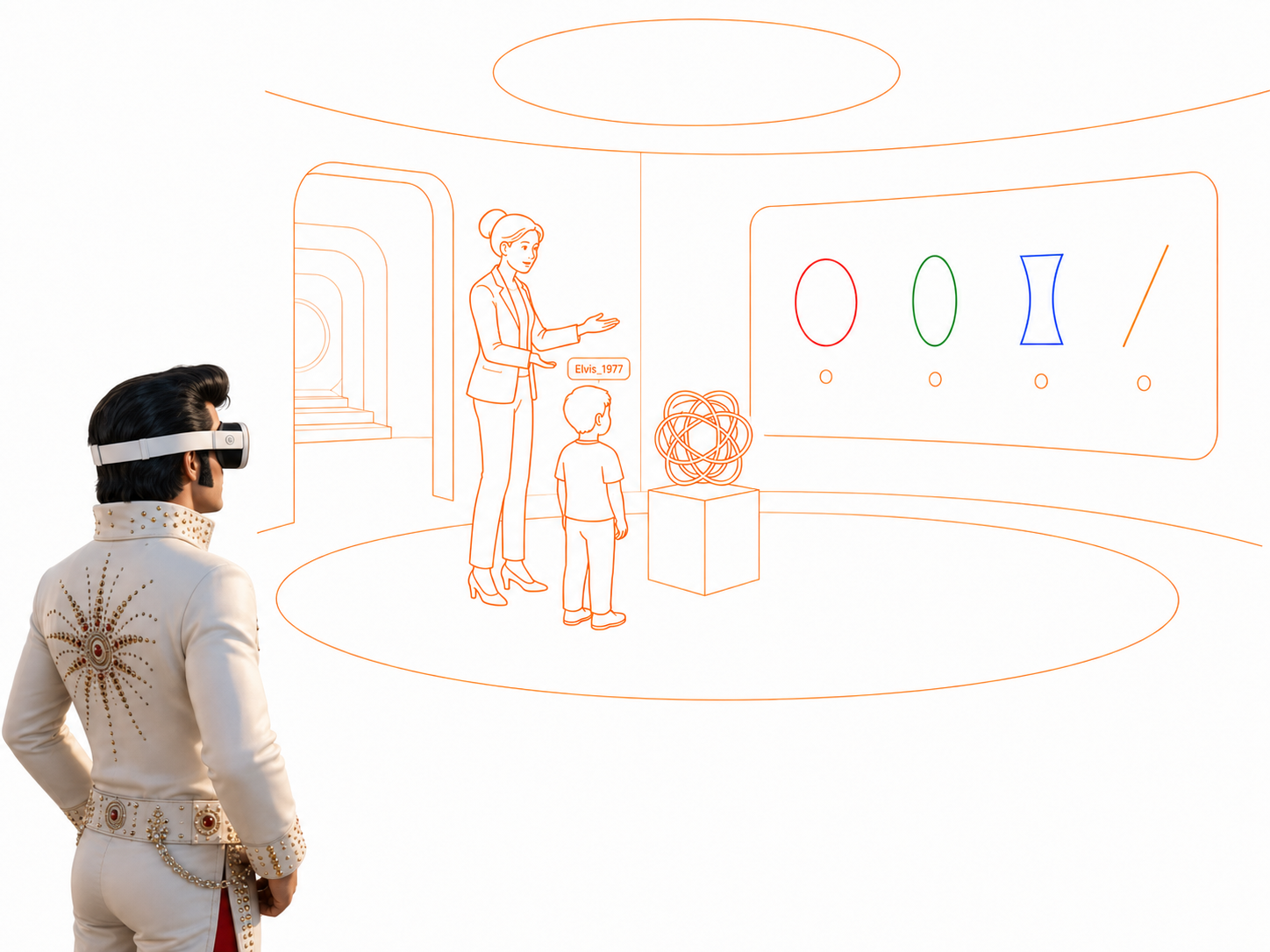
The entire proposal can therefore be reduced to one sentence:
An observation is a representation whose standing has been constituted relative to a specified subsequent operation.
The first public working-paper version is now archived on Zenodo:
Read and download Constitutive Interface Theory of Observation (CITO) on Zenodo
Stefaan Vossen (2026)
Constitutive Interface Theory of Observation (CITO): From Representational Availability to Operational Standing
Working Paper, v0.1, August 2026.
DOI: 10.5281/zenodo.22023990
The published paper develops the formal argument, applications, limitations and logical extensions in full.