Incarnation
Constitutional Incarnation: Observing Representation Through S⊙AL
A MetaMathics observation on the translation of standing, entitlement and successor state into game-playable narrative
August 19th 2026, by Stefaan Vossen
Abstract
This paper examines the S⊙AL Game as a deliberately constituted narrative environment in which abstract relations developed within Constitutional Physics are translated into playable objects, permissions, transformations and consequences.
The object under observation is not whether the proposed game is commercially successful, clinically effective, psychologically optimal or technologically complete. Nor is the game presented as empirical validation of Constitutional Physics. The narrower question is whether a constitutional relation concerning representation can be instantiated within a locally intelligible rule environment and subsequently recovered from the behaviour of that environment.
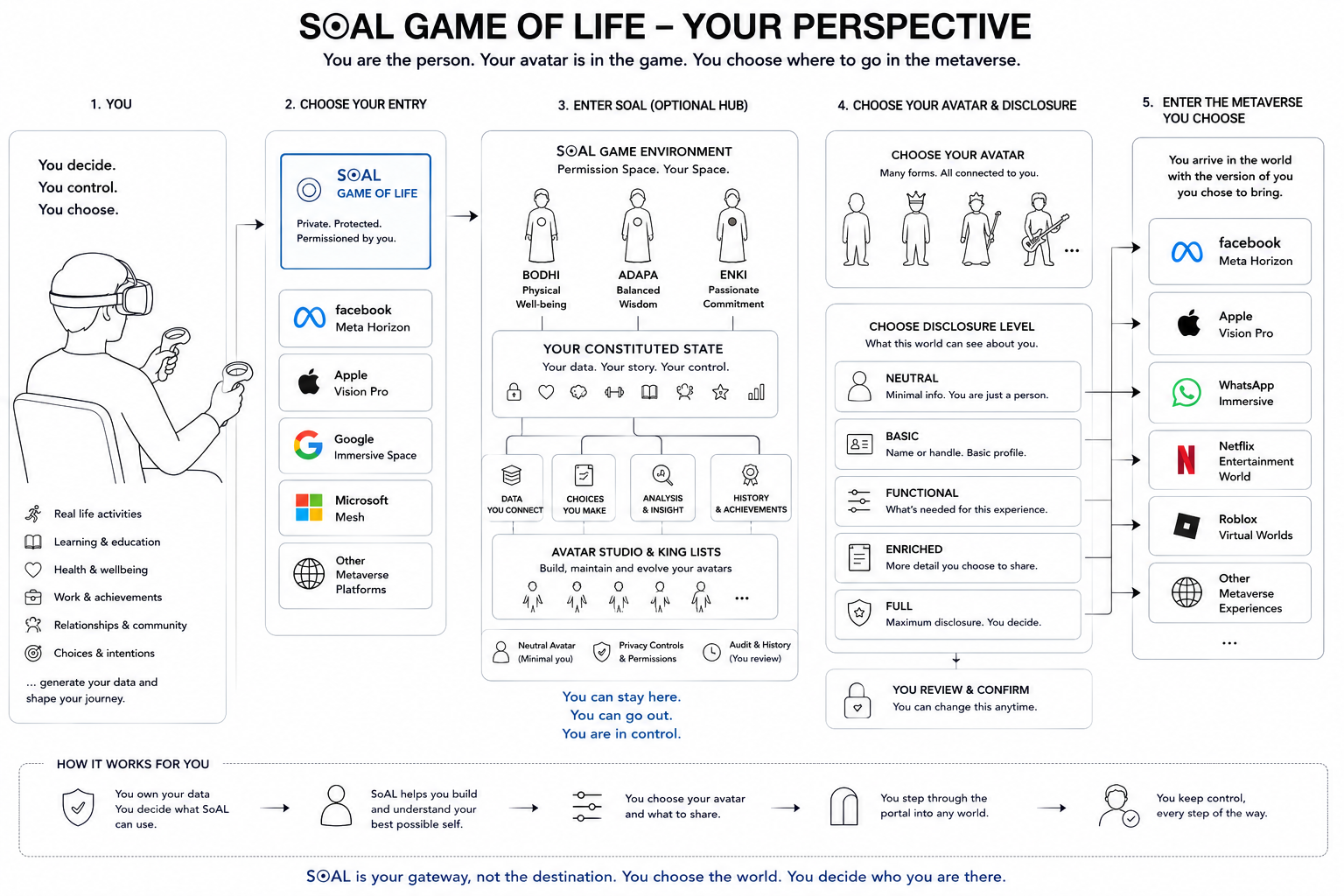
The S⊙AL Game provides such an opportunity because its central mechanics are built around distinctions between a person, information concerning that person, a constituted player-state, an avatar representing that state, the standing carried by that representation, the operations permitted upon it, and the entitlement of another observer or system to receive a resulting representation. The game therefore translates questions normally expressed in epistemic, jurisprudential or computational language into questions familiar to play: What object do I possess? What may I do with it? What does this action change? What state follows? What may leave the game? What does another player or environment become entitled to see?
Within the game proposal, personal activity may alter an avatar; additional authorised information may refine its representation; historical and cultural “King Lists” provide locally meaningful narrative registers; and the player may subsequently choose which representation, if any, is permitted to pass into an external digital environment. The same underlying state may therefore support multiple representations without requiring those representations to be equivalent. A detailed private avatar, a health-related representation, an earned cultural skin and a deliberately neutral public avatar may all derive from the same constituted player while carrying different standing and different disclosure permissions.
The paper proposes the term constitutional incarnation for this operation: the local realisation of an abstract constitutional relation as a bounded arrangement of objects, roles, permissions, transformations and observable successor states within another representational domain.
The S⊙AL Game is examined as one such incarnation. Its significance lies not in proving the originating framework, but in permitting a round-trip observation:
constitutional relation → game-native incarnation → observable game architecture → recovered constitutional relation.
The question is then not whether the game confirms the truth of Constitutional Physics, but what must remain invariant for the originating constitutional relation to remain recoverable after translation into play.
1. Introduction
Scientific and philosophical frameworks are ordinarily presented through propositions, formal systems, diagrams, explanatory language or experimental procedures. Games provide a different kind of representational environment.
A game does not merely state a rule. It gives the rule something to act upon.
A player occupies a state. An object possesses particular properties. An action is either permitted or prohibited. A permitted operation produces consequences. Those consequences modify the state of the game. Further actions become available or unavailable as a result. The world remains intelligible because the relationship between state, operation and consequence is sufficiently stable for the player to learn it.
This makes games unusually useful environments in which to examine constitutional relations.
The term constitutional is used here in the sense developed within Constitutional Physics: not merely as a reference to legal constitutions or institutional governance, but to the conditions under which an object acquires a particular standing, what operations that standing permits, and what further operation is required before a stronger standing may legitimately be attributed.
Expressed schematically:
object → standing → permitted operation → consequence → successor state.
The formulation is abstract. Within a game, however, it becomes almost unavoidable.
A key may open one door but not another.
An inventory object can be possessed without being usable.
A character may enter a territory only after acquiring the relevant status.
A player may know that an object exists without being entitled to inspect its contents.
A transformation can alter an object's appearance without altering its identity.
A saved state records what has occurred without determining what should occur next.
These are ordinary features of playable systems. Yet structurally they reproduce questions of admissibility, entitlement, provenance, jurisdiction and representational transition.
The S⊙AL Game was proposed from the opposite direction.
Rather than beginning with a conventional game mechanic and subsequently interpreting it constitutionally, S⊙AL begins with a constitutional problem: how can a person interact with increasingly rich digital representations of themselves without requiring every environment they enter to inherit the entirety of that informational identity?
The resulting game proposal introduces a series of objects:
the human user;
licensed or otherwise permitted data concerning that user;
contextual declarations;
a constituted player-state;
three persistent interpretive figures, Bodhi, Adapa and Enki;
earned activity;
a changing avatar;
cultural and historical representational registers;
a neutral avatar;
permissions governing external disclosure;
and external environments lying beyond the S⊙AL game space itself.
What is notable is that these objects were not introduced merely for decorative complexity.
They emerged because the proposed game had to answer a sequence of practical questions.
If an avatar changes because a person exercises, what precisely has changed?
If a user connects a health record, does the avatar become the health record?
If a social platform is allowed to see the avatar, does it become entitled to the underlying healthcare information?
If the same user appears as a sporting figure in one environment and a neutral human form in another, are these different people or different representations of the same constituted state?
If an avatar deteriorates, does a previously earned achievement disappear?
If a user chooses a historical figure as a model, how much resemblance can be justified by the available information?
If a cultural category such as “king”, “god”, “champion” or “icon” has meaning only within a particular narrative, what survives when the player travels between those registers?
The attempt to make the game coherent therefore generates a series of constitutional requirements.
This paper treats those requirements as observations.
It does not ask whether they establish a necessary architecture for all digital identity systems. It asks something more limited: given the locally constituted rules of the S⊙AL Game, what relations become necessary for that particular narrative environment to remain coherent, and can those relations be recovered as instances of the constitutional structure from which the proposal arose?
That distinction is central.
Recoverability does not imply validation.
A successful translation into a game may show that a constitutional relation can be instantiated and reconstructed within that environment. It does not demonstrate that the originating framework is uniquely correct, empirically complete, ontologically privileged or universally necessary.
The S⊙AL Game is therefore treated neither as proof nor merely as illustration.
It is treated as an incarnated thought object.
2. From Representation to Incarnation
A representation ordinarily stands in for something else.
A diagram represents a structure.
A mathematical expression represents a relation.
A clinical measurement represents an observed property under specified conditions.
An avatar represents a player.
Yet the term representation alone is insufficient for the operation examined here.
In the S⊙AL Game, the originating constitutional relation is not simply drawn or described inside another medium. It becomes operative.
Permission becomes a thing the player exercises.
Standing becomes a property that determines what an object may do.
A representational transition becomes an action.
A successor state becomes visible as a changed avatar.
Jurisdiction becomes the boundary between the S⊙AL environment and the external environment beyond it.
The distinction between private and public representations becomes a choice available to the player.
For that reason, this paper uses the term constitutional incarnation.
2.1 Constitutional incarnation
For present purposes:
Constitutional incarnation is the local realisation of an abstract constitutional relation as a bounded arrangement of objects, roles, permissions, transformations and observable consequences within another representational domain.
Incarnation is therefore stronger than illustration but weaker than validation.
An illustration can depict a rule without being governed by it.
An incarnation must behave according to it.
Consider the difference.
A diagram may show:
A → B → C.
Nothing follows if the arrow is ignored.
A game incarnation instead establishes:
if A possesses standing α, operation T is permitted; applying T under condition β produces B; without β, T is unavailable.
The distinction is operational.
The relation acquires consequences internal to the new environment.
This allows the originating relation to be investigated through what the new environment requires in order to remain coherent.
2.2 Local constitution
The word local is equally important.
S⊙AL does not establish that its categories apply universally.
It establishes a bounded game world in which particular rules are accepted for the purposes of participation.
Within that world, a “King List” may classify representations according to historical, mythological, sporting, artistic or cultural narratives.
Those categories have locally constituted meaning.
A king within an ancient Mesopotamian register is not made equivalent to a “King of Pop”, an athletic champion or a divine figure merely because all can occupy prominent positions within their respective narratives.
Their meanings remain internal to their registers.
What may be transferable is not the title but some aspect of the player-state from which a new representation can be generated.
The distinction can be expressed as:
Sₜ → R₁(Sₜ)
Sₜ → R₂(Sₜ)
Sₜ → R₃(Sₜ)
where Sₜ denotes the constituted player-state at time t, and each Rᵢ denotes a different representational register.
No equality between R₁, R₂ and R₃ is implied.
The question is instead:
what, if anything, is preserved across the transformations?
That question is precisely what makes the game useful as a MetaMathics object.
3. The S⊙AL Game as a Constituted Narrative
The S⊙AL Game is intentionally sparse.
Its native environment is not itself a metaverse.
It is not intended to compete with immersive virtual worlds, social networks, healthcare environments or gaming platforms.
Those environments exist outside the game.
S⊙AL is the permission space through which the player prepares a representation before deciding whether and how to cross into them.
This minimalism matters.
If the external environment were simply absorbed into the game, the distinction between internal constitution and external entitlement would disappear. By retaining a visible boundary, the game can make the transition itself playable.
Within S⊙AL, the player can:
connect → constitute → interpret → build → maintain → select → disclose.
The outside world begins only after the final transition.
3.1 The player changes; the space does not
The basic environmental rule is therefore unusually simple:
The S⊙AL space remains comparatively fixed. The player-state changes.
The game environment need not become increasingly elaborate as progress occurs.
Instead, the object undergoing development is the player representation.
Activity changes it.
Information may refine it.
Choices orient it.
Time alters it.
Neglect may degrade aspects of it.
Achievement becomes part of its history.
The surrounding S⊙AL environment remains the place in which those changes can be inspected and governed.
This places emphasis on state transformation rather than world accumulation.
The user does not primarily build a kingdom.
The user builds, maintains and interrogates a representation of themselves.
3.2 The three persistent figures
Three game-native figures remain fixed across those transformations:
Bodhi, associated with physical health and embodied condition;
Adapa, associated with balanced wisdom and collaborative good;
and Enki, associated with passionate commitment.
These characters are not alternative avatars for the player.
They are persistent interpretive positions.
Their usefulness lies partly in their possible disagreement.
An observed condition may support different evaluations when considered through different functions.
A demanding training regime may be interpreted by Enki as evidence of commitment.
Bodhi may identify inadequate recovery.
Adapa may evaluate the training objective within a wider context of work, family, education or social obligation.
The same observations therefore need not collapse into a single scalar judgement.
This has a constitutional consequence.
The system must preserve a distinction between:
observation
and
interpretation of observation.
It must also preserve the identity of the interpretive function from which a conclusion is produced.
If Bodhi, Adapa and Enki can disagree, then their outputs cannot simply be merged without loss into an undifferentiated “player score”.
Plural interpretation is therefore not merely narrative flavour.
It is a structural property of the game.
3.3 The avatar as object
The avatar occupies another distinct role.
It is neither the human individual nor the complete dataset relating to that individual.
It is a constituted representation produced under the rules of the game.
A simplified relation is:
Dₜ + Cₜ + Πₜ → Sₜ → Aᵣ,ₜ
where:
Dₜ represents currently available data;
Cₜ represents relevant contextual declarations;
Πₜ represents permissions and provenance conditions;
Sₜ represents the constituted player-state;
Aᵣ,ₜ represents an avatar generated within representational register r at time t.
This distinction prevents several otherwise easy collapses.
The avatar does not become evidence merely because it was derived from evidence.
The player's identity does not become identical to the avatar merely because the avatar represents the player.
And possession of one representation does not automatically create entitlement to the underlying state from which that representation was derived.
These distinctions become particularly important when the player leaves the S⊙AL environment.
4. The First Observable Constitutional Consequence: Representation Does Not Confer Unlimited Entitlement
The central game transition occurs at the boundary.
A player may possess an extremely detailed internal representation while choosing to disclose very little externally.
This gives rise to one of the clearest constitutional observations produced by the game:
The existence of a richer representation does not itself create entitlement in another observer to receive that richness.
A user might possess a deeply constituted private avatar derived from healthcare information, wearable data, education, training history, self-report and other sources.
The same user may enter an external shared space using only a neutral human figure.
No contradiction arises.
The private state remains rich.
The public representation remains sparse.
The difference is not a deficiency.
It is the consequence of a different entitlement.
Thus:
greater constitution ≠ greater compulsory disclosure.
The game makes this relation visible.
It allows the player to perform the transition rather than merely consenting to it within an unread legal document.
In this sense, S⊙AL turns data-protection logic into a user-facing product feature.
The player does not simply agree that data minimisation is desirable.
The player chooses a minimal avatar.
The player does not simply accept that purpose limitation exists.
The player chooses which attributes travel into a particular environment.
The player does not merely read that permission can be withdrawn.
The player changes the representation or returns to the neutral state.
The constitutional relation is therefore incarnated as gameplay.
And once incarnated, it becomes observable.
The remaining sections of this paper will examine what further consequences follow from that translation: the horizontal structure of the King Lists; trace resolution and avatar refinement; history versus present state; the Tamagotchi-like maintenance loop; external observer entitlement; and the round-trip recovery of the originating constitutional relation from the game-native system that results.